TL;DR
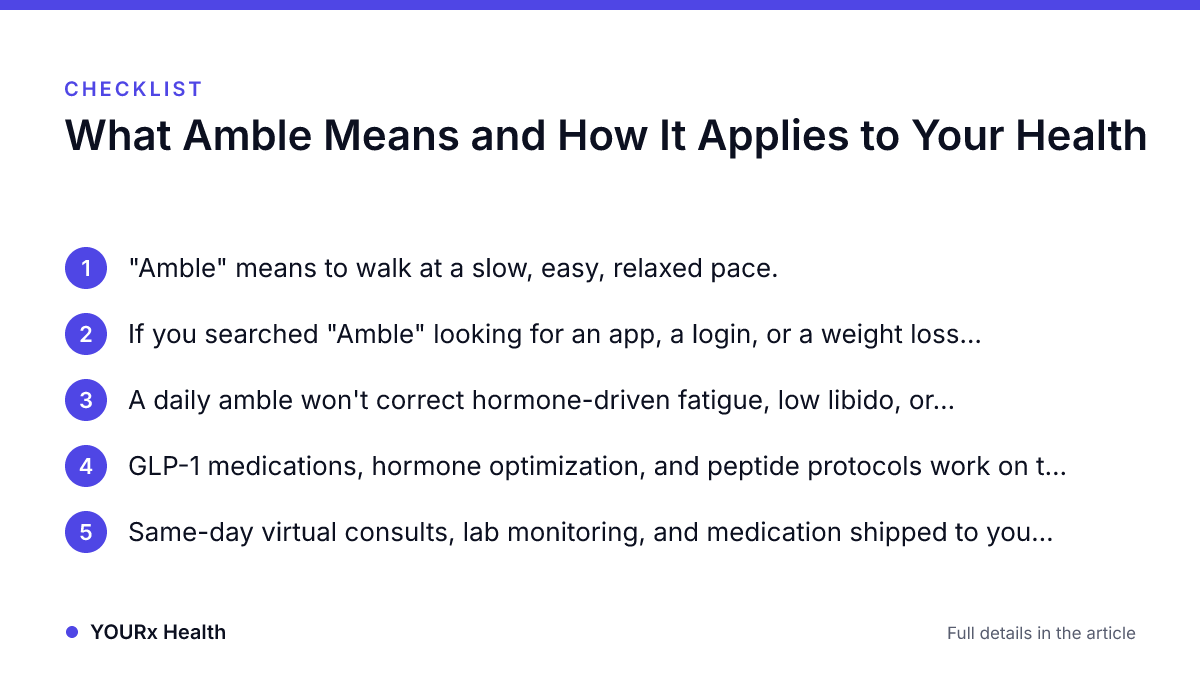
- “Amble” means to walk at a slow, easy, relaxed pace. No rush, no real exertion. Merriam-Webster defines it as an easy or relaxed gait.
- If you searched “Amble” looking for an app, a login, or a weight loss program, that’s a separate consumer product. YOURx Health is a physician-led telehealth practice with no affiliation to it.
- A daily amble won’t correct hormone-driven fatigue, low libido, or stubborn weight gain. Those need bloodwork and a treatment plan, not more steps.
- GLP-1 medications, hormone optimization, and peptide protocols work on the biology underneath slow metabolism and flat energy, which walking alone can’t reach.
- Same-day virtual consults, lab monitoring, and medication shipped to your door are all available through YOURx Health. No waiting room.
Most people who type “amble” into Google want one of two things: the dictionary definition, or a login screen for an app with Amble in the name. Let’s settle the word first. Then let’s talk honestly about why a leisurely walk isn’t going to fix the fatigue, weight, or libido problem that’s probably sitting behind your search.
Thank you for reading this post, don't forget to subscribe!
Table of Contents
- What does “amble” actually mean?
- Is Amble a health or weight loss app?
- Why doesn’t walking at an amble pace fix fatigue or weight gain?
- What does an amble actually burn? Let’s run the numbers
- What treatment options actually move the needle?
- How does a telehealth visit actually work?
- Who should look at medical treatment instead of just walking more?
- Your next step
- Frequently asked questions
What does “amble” actually mean?
To amble is to walk slowly and easily. A stroll through the park, not a workout. Merriam-Webster defines “amble” as walking in an easy or relaxed gait, and by extension, moving along at a leisurely pace. Think stroll, saunter, mosey. The opposite of a brisk walk.
Worth knowing, because a lot of health content treats “just get moving” as a complete answer to fatigue and weight gain. It isn’t. An amble burns a handful of calories. It is not a metabolic intervention. If your body is working against low testosterone, blunted GLP-1 signaling, or a sluggish thyroid, you cannot out-walk that biology at 2.5 miles per hour.

Is Amble a health or weight loss app?
If you searched “amble health,” “amble weight loss,” “amble login,” or “join amble,” you’re almost certainly looking for a consumer app or program that uses Amble as its brand name. That’s someone else’s product. We’re not affiliated with it, we can’t reset your password, and we can’t see your account.
Here’s the part we can help with. Whatever app you’re using to log walks, it’s a tracking tool. Tracking tools are good at building habits and terrible at diagnosing anything. We’ve had patients come to us with 18 months of near-perfect step data and a scale that hasn’t moved an ounce. The data wasn’t wrong. It was measuring the wrong thing.
Pro tip: if an app or program promises real weight loss or hormone symptom relief without a physician, lab work, or a prescription anywhere in the process, treat that as a red flag. Metabolic and hormonal problems get diagnosed with bloodwork. Our guide on how to choose a legit telehealth longevity clinic covers exactly what to ask before you hand over a credit card.
Why doesn’t walking at an amble pace fix fatigue or weight gain?
Because low energy and stuck weight usually trace back to hormones and metabolism, not to how many minutes you spend upright. Twenty or thirty minutes of walking a day is a good habit. It helps circulation, mood, and baseline activity. It’s also a small lever compared to what’s actually happening under the hood for a lot of people in their 30s, 40s, and 50s.
Four patterns come up over and over on our intake calls:
- Low testosterone in men. Flat energy, lost muscle, dead libido, weight that migrates to the midsection. Walking does not reverse it.
- Blunted metabolic signaling. This is what GLP-1 medications target. Your body stops getting the “I’m full, stop storing” message clearly, no matter how active you are.
- Low or dysregulated cortisol. You wake up exhausted after eight hours. Pushing harder often makes it worse, which is exactly the pattern behind what the low cortisol meme actually means. We go deep on this in our cortisol symptoms guide, and it’s the first thing to read if fatigue is your main complaint.
- Low testosterone in women. Routinely missed, because it doesn’t show up unless someone orders the right panel and knows what range to look at. We cover it in low testosterone symptoms doctors miss in women.
None of those improve by walking slower or faster. They improve when someone identifies the deficiency and treats it.
What does an amble actually burn? Let’s run the numbers
Here’s an illustrative scenario. Not a promise, and your body will behave like your body, but the arithmetic is worth doing once because it reframes the whole question.
Say you weigh 220 lbs and you commit to an easy 2.5 mph pace for 30 minutes, five days a week. The working figure we use for that kind of session is somewhere in the neighborhood of 100 to 120 calories, depending on build and terrain. Call it 110.
- 110 calories × 5 sessions = 550 calories per week from the walking
- A pound of body fat runs roughly 3,500 calories
- 550 ÷ 3,500 = 0.157 lbs per week
- 0.157 × 52 weeks = about 8 lbs over a full year
And that 8 lbs assumes nothing else changes. No bad week, no birthday cake, no holiday travel, no compensatory snacking, which is real and which most people underestimate. Plug in your own numbers: weekly calories burned, divided by 3,500, times 52. That’s your ceiling from walking alone.
Now put that next to a supervised GLP-1 protocol. In our practice, patients on medically monitored semaglutide with basic dietary guidance typically see more progress in their first couple of months than the walking math above predicts for an entire year. The reason is mechanical, not motivational: the medication works on appetite regulation and satiety signaling, so you’re not white-knuckling a deficit. Our breakdown of what compounded semaglutide actually costs you lays out pricing if you want to weigh it against a year of incremental progress.
Pro tip: if you’ve been walking daily for 8 to 10 weeks and the scale hasn’t moved, that’s a signal to get labs, not a signal to walk faster. Metabolic resistance is measurable. It is not a willpower problem.
What treatment options actually move the needle?
| Approach | What it does | What it doesn’t do |
|---|---|---|
| Ambling / light daily walking | Supports circulation, mood, baseline activity | Won’t correct hormone deficiencies or reverse significant weight gain |
| Diet changes alone | Creates a modest calorie deficit | Doesn’t fix appetite dysregulation or a slowed metabolism |
| GLP-1 medication (semaglutide) | Regulates appetite and satiety signaling for sustained weight loss | Requires supervision, dose titration, and lab monitoring |
| Testosterone optimization | Restores energy, muscle retention, libido, and mood in men with clinically low levels | Only helps if levels are genuinely low, which means bloodwork first |
| Peptide therapy (BPC, TB-500) | Supports recovery, tissue repair, and cellular function | Doesn’t replace treating an underlying hormone or metabolic issue |
If you’re already on a GLP-1 and progress has stalled, read the semaglutide dosing mistakes that stall progress before you assume the drug failed. In our experience most stalls come down to titration timing, not the medication.
How does a telehealth visit actually work?
Faster than most people expect, and nobody sits in a waiting room. The typical flow with YOURx Health:
- Complete a secure health profile. History, symptoms, goals, current medications and supplements. Be honest about the supplements, because several of them interfere with lab interpretation.
- Meet a board-certified physician by video. Same-day consults are available, so you’re not booking six weeks out.
- Get labs ordered if your case needs them. Testosterone panels want a morning draw, ideally before 10 a.m., and fasting matters for metabolic work. Plan the appointment accordingly or you’ll be redrawing.
- Receive your prescription at your door. No pharmacy counter, no line, no conversation with a stranger about what you’re picking up.
- Stay on track with check-ins and refills. Your physician adjusts dosing based on how you’re actually responding, not on a fixed schedule.
If you want to understand why the model behind the app matters, in-house telehealth vs hiring an outsourced clinic explains who’s really managing your care in each setup.
Pro tip: ask any telehealth provider one question. Does a licensed physician personally review my labs, or does software flag them? The answer tells you almost everything about how seriously they take monitoring.
Who should look at medical treatment instead of just walking more?
Book a physician consult before you put another month into activity alone if any of this sounds familiar:
- You’re training consistently and the scale won’t move. That’s metabolic resistance, not laziness.
- Your energy is flat no matter how you sleep or how much coffee you drink. Testosterone, cortisol, and thyroid all belong on the list.
- Libido and performance have dropped noticeably. Frequently hormonal, and frequently fixable once someone measures it.
- You’re losing muscle despite lifting. A classic marker of declining testosterone in men past 35.
- You’re managing a chronic condition and want physician-monitored structure around your energy and metabolic health instead of guesswork.
Your next step
An amble is a fine habit. It is not a treatment plan. If you’ve been walking along hoping your energy, libido, or weight eventually catches up, get the bloodwork and get a physician’s eyes on it. Start with a same-day consult, or read our FAQs first if you want cost and timeline details before you book.
Frequently asked questions
Does YOURx Health require insurance to get started?
No. We operate as a direct telehealth practice, so you don’t need insurance to book a consult or get prescribed medication. Pricing is transparent upfront and you pay directly for the visit and the medication.
Can I combine daily walking with a GLP-1 or hormone protocol?
Yes, and you should. Walking supports cardiovascular health and helps preserve muscle during weight loss, which matters a lot on a GLP-1. Tell your physician your actual activity level so it can factor into your plan and dosing.
How is peptide therapy different from GLP-1 medication?
GLP-1 medications like semaglutide act on appetite and satiety for weight loss. Peptides such as BPC-157 or TB-500 are generally used for recovery, tissue repair, and cellular support rather than weight management. Our what peptide injections actually do page breaks the distinction down further.