
TL;DR
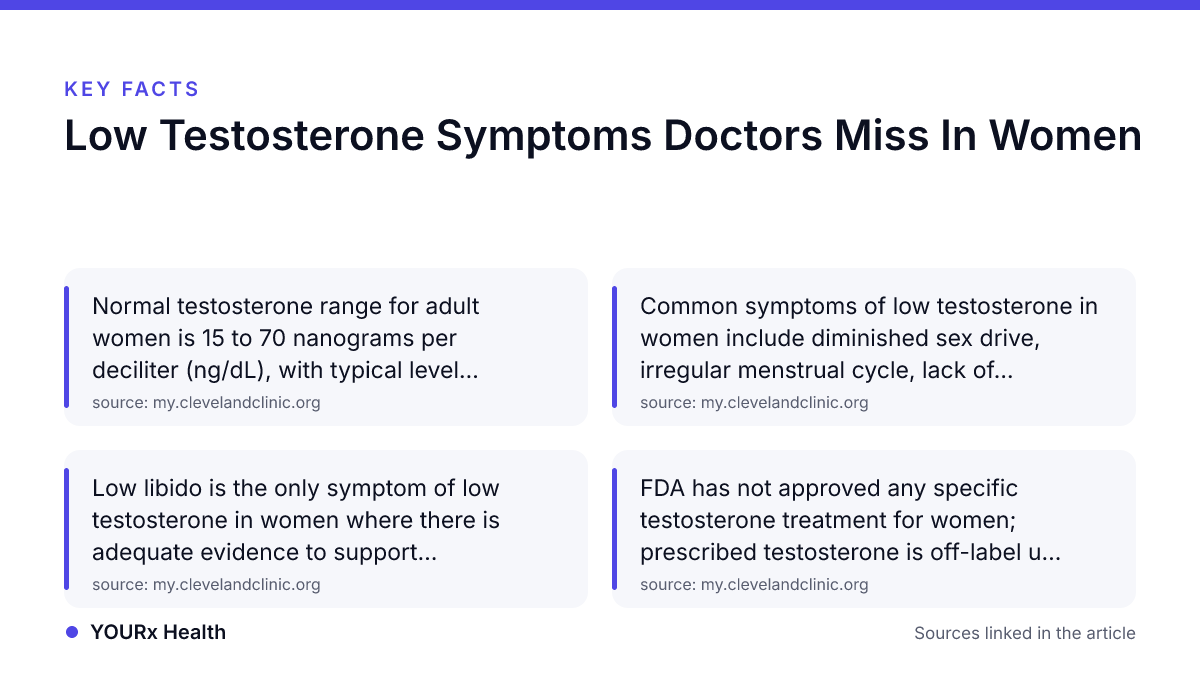
- Normal female testosterone runs 15 to 70 ng/dL, with a typical level near 40 ng/dL. A single draw taken at the wrong point in your cycle can read “fine” while you still feel terrible (Cleveland Clinic).
- Low libido is the only symptom with adequate evidence behind testosterone therapy in women. Fatigue, brain fog, and muscle loss are real complaints, but the research supporting hormone treatment for those specific symptoms is thinner.
- No testosterone product is FDA-approved for women. Every prescription is off-label, dosed down from formulations built for men, which is why monitoring matters more than the brand on the tube.
- A blood test is the only way to confirm low T, and levels move with the menstrual cycle, so timing and repeat testing beat any single number.
- Strength training, sleep, and stress control usually move things before medication does, and a physician-guided plan gets you there with fewer expensive guesses.
You’re 43. You lift the same weights, eat roughly the same food, sleep in the same bed, and somehow your body has quietly rearranged itself. Your drive is gone. Your labs came back “normal.” Nobody checked your testosterone, because almost nobody does.
Thank you for reading this post, don't forget to subscribe!
Table of Contents
- What happens when testosterone levels are low in females?
- What are the low testosterone symptoms doctors miss in women?
- What causes low testosterone in women?
- How to fix testosterone imbalance in females?
- How does a woman raise her testosterone levels naturally?
- What dosing and monitoring protocol do physicians actually use?
- How does treatment differ across life stages?
- What’s next if you think you have low testosterone?
- Frequently asked questions
What happens when testosterone levels are low in females?
Low testosterone in women shows up as a cluster of complaints that get blamed on stress or aging: diminished sex drive, an irregular cycle, low energy, mood changes, brain fog, loss of muscle mass and strength, and insomnia (Cleveland Clinic).
This isn’t a male hormone making a cameo appearance. Testosterone has a direct role in women’s libido, cognition and mood, bone and muscle health, and baseline energy. When it drops, training that used to build muscle just maintains it, and eating that used to maintain weight starts adding it.
That’s the part most visits miss. Thyroid gets checked. Estrogen gets checked. Testosterone never makes the order form.

What are the low testosterone symptoms doctors miss in women?
Most primary care appointments screen for thyroid dysfunction and menopause and stop there, so these get written off as normal aging.
- Muscle tone that no longer responds to training. Same weights, same protein, less definition. That’s a hormone signal, not a discipline problem.
- A sex drive that quietly went flat. Not “less interested some weeks.” A sustained drop that outlasts the stressful quarter at work and the rough patch in your relationship.
- Brain fog that feels different from tiredness. Losing the word you use every day. Dropping your train of thought mid-sentence.
- Emotional flatness instead of textbook depression. Women describe it as numb or muted more often than sad, which is why depression screeners miss it.
- Early bone density loss on a DEXA scan, especially heading into perimenopause, since testosterone supports bone maintenance alongside estrogen.
- Midsection weight gain with no change in diet or activity. One of the most common reasons women start searching in the first place, and one of the easiest things to dismiss in a 15-minute appointment.
Pro tip: if your labs came back “normal,” ask two questions. What reference range did the lab use? And what cycle day was the blood drawn? Levels fluctuate naturally, including across the menstrual cycle, so a draw at a low point can look acceptable on paper while you’re functionally depleted.
What causes low testosterone in women?
Production declines gradually with age, but a few things accelerate it, and some of them are reversible.
- Perimenopause and menopause. Ovarian output falls, and the symptom picture gets tangled up with estrogen changes.
- Oophorectomy or chemotherapy. Removing the ovaries drops testosterone abruptly rather than gradually. These patients don’t get a slow slide; they fall off a cliff and feel it within weeks.
- Combined oral contraceptives. The pill raises sex hormone-binding globulin, and SHBG binds free testosterone. Total testosterone can look acceptable while the free fraction, the part your tissues actually use, sits on the floor. This is why we order SHBG and free testosterone, not just total.
- Chronic stress and corticosteroids. Sustained cortisol elevation and healthy androgen output don’t coexist comfortably, and if your cortisol is running low rather than high, it’s worth reading up on low cortisol symptoms and what actually helps since adrenal issues can muddy the testosterone picture in both directions. If you’re also dealing with exhaustion that sleep doesn’t touch, lightheadedness on standing, or a hard crash at 3 p.m., have adrenal function evaluated in the same workup rather than six months later.
- Prolonged under-eating. Bodies in a long calorie deficit downregulate reproductive hormones as a survival measure. We see this constantly in women who’ve been dieting on and off for a decade.
How to fix testosterone imbalance in females?
It starts with a blood test, not a supplement order, because blood testing is the only way to confirm low levels and cycle timing changes how you read the result (Cleveland Clinic).
Once low T is confirmed and low libido is the driving complaint, meaning the one area with adequate evidence behind treatment, a physician can prescribe a compounded testosterone cream applied to the lower abdomen or buttocks. Creams are the safest and most commonly prescribed form for women in the US (Cleveland Clinic). For fatigue or brain fog without the libido component, expect a plan weighted toward the lifestyle levers below, because the evidence for hormone therapy resolving those specific symptoms is weaker.
Pro tip: if someone offers you pellets or injections before discussing cream, ask why. Cream lets you titrate in small increments and stop within days if acne or unwanted hair growth shows up. A pellet is in you for months. There’s no undo button.
How does a woman raise her testosterone levels naturally?
Strength training, sleep, and stress reduction outperform anything in a bottle. Here’s what we actually tell patients:
- Lift with compound movements, two to four sessions a week. Squats, deadlifts, presses, rows. Thirty minutes of heavy work beats ninety minutes of cardio for preserving muscle and the hormonal environment that supports it.
- Protect sleep like a scheduled appointment. Short, fragmented sleep keeps cortisol elevated, and elevated cortisol works against you here. Consistent bedtime matters more than total hours in bed.
- Test nutrient status before you buy supplements. Magnesium and vitamin D come back low often enough that we screen for both. Our breakdown of magnesium’s role in hormone and energy support covers why this mineral gets overlooked.
- Eat enough protein, consistently. Our working rule of thumb is roughly 0.7 grams per pound of goal body weight, spread across meals rather than dumped into dinner.
- Stop the chronic deficit. If you’ve been under-eating for years, a period of eating at maintenance does more for your hormones than any adaptogen on the shelf.
For the full lever set, including what genuinely moves labs versus what’s marketing, our guide on how to increase testosterone walks through the same physiology. Production pathways overlap between men and women far more than most people assume.
What dosing and monitoring protocol do physicians actually use?
Baseline labs come first, always. A typical telehealth sequence: your physician orders a testosterone panel (usually alongside estrogen, thyroid, and sometimes cortisol), reviews your symptom history and cycle timing, and if the labs and symptoms agree with low libido as the primary complaint, starts a low-dose compounded cream. Since no product is FDA-approved for women, dosing is conservative and individualized rather than read off a package insert (Cleveland Clinic).
Illustrative scenario with the math: your baseline comes back at 9 ng/dL against a normal range of 15 to 70 and a typical level near 40. Work out where you actually sit in the range:
Position in range = (your level − 15) ÷ (70 − 15)
At 9 ng/dL you’re below the floor entirely. You’re at 9 ÷ 40 = 23% of a typical female level.
Your physician starts a low daily dose of cream and schedules a repeat draw at six to eight weeks, long enough to reach steady state, short enough that side effects don’t run unchecked. The recheck reads 28 ng/dL. Run the same formula: (28 − 15) ÷ (70 − 15) = 13 ÷ 55 = 24% into the normal range. Solidly inside, nowhere near the ceiling. If libido has improved and there’s no acne or voice change, that dose holds.
The threshold worth remembering: you’re aiming to land inside 15 to 70 with symptoms resolved, not to chase the top of the range. Overshooting past 70 is how women end up with side effects, and the fix is always dose reduction, not pushing through.
| Monitoring stage | What happens | Typical timing |
|---|---|---|
| Baseline | Full hormone panel, symptom review, cycle day recorded | Before any prescription |
| Initial follow-up | Repeat testosterone level, side effect check | 6–8 weeks after starting |
| Dose adjustment | Titrate up, down, or hold based on labs and symptoms | As needed after follow-up |
| Maintenance monitoring | Repeat labs and clinical check-in | Every 3–6 months once stable |
Pro tip: ask whether your recheck is scheduled for the same point in your cycle as your baseline. Compare apples to apples, or normal fluctuation gets mistaken for a treatment effect and your dose gets changed for no reason.
How does treatment differ across life stages?
A 34-year-old with postpartum fatigue and no libido needs a different plan than a 52-year-old in perimenopause. Running one protocol for everyone is lazy medicine.
| Life stage | Common presentation | Typical approach |
|---|---|---|
| 30s, pre-menopause | Low libido, fatigue, cycle-linked symptom timing | Cycle-timed testing, cream if libido is the primary complaint |
| Perimenopause (40s) | Fatigue, mood shifts, muscle loss, irregular cycles | Combined estrogen and testosterone evaluation, tighter monitoring |
| Post-menopause (50s+) | Vaginal dryness, low libido, bone density concerns | Testosterone alongside broader hormone support, DEXA baseline considered |
| Post-surgical (oophorectomy) | Sharp, sudden symptom onset within weeks | Faster intervention, closer early monitoring |
Perimenopausal women often need testing repeated more than once. Cycles become unpredictable, so a single draw tells you less than it would have five years earlier. Post-surgical patients are the opposite problem: symptoms arrive fast and hard, and making them sit through multiple test cycles before starting treatment isn’t doing them any favors.
What’s next if you think you have low testosterone?
Get tested before you spend another dollar on a supplement promising to “balance hormones” with no diagnostic behind it. A same-day video consult with a physician who orders the right panel and reads it against your symptoms will save you months.
If low T is confirmed, YOURx Health’s health hub covers how hormone optimization fits a broader longevity plan, and our piece on hormone balance explains why treating one hormone in isolation rarely works as well as treating the system. Curious about complementary options? Our overview of the benefits of peptides is a reasonable next read.
For more clinical background, Northside Hospital’s breakdown of when testing becomes essential and TCT Med’s Q&A on low T in women are both worth your time.
Frequently asked questions
What is considered low testosterone in women?
There’s no single universal cutoff. Levels below the normal range of 15 to 70 ng/dL, paired with symptoms like low libido, fatigue, or muscle loss, are what most physicians treat as clinically low (Cleveland Clinic). The number on its own doesn’t make a diagnosis. Symptoms have to match.
What are the signs of testosterone that’s too high in women?
Acne, excess facial or body hair, scalp hair thinning, irregular or absent periods, and occasionally voice deepening. These also show up with polycystic ovary syndrome. If you’re on therapy and see them, that’s your signal the dose needs to come down. It’s not evidence the treatment is working especially well.
Can low testosterone cause weight gain in women?
Indirectly, yes. Testosterone supports muscle mass, and less muscle means a lower resting metabolic rate, so weight comes on more easily and comes off harder at the same calorie intake. It’s rarely the whole story, but it’s a real contributor that gets ignored when the conversation stays stuck on willpower and calories.