
TL;DR
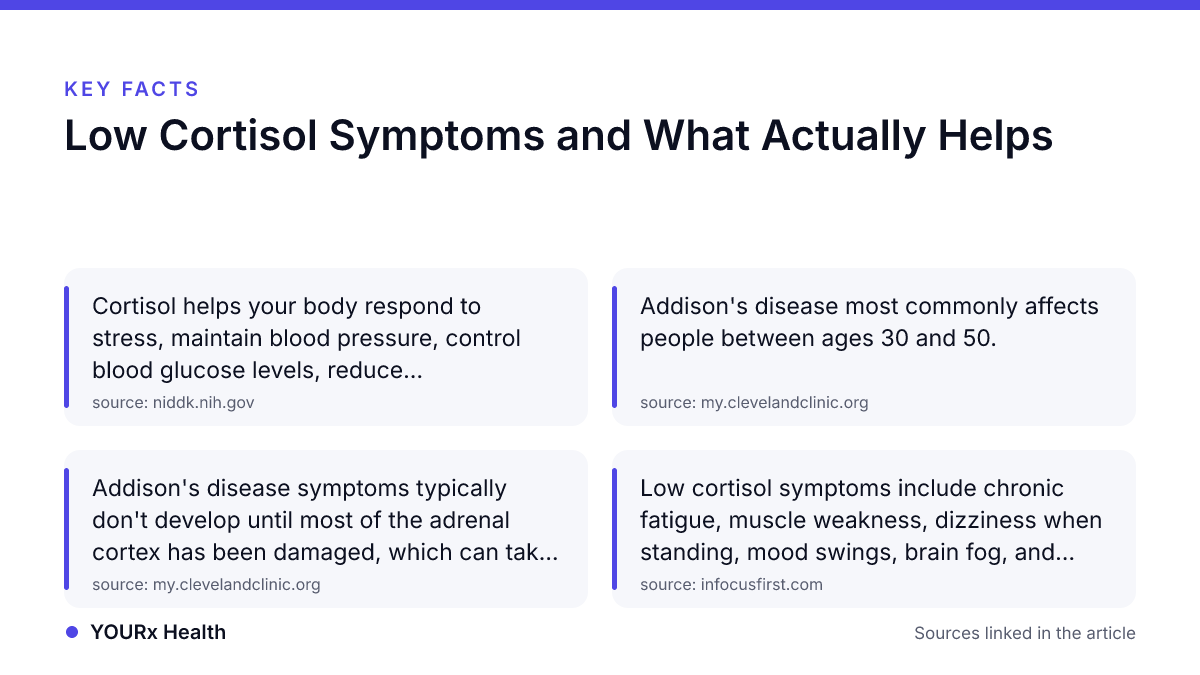
- Low cortisol means adrenal insufficiency, not calmness. Cortisol regulates your stress response, blood pressure, blood glucose, inflammation, and metabolism, so when it drops, all five slip at once.
- The classic symptom cluster is chronic fatigue, muscle weakness, dizziness on standing, mood swings, brain fog, and salt cravings. In men it overlaps heavily with low testosterone.
- Diagnosis is a morning blood draw, sometimes followed by an ACTH stimulation test. A symptom checklist or a social media trend is not a diagnosis.
- Addison’s disease usually shows up between ages 30 and 50, and symptoms often stay hidden until most of the adrenal cortex is already damaged, which can take months or years.
- Confirmed adrenal insufficiency needs prescription hormone replacement. Milder, stress-driven cortisol dysregulation responds to sleep timing, sodium, and training changes instead.
Low cortisol means your adrenal glands aren’t producing enough of the hormone your body relies on to manage stress, blood sugar, blood pressure, and inflammation, according to NIDDK. Doctors call the sustained, severe form adrenal insufficiency. The autoimmune version is Addison’s disease, which most commonly develops between ages 30 and 50, per Cleveland Clinic.
Thank you for reading this post, don't forget to subscribe!
Here’s the part that traps people. Symptoms often don’t appear until most of the adrenal cortex has already been damaged, a process that can run months or years. So patients spend a year or two being told “you’re just stressed” before anyone orders a cortisol panel.

Table of Contents
- What does it mean if your cortisol levels are low?
- What are the symptoms of low cortisol?
- Does low cortisol mean less stress?
- How do you test for low cortisol, and what does a normal range mean?
- Can low cortisol cause weight gain?
- What actually helps with low cortisol?
- When should this move from lifestyle fixes to a doctor visit?
- Frequently asked questions
What does it mean if your cortisol levels are low?
It means the two small glands sitting on top of your kidneys aren’t secreting enough cortisol to keep your core systems running. Cortisol isn’t a vague “stress hormone.” It helps your body respond to stress, maintain blood pressure, control blood glucose, reduce inflammation, and regulate metabolism, according to NIDDK. Drop the supply and every one of those jobs gets done worse.
There are three versions of this, and the difference changes treatment:
- Primary adrenal insufficiency (Addison’s disease): the adrenal glands themselves are damaged, most often by an autoimmune attack, which Cleveland Clinic names as the most common cause.
- Secondary adrenal insufficiency: the pituitary gland isn’t sending enough ACTH, the signal that tells your adrenals to produce cortisol.
- Tertiary adrenal insufficiency: the hypothalamus underproduces the hormone that starts the signaling chain. This is what we see most often after someone stops long-term steroids abruptly, including the prednisone taper nobody finished properly after a bad flare or a sports injury.
You’ve probably seen the “low cortisol girl” memes, the joke about being too exhausted to even feel anxious. There’s a real physiological kernel in there, because chronically low cortisol blunts your stress response and your energy simultaneously. But a meme isn’t a diagnosis, and treating adrenal insufficiency like a personality trait delays the blood work that catches it.
What are the symptoms of low cortisol?
The list is broad, which is precisely why low cortisol gets filed under “burnout” for years. The core symptoms:
- Chronic fatigue that doesn’t budge with a full night of sleep or a second coffee.
- Muscle weakness, most noticeable on stairs or standing up from a low chair.
- Dizziness when standing up, tied directly to cortisol’s role in blood pressure.
- Mood swings and brain fog that feel disconnected from anything happening in your life.
- Salt cravings that are oddly specific. Patients reach for pickles, olives, and chips, not sweets.
Those symptoms are documented in InFocus First’s overview of low cortisol and mental health, and they show up whether the underlying cause is autoimmune, pituitary, or long-term stress.
Symptoms of low cortisol in females carry extra markers. Women with Addison’s disease may experience irregular periods, loss of body hair, and low sex drive, according to Cleveland Clinic. In men, the presentation mimics low testosterone almost exactly: low libido, muscle loss, flat mood, workouts that take four days to recover from instead of one. If you’re in your 30s or 40s and that sounds familiar, read our breakdown on how to increase testosterone, because these two systems get evaluated in the same conversation more often than not.
Pro tip: Salt cravings aren’t a willpower failure. If cortisol is low, your body is scrambling to hold onto sodium to prop up blood pressure. Patients tell us they’ve been “fighting” that craving for months on a low-sodium diet and feeling steadily worse. Get tested before you fight it, then adjust intake with a physician’s guidance.
Does low cortisol mean less stress?
No. Low cortisol doesn’t mean less stress hitting you. It means your body is worse at answering it.
Think of cortisol as the hormone that shows up when a stressor does. Deadline, illness, skipped meal, hard training session: cortisol is supposed to mobilize glucose and hold your blood pressure steady so you can handle it. When supply is short, the stressor still lands. Your capacity to absorb it doesn’t.
That explains a pattern we hear constantly in consults. Patients describe feeling wiped out and wired at the same time, too tired to work but too rattled to nap. Both high and low cortisol impair cognitive function, destabilize mood, and can cause structural changes in the brain’s fear and memory centers, per InFocus First. Exhausted and anxious aren’t contradictory symptoms. They’re the same broken feedback loop showing two faces.
How do you test for low cortisol, and what does a normal range mean?
You test with a blood draw, almost always first thing in the morning, because cortisol runs on a daily rhythm and peaks shortly after waking. A physician evaluating unexplained fatigue, weight changes, and low blood pressure typically starts with an early-morning serum cortisol, then orders an ACTH stimulation test if the first number comes back low or borderline. That sequence is laid out in the clinical review on primary adrenal insufficiency in adults. The stimulation test asks whether your adrenals can ramp up production when prompted, which separates an adrenal problem from a signaling problem further up the chain.
Now the honest answer on “normal”: there isn’t one universal number. Reference ranges shift by lab, by time of day, and by assay. One low-ish morning result isn’t a diagnosis either. Your physician reads it against your symptoms, your ACTH, and often a repeat draw.
Plan the draw backward from the lab’s clock
This is where most people blow the test. Morning cortisol drifts down through the day, so a 1 p.m. “morning” draw can look falsely low, and a rushed, caffeinated arrival can look falsely reassuring. Count backward instead.
Say the lab opens at 7:00 a.m. and you want to be drawn within the first 30 minutes. Work the arithmetic:
- 7:00 a.m. target draw
- minus 10 minutes for check-in and paperwork = 6:50 arrival
- minus a 25-minute drive = 6:25 departure
- minus 30 minutes to shower, dress, and be genuinely awake = 5:55 a.m. alarm
Run that with your own drive time and lab hours. The rule of thumb: if the math forces you out of bed before you can be calm and unhurried, book a different day rather than showing up sprinting and dehydrated. That single choice changes the number on the page.
| Type of adrenal insufficiency | What’s happening | Most common cause |
|---|---|---|
| Primary (Addison’s disease) | Adrenal glands are directly damaged | Autoimmune attack |
| Secondary | Pituitary isn’t sending enough ACTH signal | Pituitary damage or tumor |
| Tertiary | Hypothalamus underproduces the starting signal (CRH) | Long-term steroid use stopped abruptly |
Pro tip: Doing an at-home cortisol test? Collect it before coffee, before your workout, and before you spend an hour doom-scrolling in bed. Caffeine, exercise, and acute stress all push cortisol up temporarily and can hide a genuinely low baseline.
Can low cortisol cause weight gain?
Yes, though not in a straight line. Cortisol controls metabolism and blood glucose, so when it drops, weight can move in either direction depending on the cause.
Severe, classic Addison’s disease more often produces unintentional weight loss alongside poor appetite and GI symptoms. The milder, fluctuating pattern that builds over years of chronic stress, the kind that never meets Addison’s criteria, tends to come with weight gain instead. The mechanism is indirect and unglamorous: you move less because you’re exhausted, sleep poorly, ride blood sugar swings, and reach for salty calorie-dense food that matches the salt-craving pattern already linked to low cortisol.
If you’re carrying stubborn weight and feel constantly drained, low cortisol may be one thread, rarely the whole rope. Thyroid function, testosterone, and insulin resistance usually travel with it. That’s why our weight loss program reads the metabolic picture as a whole instead of chasing one hormone.
What actually helps with low cortisol?
Treatment splits on one question: confirmed adrenal insufficiency, or a milder stress-driven pattern? Most generic health articles skip that fork entirely.
- Get the diagnosis before you change anything. Confirmed adrenal insufficiency is treated with prescription glucocorticoid replacement, commonly hydrocortisone, dosed by a physician and increased during illness, surgery, or major stress. Cleveland Clinic describes that management as lifelong for Addison’s disease. No supplement replaces it.
- Protect the timing of your sleep, not just the hours. Cortisol runs circadian. Going to bed at 10 p.m. one night and 2 a.m. the next blunts the morning peak that’s supposed to get you out of bed with energy. Consistent wake time beats extra hours.
- Don’t cut sodium reflexively. If salt cravings are part of your picture, a generic “heart healthy” low-salt diet adopted without medical guidance can make you feel notably worse.
- Lift weights instead of adding cardio. Resistance training defends the muscle that fatigue and low cortisol erode, and in our experience patients tolerate three short lifting sessions a week far better than a daily hour on the treadmill.
- Check testosterone and cortisol together in men. Treating one while ignoring the other leaves symptoms half-solved. Our physicians evaluate both during a men’s hormone optimization consult.
- Consider recovery-focused peptides where appropriate. Some patients use peptides like BPC-157 under physician supervision to support tissue repair and recovery capacity, much the same way patients weighing metabolic treatments want to know what compounded semaglutide actually costs before starting. Our founder, Vincent Broussard, built YOURx Health after managing his own chronic condition, and you can read that story on our about page.
Pro tip: If your labs land “normal but low-normal” and your symptoms are real, don’t accept a shrug. Ask for the full picture: ACTH, thyroid, testosterone. One number in isolation clears nobody. That’s the workup we run during a same-day video consult.
When should this move from lifestyle fixes to a doctor visit?
If fatigue, dizziness, salt cravings, or unexplained weight changes have run longer than a few weeks and sleep and diet changes haven’t touched them, you need blood work, not another supplement.
Severe symptoms are a different category. Fainting, persistent vomiting, extreme weakness, and confusion can signal an adrenal crisis, and that’s an emergency room trip right now, not a telehealth appointment. Everything short of that is exactly what a same-day virtual consult and lab order sort out fast. Our FAQs explain how intake and labs work, and the health hub has more on hormone-related fatigue.
| Point | Details |
|---|---|
| What low cortisol means | Adrenal glands underproducing the hormone that manages stress response, blood pressure, blood sugar, and inflammation |
| Who it affects most | Addison’s disease most commonly develops between ages 30 and 50 |
| Top causes | Autoimmune attack (primary), pituitary issues (secondary), abrupt steroid withdrawal (tertiary) |
| Core symptoms | Fatigue, muscle weakness, dizziness on standing, mood swings, brain fog, salt cravings |
| How it’s confirmed | Morning blood cortisol, sometimes followed by an ACTH stimulation test |
| Emergency red flag | Adrenal crisis: fainting, vomiting, extreme weakness, confusion. Go to the ER |
Recognize yourself in that symptom list? Set the alarm, book the morning draw, and get a number instead of a guess. Start with a physician consult.
Frequently asked questions
What is a dangerously low cortisol level?
There’s no single universal cutoff, since reference ranges vary by lab and by time of day. Functionally, a dangerously low level is one that triggers an adrenal crisis: sudden severe weakness, vomiting, very low blood pressure, and confusion. That combination is a medical emergency and needs immediate ER care, not an outpatient follow-up next week.
Is low cortisol ever a good thing?
No. Some people assume low cortisol means they’re calmer, but both high and low cortisol impair cognitive function and destabilize mood, according to InFocus First. What supports steady energy and mood is a healthy, well-timed cortisol rhythm, not a suppressed one.
How is low cortisol different from low testosterone in men?
Different glands, overlapping symptoms. Fatigue, low libido, muscle loss, and mood changes show up with both, so you can’t separate them by how you feel. Bloodwork measuring each hormone directly is the only way to tell, which is why a proper workup for symptoms for low testosterone in men should rule cortisol in or out rather than assuming a single cause.