TL;DR
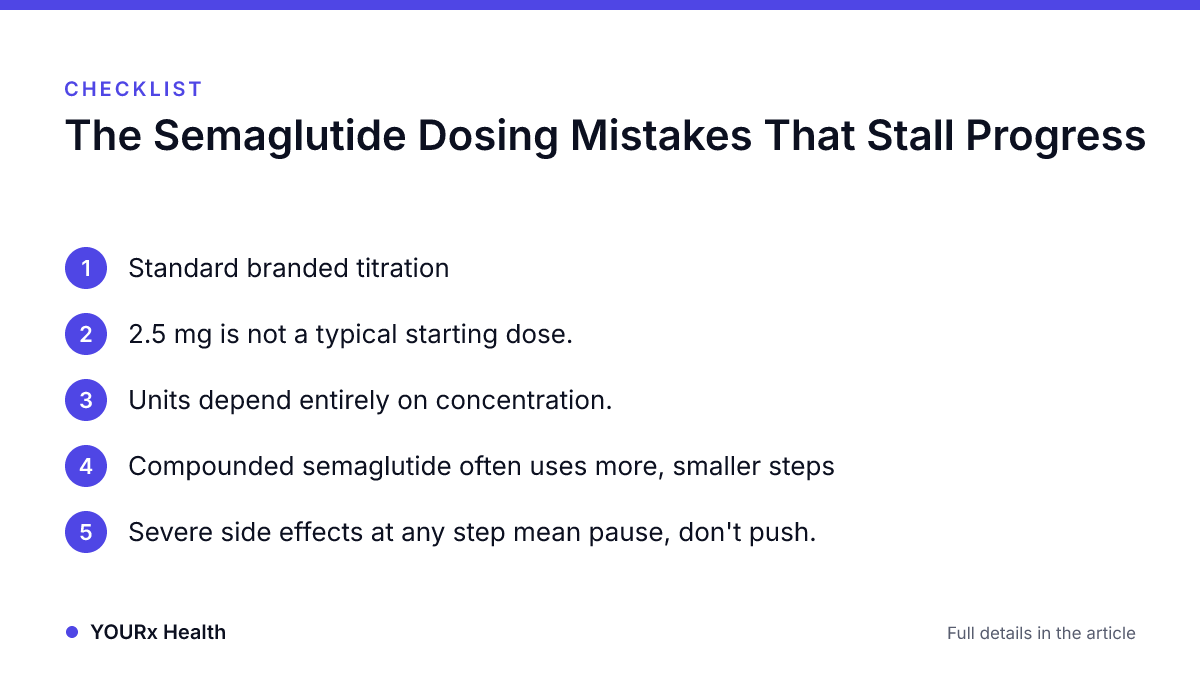
- Standard branded titration moves through five steps: 0.25 mg, 0.5 mg, 1 mg, 1.7 mg, and 2.4 mg, holding each dose at least four weeks before increasing, per Mayo Clinic’s dosing guidance.
- 2.5 mg is not a typical starting dose. It’s usually a maintenance-tier dose some compounded protocols use in place of the branded 2.4 mg ceiling.
- Units depend entirely on concentration. 2.5 mg equals 100 units at 2.5 mg/mL, 50 units at 5 mg/mL, and 25 units at 10 mg/mL. Check the vial label before every draw.
- Compounded semaglutide often uses more, smaller steps than branded pens. Slower to maintenance, easier on the stomach along the way.
- Severe side effects at any step mean pause, don’t push. Repeated vomiting, inability to keep fluids down, or signs of dehydration are reasons to hold your dose and call your prescriber that week, not at your next check-in.
Mark is 44, runs operations for a logistics company, and had read about semaglutide for two years before he ever filled a prescription. He’s a composite of the patients we see every week. What kept him on the sidelines was simple: the nausea horror stories, and the brand-name sticker price with no idea whether his insurance would touch it.
Thank you for reading this post, don't forget to subscribe!
What finally moved him wasn’t a pep talk. It was a physician walking him through his dosing schedule in actual numbers.
That conversation is the one most people never get. It’s also why so many patients quit in week three or over-titrate themselves into a miserable month four. Here’s the breakdown that should come with every prescription.
Table of Contents
- What is the standard semaglutide dosing schedule?
- Can you start semaglutide at 2.5 mg?
- How many units is 2.5 mg of semaglutide?
- What do you do if side effects get bad before your next dose increase?
- How does compounded semaglutide dosing differ from branded semaglutide?
- How long does it realistically take to reach maintenance dose?
- Does a slower titration cost more in the end?
- Frequently asked questions
What is the standard semaglutide dosing schedule?
Standard branded semaglutide dosing starts at 0.25 mg once weekly for four weeks. That dose won’t do much for your weight, and it isn’t supposed to. It’s there to let your GI system meet the drug before the dose gets serious.
Week five, you double to 0.5 mg for four weeks. Tolerating that? You move to 1 mg for weeks nine through twelve, 1.7 mg for weeks thirteen through sixteen, then 2.4 mg as long-term maintenance from week seventeen on. That’s the published Wegovy schedule, mirrored closely by the Ozempic titration used off-label for weight management, and it lines up with the pharmacokinetic data behind semaglutide’s original weight-management trials.
Read every step as a minimum hold, not a fixed one. Plenty of patients sit at one dose for six or eight weeks.
| Step | Weekly dose | Typical duration | Purpose |
|---|---|---|---|
| 1 | 0.25 mg | Weeks 1–4 | GI tolerance adjustment, minimal weight effect |
| 2 | 0.5 mg | Weeks 5–8 | First dose where appetite suppression becomes noticeable |
| 3 | 1 mg | Weeks 9–12 | Meaningful appetite and intake reduction for most patients |
| 4 | 1.7 mg | Weeks 13–16 | Bridge dose before full maintenance |
| 5 | 2.4 mg | Week 17+ | Long-term maintenance dose |
Pro tip: if your scheduled step-up lands during a travel week, a brutal work deadline, or four days of holiday restaurant meals, ask about holding your current dose two extra weeks. Nobody gets a medal for hitting 2.4 mg fastest. Plenty of people quit the medication entirely because they increased at the worst possible moment.
Can you start semaglutide at 2.5 mg?
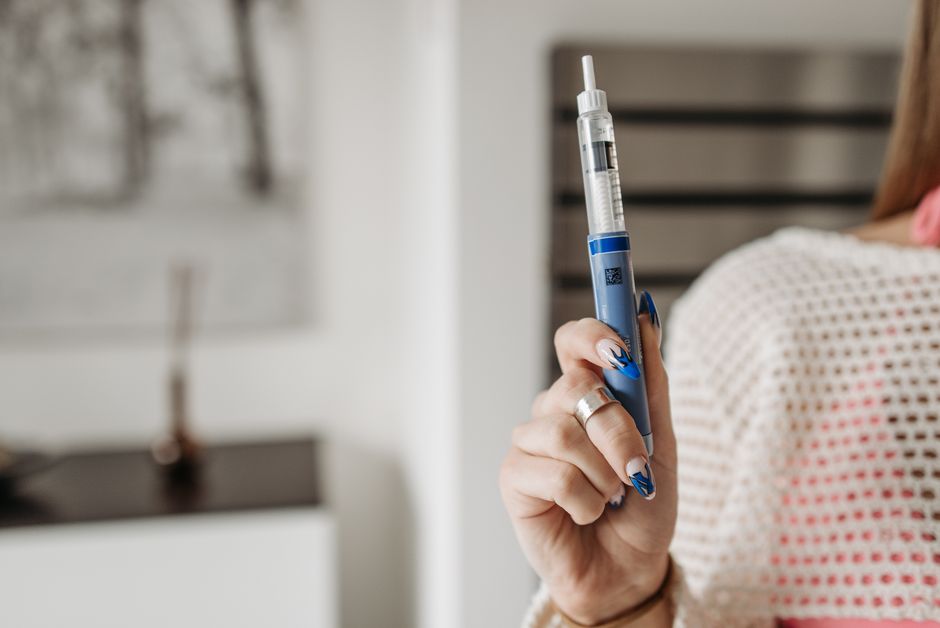
No. 2.5 mg is not a standard starting dose, and beginning there skips the whole point of titration. Branded Wegovy and Ozempic both start at 0.25 mg, which is one-tenth of that.
The confusion almost always traces back to compounded vials. Some compounding pharmacies label their top-tier maintenance dose 2.5 mg instead of the branded 2.4 mg. Other times a protocol says “2.5” when it means 2.5 mg/mL concentration, not a 2.5 mg dose.
Here’s the version of this mistake we see most often, and it’s worth burning into memory. A vial label might read something like “Semaglutide 10 mg / 2 mL.” Patients read the big number and assume 10 mg is a dose. It isn’t. That’s the total drug in the vial, the concentration is 5 mg/mL, and their actual weekly dose might be 0.25 mL of it. Three numbers on one sticker, only one of which is your dose.
So if you see 2.5 mg written anywhere on a prescription or chart, ask your prescriber one question before you touch a syringe: is that the dose, or the concentration? Those are entirely different numbers, and confusing them is the single most common self-dosing error among patients moving from a branded pen to a vial-and-syringe setup.
How many units is 2.5 mg of semaglutide?
It depends on the concentration in your vial. There’s no universal answer, which is exactly why unit-based dosing trips people up more than mg-based dosing.
Insulin syringes measure in units, where 100 units equals 1 mL, no matter what’s dissolved in that milliliter. The formula:
units = (dose in mg ÷ concentration in mg/mL) × 100
- At 2.5 mg/mL: 2.5 ÷ 2.5 = 1 mL = 100 units
- At 5 mg/mL: 2.5 ÷ 5 = 0.5 mL = 50 units
- At 10 mg/mL: 2.5 ÷ 10 = 0.25 mL = 25 units
Same 2.5 mg dose, anywhere from 25 to 100 units on the barrel. That’s a fourfold swing, and it’s the arithmetic that turns a routine injection into an accidental overdose or a wasted week. Every compounded vial should state its concentration plainly on the label. If yours doesn’t, or the number doesn’t match what your provider told you, don’t draw anything until you’ve confirmed it. Drugs.com’s semaglutide reference is a reasonable place to double-check conversions between appointments.
Pro tip: write your concentration and your unit count on a sticky note taped to the box, not just in a notes app. Low-tech. Also the cheapest insurance against the most common compounded-dosing mistake there is, because nobody opens an app at 6 a.m. before work.
What do you do if side effects get bad before your next dose increase?
Hold your current dose and contact your prescriber within 24 to 48 hours. Don’t wait for the scheduled increase, and don’t take it.
Mild nausea, burping, or loose stools in the first week or two of a new dose are ordinary and usually settle within seven to ten days. Severe symptoms are a different animal. They mean the titration pace is too fast for your body specifically, not that you need to grit through it.
How to tell the difference, and what to do at each level:
- Mild and manageable (nausea, mild fatigue, occasional loose stool): Ride it out. Smaller, lower-fat meals, steady hydration, and skip alcohol for the first 48 hours after your injection. That’s when GI symptoms peak.
- Moderate (nausea bad enough to affect eating or work, occasional vomiting): Do not increase on schedule. Message your provider and ask to stay put for another two to four weeks.
- Severe (can’t keep water down, dizziness or dark urine, vomiting past 24 hours): Call the same day. Some patients need to step back down a dose level, not just pause. That’s a normal part of titration, not a failure.
- Rare but urgent (severe abdominal pain that won’t ease, signs of pancreatitis, allergic reaction): Stop the medication, get medical care immediately, then loop in your prescriber.
According to Mayo Clinic’s semaglutide side effect guidance, GI symptoms are the most commonly reported effects across dose levels, and they track with dose. In practice that means the jump from 1.7 mg to 2.4 mg is far more likely to wreck a week than the jump from 0.25 mg to 0.5 mg.
This is what ongoing check-ins are for. A physician who can adjust your pace in real time keeps you out of the trap where the only two options feel like “push through” or “quit.” You can see how that monitoring works on our weight loss program page.
How does compounded semaglutide dosing differ from branded semaglutide?
Compounded protocols typically use more, smaller titration steps than the five-step branded schedule. Longer road to maintenance, noticeably gentler trip.
Wegovy goes from 0.25 mg straight to 0.5 mg, doubling the dose in one move. Many compounded protocols slide an intermediate step in between, something like 0.375 mg, or stretch each hold to six weeks instead of four. The tradeoff is worth understanding before you pick a plan:
| Factor | Branded (Wegovy/Ozempic) | Compounded semaglutide |
|---|---|---|
| Starting dose | 0.25 mg fixed | 0.25 mg, sometimes lower depending on formulation |
| Number of titration steps | 5 fixed steps | Often 6–8 steps, provider-adjustable |
| Dose measured in | Fixed pen clicks (mg) | mL or units, based on vial concentration |
| Flexibility to slow down | Limited, pen doses are fixed increments | High, provider can prescribe custom intermediate doses |
| Typical time to top maintenance dose | About 16–17 weeks per label | Commonly 20–28 weeks in our practice |
| Delivery format | Pre-filled pen | Vial and syringe, or compounded semaglutide pills in some formulations |
That same flexibility is compounded semaglutide’s biggest liability without physician supervision. When your dose lives in mL or units instead of a pen click, one mismatched concentration causes a real dosing error in a way a pre-set pen simply won’t allow.
Oral formulations are their own category again, with a different mg-based curve and absorption profile. The Wegovy pill dosing guide covers the branded oral version specifically. If you’re weighing pills against injections, have that conversation with your prescriber directly, since absorption and side effect timing genuinely differ. You can browse the injectable protocols we prescribe on our Ozempic and Zepbound pages.
How long does it realistically take to reach maintenance dose?
In our practice, 20 to 28 weeks is the honest range once you account for extended holds. The 16-to-17-week label timeline assumes zero adjustments, which describes a minority of real patients.
Roughly speaking, we see three groups. Some patients march through the four-week steps with nothing worse than a sluggish Sunday. A larger share needs one or two extended holds, and they cluster at the 1 mg and 1.7 mg transitions where GI effects tend to bite hardest. A third group, often older patients, smaller-framed patients, or anyone with a history of a touchy stomach, needs six to eight weeks at nearly every step, which stretches the whole thing to five or six months.
What an extended hold actually looks like: you take the same dose you took last week, your provider checks in around day ten, and if food is staying down and you’re hitting your protein, you step up the following week. That’s it. No restart, no lost ground, no penalty.
The genuine mistake is treating week 17 as a deadline and powering through bad weeks to stay on it. Slower titration with no skipped doses beats faster titration followed by a two-week stoppage every time, because a gap long enough to reset your tolerance usually means repeating the dose you just paid for.
Does a slower titration cost more in the end?
Slower titration costs more in total dollars during the titration phase. It rarely costs more per pound lost, and it frequently costs less once you count restart fees and abandoned attempts. Here’s the math so you can re-run it with your own pricing.
Setup: treat a month as four weekly doses. Use $350/month for the starting dose tier and $450/month once you reach 1 mg or higher. (Illustrative numbers in a plausible mid-range for compounded semaglutide; swap in whatever your plan actually charges.)
- Patient A, standard 16-week titration: one month at $350, plus three months at $450 ($1,350). Total = $1,700 to reach maintenance.
- Patient B, 24-week titration with extended holds: two months at $350 ($700), plus four months at $450 ($1,800). Total = $2,500 to reach maintenance.
An $800 difference. Real money, and we’d rather say so upfront than pretend otherwise.
Now Patient C, who stays on the standard schedule and pushes through. She pays $350 for month one and $675 for six weeks at the higher tier, so $1,025 spent, then quits at week ten because the nausea became unlivable. Two months off. A re-consult. She restarts at 0.25 mg and pays the full $1,700 climb over again. She’s at $2,725 and ten months in before she sees a maintenance dose.
Rule of thumb: if one extra hold costs you roughly one month of medication, and quitting costs you a full restart plus a re-consult, any hold that meaningfully raises your odds of staying on the drug pays for itself. Two extended holds is still cheaper than one abandoned attempt.
If money is tight, say that to your prescriber out loud. A good physician can shape your titration steps around your budget and your tolerance in the same conversation instead of treating them as separate problems.
Pro tip: ask whether your plan bills per dose tier or a flat monthly rate regardless of dose. Flat-rate pricing removes the financial pressure to rush your titration, which matters more than it sounds like it should.
YOURx Health physicians set your titration pace at the first visit rather than handing you a generic chart. You can see how the initial consult and lab monitoring work on our treatments overview or get the full picture on our GLP-1 program page.
Frequently asked questions
What’s the difference between a semaglutide dosing chart in mg and one in mL?
A mg chart gives you the active drug amount per injection. An mL chart gives you the liquid volume to draw, and that volume is only correct for one specific concentration. Switch pharmacies or vial strengths and your mg dose usually stays the same while your mL or unit number changes completely. Confirm the concentration on the vial in your hand before reusing a number you remember from last month.
Can you skip a dose if you missed your injection day?
Missed it by a day or two? Most protocols say take it when you remember and resume your normal schedule. Past several days, call your prescriber before injecting. Some situations call for restarting a step lower rather than picking up where you left off, particularly at 1.7 mg or 2.4 mg where tolerance drops off fastest during a gap.
Does low cortisol affect how someone tolerates semaglutide titration?
It can. Patients we’ve treated with known adrenal or cortisol issues often report more fatigue and more GI sensitivity during dose increases, which tracks with eating less and losing fluid at the same time. Bring it up at intake if it applies to you. Your physician will likely build in a slower pace and closer lab monitoring than the standard schedule.
Mark hit 1 mg in week eleven instead of week nine, because his provider parked him at 0.5 mg for two extra weeks after one rough Tuesday. He’s at maintenance now, steady, and hasn’t had a bad GI week in months. The schedule on the box was never his plan. His plan was whatever pace his body could handle, set by someone actually watching.
If you’re starting, or restarting after a bad attempt somewhere else, find a physician who’ll build your semaglutide dosing around your side effects instead of a printed chart. Start that conversation on our health hub or book a same-day consult through YOURx Health.