
TL;DR
- Peptide injections deliver short amino acid chains that trigger one specific biological signal: appetite suppression (semaglutide), tissue repair (BPC-157), or growth hormone release (sermorelin). In our practice, protocols typically run 8 to 24 weeks before we judge them.
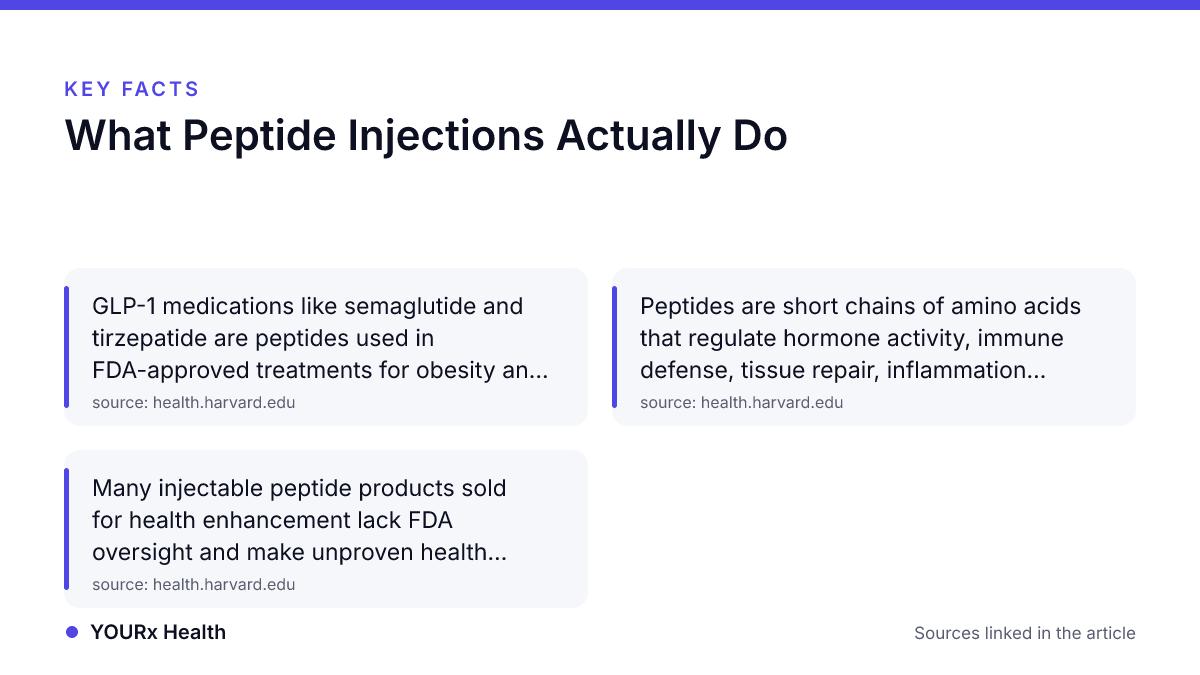
- Only a small number of peptides carry FDA approval, and only for defined conditions. Semaglutide and tirzepatide are used in FDA-approved treatments for type 2 diabetes and obesity. BPC-157 and TB-500 have no approved human indication.
- Cost is a math problem, not a price tag. Divide vial quantity by daily dose to get days per vial, then work back to a monthly figure. The worked example below shows how.
- Human clinical data on BPC-157 is thin. Most of what’s published comes from animal research, so treat confident human claims as extrapolation.
- The bigger risk is the source, not the molecule. Injection site reactions and hormonal side effects are manageable with monitoring. Unregulated vials carry purity and dosing risks that a prescription pathway removes.
Peptide injections put short chains of amino acids under your skin to make your body do one specific thing: blunt appetite, repair a tendon, release more growth hormone. They aren’t a single drug. They’re a category, and what one peptide does has almost nothing to do with what the next one does.
Thank you for reading this post, don't forget to subscribe!
A vial of semaglutide and a vial of BPC-157 are both technically “peptides.” One is part of an FDA-approved treatment for obesity and type 2 diabetes. The other is a research compound with a fraction of the human evidence behind it. So the question worth asking isn’t whether peptide injections work. It’s which one, for what, and under whose supervision.
Table of Contents
- What does taking peptide injections do?
- What are the risks of taking peptides?
- How long do peptide injections last?
- What does peptide injection therapy actually cost per month?
- Are peptides FDA-approved, and what does that mean for you?
- What does the clinical evidence say about BPC-157?
- Who actually qualifies for peptide therapy?
- Where to go from here
- Frequently asked questions
What does taking peptide injections do?
They mimic or amplify a signal your body already sends. Peptides regulate hormone activity, immune defense, tissue repair, inflammation control, and digestion, according to Harvard Health. Injectable versions push one of those signals harder or longer than your own physiology would.
GLP-1 peptides like semaglutide slow gastric emptying and tell your brain you’re full, which is why patients eat less without white-knuckling a diet. Sermorelin works upstream, nudging your pituitary to release more of its own growth hormone instead of injecting synthetic HGH. BPC-157 is theorized to speed blood vessel formation and collagen synthesis at injury sites, though that mechanism is mostly documented in animals.
What you actually feel, and how fast, depends entirely on the compound:
- Semaglutide (GLP-1): appetite drops within the first week. Meaningful weight change shows up over several months, not the first month.
- BPC-157: patients report easing of joint or soft tissue pain across roughly 4 to 8 weeks of use. That’s anecdotal plus animal data, and we say so up front.
- Sermorelin: deeper sleep first, usually within a few weeks. Recovery and body composition changes come later, over 3 to 6 months.
- B12/MIC injections: a quick subjective lift within a day or two, largely tied to correcting an actual deficiency. Short-lived by design.
Pro tip: if a peptide promises dramatic results inside a week and it isn’t appetite-related, that’s marketing — the same inflated-promise pattern behind the low cortisol meme making the rounds online. Anything acting on tissue repair or hormone signaling moves slowly. Rapid “fat melting” from BPC-157 or TB-500 is a claim nobody has demonstrated in people.

What are the risks of taking peptides?
Two separate categories, and the second one is bigger than most patients realize.
Physiologically, injectable peptides can cause injection site redness or swelling, nausea (very common with GLP-1s during dose titration), headache, and with growth-hormone-releasing peptides, water retention or morning joint stiffness. Those are dose-dependent and usually fixable by adjusting or slowing the titration.
Then there’s product quality. The American Medical Association has flagged the real problem: many peptides sold online for muscle growth, anti-aging, or fat loss never go through any FDA review of manufacturing, purity, or dosing accuracy. Harvard Health makes the same point about injectable peptide products marketed for health enhancement. Two vials with identical labels from two different sellers can hold meaningfully different amounts of active compound, plus whatever else nobody tested for.
That’s the gap that matters if you’re comparing “peptide injections near me” against a telehealth option. A compounding pharmacy filling a physician’s prescription answers to a licensing board. A gray-market research chemical seller answers to nobody. UCHealth notes the FDA has issued warnings about unapproved peptide products precisely because the health claims were never studied in the people buying them.
| Risk factor | Physician-prescribed, pharmacy-compounded | Unregulated online purchase |
|---|---|---|
| Dosing accuracy | Verified against compounding pharmacy standards | Seller’s word, rarely verified |
| Product purity | Batch-tested before release | Certificates often unverifiable or reused |
| Medical monitoring | Baseline labs, follow-up labs, prescriber check-ins | None |
| Legal status | FDA-approved use or documented off-label prescribing | Sold “research use only” to dodge regulation |
| Recourse if something goes wrong | Named physician and licensed pharmacy | Effectively none |
Pro tip: a vial labeled “not for human consumption” that’s being sold to you for injection isn’t a technicality. That label exists so the seller can avoid FDA accountability if the contents hurt you. Read it as a warning, not fine print.
How long do peptide injections last?
The question means two things: how long one dose stays active, and how long you stay on the protocol. Both answers change by compound.
Semaglutide stays active long enough to be dosed once weekly, and weight management protocols commonly continue for six months to a year or longer, similar to how GLP-1s are used long-term in type 2 diabetes and weight loss management, and if you’re comparing pharmacy sources, it’s worth understanding what compounded semaglutide actually costs you before committing to a monthly protocol. BPC-157 clears far faster and is typically cycled in 4 to 8 week courses with a break before restarting. Sermorelin is dosed at night to ride your body’s natural nighttime growth hormone pulse, and body composition protocols usually run 3 to 6 months. B12 and glutathione clear fastest of all, which is why they’re given weekly or biweekly as ongoing maintenance rather than a finite course.
One practical detail nobody tells first-time patients: a reconstituted peptide vial has a much shorter usable life than a sealed one. Once you add bacteriostatic water, it lives in the refrigerator, not the bathroom cabinet, and your pharmacy will give you a specific discard date. Don’t reconstitute a second vial “to have it ready.” You’ll be throwing away product.
Pro tip: don’t evaluate a protocol at two weeks. These compounds work by cumulative signaling, so the honest review window is roughly 8 to 12 weeks for repair and hormone peptides, and 12 to 16 weeks for weight loss on a GLP-1. Weigh yourself or track pain on the same day each week, not daily. Daily numbers are noise, and noise makes people quit early.
What does peptide injection therapy actually cost per month?
Advertised prices tell you almost nothing, because a cheap vial with a high daily dose costs more per month than an expensive vial with a low one. Here’s the arithmetic, run on an illustrative BPC-157 scenario.
Say the vial holds 5 mg, which is 5,000 mcg. A common protocol is 250 mcg twice daily, so 500 mcg per day.
- 5,000 mcg ÷ 500 mcg per day = 10 days per vial
- At $90 per vial: $90 ÷ 10 = $9 per day
- $9 × 30 = $270 per month
Now change one variable. Drop to 250 mcg once daily and the same vial lasts 20 days, cutting the monthly cost to $135. Same product, same price, half the spend. That’s why the dose matters more than the sticker.
Run it on whatever you’re considering:
- Find the total peptide per vial in mcg or mg, from the label, not the ad.
- Divide by your prescribed daily dose to get days per vial.
- Divide vial cost by days per vial for your true daily cost.
- Multiply by 30 for a real monthly number.
Rule of thumb we use with patients: if the monthly number lands under about half of what comparable physician-prescribed protocols cost, the savings are coming from somewhere. Ask which pharmacy compounds it, whether it’s licensed in your state, and whether a physician reviews your labs before anything ships. That’s usually where the corners got cut.
Are peptides FDA-approved, and what does that mean for you?
Very few injectable peptides carry FDA approval, and the ones that do are approved for specific conditions rather than general wellness. Semaglutide and tirzepatide are used in FDA-approved treatments for obesity and type 2 diabetes. BPC-157 and TB-500 have no FDA approval for any human use and are frequently sold under research-use disclaimers, per Harvard Health.
Practically, that difference is about what’s already been proven. An approved peptide went through trials that established dosing, safety, and efficacy in a defined population. An off-label prescription from a physician is still legitimate medicine (a large share of everyday prescribing is off-label), but it rests on the prescriber’s judgment and the available literature rather than a reviewed indication. Those are different levels of certainty, and you deserve to know which one you’re buying.
Worth clarifying while we’re on the subject, because patients mix these up constantly: type 1 diabetes is an autoimmune condition where the pancreas stops making insulin, usually diagnosed young. Type 2 is a metabolic condition driven by insulin resistance that builds over years and tracks closely with weight and lifestyle. GLP-1 peptides are used in approved treatments for type 2 diabetes and obesity. They are not a treatment for type 1, which requires insulin regardless of body weight.
Pro tip: ask any provider point blank, “is this FDA-approved for this use, or off-label?” A physician-led practice answers in one sentence and explains the reasoning. A seller who dances around it has told you everything you need to know.
What does the clinical evidence say about BPC-157?
Human evidence for BPC-157 is limited. Most of the published work involves animal models of gut healing, tendon repair, and blood vessel growth, not controlled trials in people.
That doesn’t make it junk. Plenty of standard treatments started with strong animal data years before human trials caught up. But it does mean the confident claims you’ll read about BPC-157 curing tendonitis or reversing gut damage in humans are extrapolated from rats, and you should hold them loosely. The AMA has cautioned patients that injectable peptides marketed for enhancement and anti-aging routinely make claims that run ahead of the research. Stoneville’s overview of injectable peptides lands in the same place: a mechanism shown in cells or animals is not demonstrated efficacy in people.
Here’s the opinion we’ll defend. Peptides like BPC-157 belong in a plan, never as the plan. The patients who report the most benefit are the ones pairing it with loaded eccentric rehab for a tendon or a structured physical therapy program, and they’d likely have improved somewhat on the rehab alone. That’s exactly why we set expectations before the first injection instead of after. Our BPC-157 and TB-500 protocols are prescribed as part of a broader recovery plan, monitored with labs, and never sold as a guaranteed fix.
Who actually qualifies for peptide therapy?
Qualification comes down to your labs, your symptoms, and your history. Every legitimate protocol starts with a real medical evaluation. A physician reading your bloodwork is the difference between a protocol and a guess.
- Men with symptoms of low testosterone, meaning low energy, reduced libido, lost muscle, poor recovery, or brain fog, are common candidates for hormone optimization, sometimes alongside sermorelin or TRT. If you’re unsure whether your symptoms fit, our guide on how to increase testosterone lists the specific signs worth testing for.
- Adults whose BMI or metabolic labs qualify them for medical weight loss are typical candidates for GLP-1 protocols like Ozempic or Zepbound, especially after diet and exercise alone stopped holding.
- People rehabbing a soft tissue injury or managing chronic joint pain may qualify for BPC-157 or TB-500 as an addition to physical therapy. Not a substitute for it.
- People with chronic fatigue or a diagnosed condition affecting energy metabolism may be candidates for B12/MIC or NAD+ support, depending on what the labs show.
- Longevity-focused patients with no deficiency or diagnosis can still qualify for select peptides, but a responsible physician will tell you plainly which parts are evidence-backed and which are experimental.
Pro tip: a provider who prescribes without ever requesting labs or reviewing your history isn’t saving you time. They’re skipping the step where a contraindication gets caught, and elevated blood pressure, thyroid nodules, a personal or family history of medullary thyroid carcinoma, or an unexplained A1c all change what should be prescribed.
Getting evaluated is the real gate, not your age or your goal. Our process starts with a secure health profile and a video visit with a board-certified physician, which is how we decide which of our treatments fits your labs and history before anything ships.
Where to go from here
Take the four-step math above and run it on whatever protocol you’re considering, then compare that monthly number against a physician-led option. In most cases the gap is smaller than people assume, and the prescription pathway includes lab monitoring, dose adjustments based on how you’re actually responding, and a prescriber who’s accountable for what’s in the vial.
Our FAQs page walks through the intake process, or you can book a same-day consult and find out which peptide, if any, your labs support.
Frequently asked questions
Can women use peptide injections too?
Yes. Semaglutide for weight management, B12/MIC for energy, and sermorelin for recovery and body composition are prescribed to women routinely. Hormone-optimization protocols differ by sex-specific labs and goals, so the panel we order and the dosing we use aren’t the same as a male patient’s. The evaluation decides it, not your gender.
Is it legal to buy peptide injections online without a prescription?
Peptides sold as “research chemicals” sit in a legal gray area because they’re not marketed for human consumption, even though buyers inject them anyway. The FDA has warned about the safety gaps that creates, including unproven claims and no oversight of purity or dosing. Buying through a licensed telehealth physician who prescribes via a regulated pharmacy is the legitimate route, and it’s the only one that comes with quality assurance and medical oversight.
Do peptide injections hurt, and how are they administered?
Most are subcutaneous, going into the fat layer just under the skin with a needle about as thin as an insulin syringe. Patients describe a quick pinch, not real pain. Two things reduce discomfort: let the vial come closer to room temperature before injecting, and rotate sites around the abdomen and thighs instead of using the same spot. We walk you through technique during onboarding, and most people are comfortable self-administering within the first week.