
TL;DR
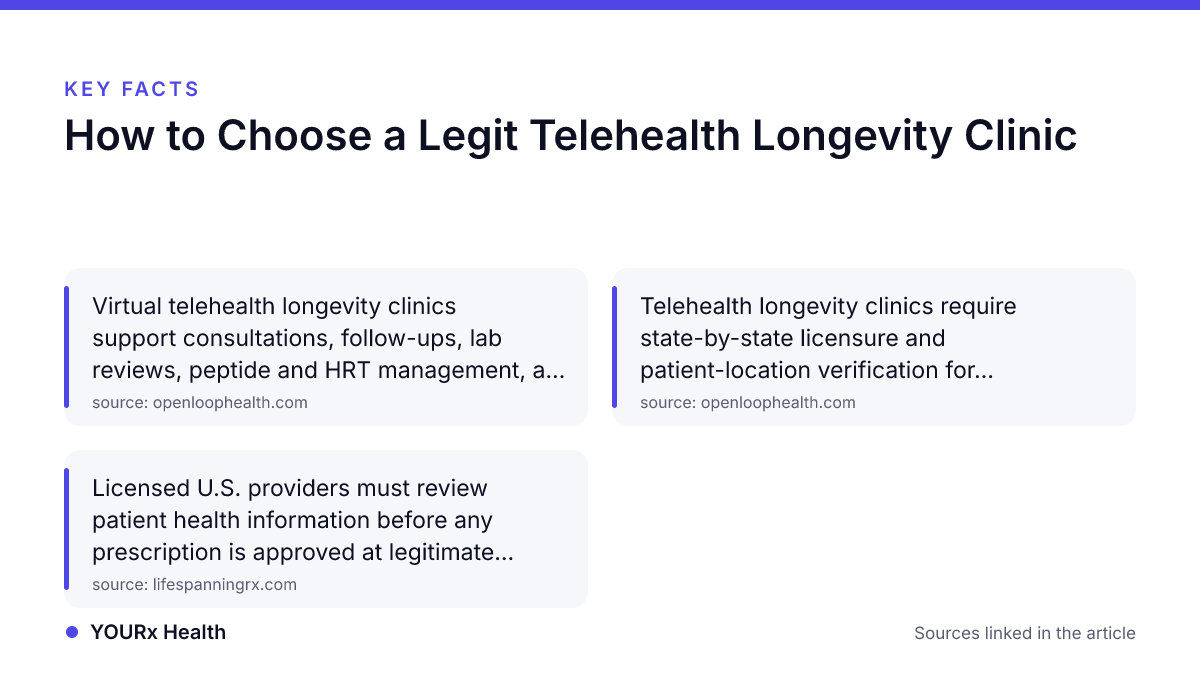
- A licensed U.S. provider must review your health information before any prescription is approved. That review is the legal and clinical difference between a telehealth clinic and an order form with a doctor’s photo on it.
- Multi-state licensure and patient-location verification are requirements, not extras. A clinic treating patients across state lines needs licensure in each state and has to confirm where you physically are, per OpenLoop’s breakdown of telehealth longevity models.
- Plan on paying out of pocket. In our experience most patients on GLP-1, testosterone, or peptide protocols pay cash, because weight-loss medications and peptide therapy are rarely covered.
- Four red flags end the conversation: no live video visit, an unnamed pharmacy, guaranteed results in the marketing, and medication that ships before labs are reviewed.
- Ask one question to separate real practices from funnels: “What happens if my labs come back abnormal?” A clinic that can’t answer specifically doesn’t have a monitoring plan.
A legitimate telehealth longevity clinic does four things. A licensed provider reviews your history and approves every prescription. Your medication is filled by a state-licensed pharmacy you can look up by name. The clinic confirms which state you’re physically in, because that’s what the licensing rules require. And your health data sits behind actual HIPAA safeguards you can read about before you hand any of it over.
Thank you for reading this post, don't forget to subscribe!
Skip the doctor visit, ship before labs, refuse to name the pharmacy, and you’re not looking at a medical practice. You’re looking at a supplement funnel with a better logo.
The market got crowded fast. GLP-1 demand, testosterone optimization, and peptides like BPC-157 turned “longevity medicine” into a keyword with hundreds of copycat sites chasing it. Some are physician-led practices doing careful, monitored work. Others are landing pages with a pharmacy contract bolted on. Telling them apart takes about twenty minutes if you know where to look.

Table of Contents
- How do you vet a telehealth longevity clinic step by step?
- Can you trust telehealth with sensitive health data?
- Are longevity clinics worth the money?
- What should telehealth longevity care actually cost?
- What red flags signal an illegitimate clinic?
- Frequently asked questions
How do you vet a telehealth longevity clinic step by step?
Work through this in order. Skipping steps is how people end up on unmonitored hormone protocols with no idea who to call when something feels wrong.
-
Confirm a human provider reads your intake. Legitimate telehealth clinics require a licensed U.S. provider to review your health information before any prescription is approved, according to Lifespanning Rx’s rundown of top telehealth longevity clinics. Ask it bluntly: does a clinician read my intake, or does software approve it? Hesitation is your answer.
-
Check state licensure and location verification. Clinics operating across state lines need active licensure in every state where they treat patients, and they need to confirm where you physically are during the visit rather than where you signed up from (OpenLoop). If nobody ever asks what state you’re in, that’s a compliance gap dressed up as convenience.
-
Ask which pharmacy fills your script. A real clinic names the pharmacy and confirms it’s licensed where you live. “Our fulfillment partner” is not a pharmacy name. Compounded semaglutide, peptide vials, and testosterone creams all come from somewhere you should be able to look up on your state board’s website.
-
Look for the privacy policy, not the badge. A footer that says “HIPAA compliant” costs nothing to add. A readable Notice of Privacy Practices, an encrypted portal, and a named privacy contact cost effort.
-
Insist on labs before dosing, not after. For testosterone, that means total and free testosterone drawn before 10am, plus a CBC so someone is watching hematocrit. For a GLP-1, expect A1C, a comprehensive metabolic panel, lipids, TSH, and pregnancy screening where relevant. A symptom questionnaire misses low cortisol, thyroid disease, and the occasional pituitary problem that mimics hormone deficiency almost perfectly.
-
Find out who monitors you in month four. Hormone and weight-loss protocols are not set-and-forget. Ask how often check-ins happen, whether follow-up labs are included or billed separately, and who picks up when you have a side effect at 9pm on a Saturday.
-
Get the full cost in writing first. Membership, medication, and lab fees itemized on one screen you can screenshot. If pricing only appears after your card number does, that sequence was a choice.
-
Read reviews that mention a clinician. “Fast shipping” tells you about logistics. Look for reviews describing a dose adjustment, a phone call about a side effect, or a provider who paused treatment. Those describe medicine.
Pro tip: Email support before you book and ask one narrow question: “What labs do you require before starting semaglutide?” A real practice fires back specifics. A marketing operation says “great question, your provider will cover that on the consult.”
What almost nobody checks
Everyone verifies “board-certified physicians” on the homepage. Almost nobody verifies that the physician holds a license in their state, which is the part that actually matters legally. Go one step further and ask what happens when labs come back abnormal. Does the clinic pause the prescription, or does it ship anyway because the order’s already queued and the pharmacy runs on Tuesdays?
In our experience, that single question sorts clinics faster than any credential. A practice with real monitoring will tell you their thresholds without being asked twice: hematocrit above the mid-50s and testosterone gets held, elevated liver enzymes and the peptide plan changes. A funnel will tell you not to worry. YOURx Health publishes its clinical commitments openly on its oath page, and comparing that kind of written commitment across every clinic on your shortlist is a five-minute exercise worth doing.
Can you trust telehealth with sensitive health data?
Yes, when the clinic can show you specifics instead of asserting compliance. HIPAA requires administrative, physical, and technical safeguards around your protected health information, and you’re entitled to a written Notice of Privacy Practices explaining how that information gets used and shared.
Three things to check before you fill out an intake form:
- Where the intake form actually lives. If your symptoms and medication history are being collected on a generic form builder embedded in a marketing site, ask whether there’s a business associate agreement behind it. Plenty of clinics have never thought about this.
- Whether the video platform is covered. A standard consumer video link is not the same as a platform operating under a BAA. Ask which one they use.
- What’s tracking you on the intake page. Advertising pixels firing on pages where you disclose health conditions is a real and documented problem in digital health. You can see them yourself in your browser’s network tab, or just ask the clinic directly.
Telehealth longevity platforms handle consultations, follow-ups, lab reviews, and ongoing peptide or HRT management entirely remotely, which is exactly why the plumbing behind the convenience deserves the same scrutiny as the prescribing (Biohackr Health; OpenLoop). If a clinic can’t produce a privacy policy within a day of you asking, don’t give them your lab results.
Are longevity clinics worth the money?
They’re worth it when you need ongoing medical management that a busy primary care office isn’t built to provide: dose titration, quarterly labs, side-effect troubleshooting, refills that don’t require a new appointment every time. GLP-1 therapy, testosterone optimization, and peptide protocols all fall into that bucket.
They’re not worth it when the membership buys content you could get free, or when the “medical” component is a wellness coach sending encouragement.
Here’s the test we’d apply. Imagine the medication disappeared tomorrow and all you were left paying for was the labs, the check-ins, and the provider access. Would you still write the check? If yes, you’re buying care. If no, you were renting a prescription vending machine at a markup.
A useful tell: ask whether anyone has ever been declined. Practices doing real medicine turn people away, because some patients shouldn’t be on a GLP-1 and some fatigue isn’t testosterone. A clinic that has never said no to anyone isn’t screening. Lab-driven dosing across treatments like testosterone, sermorelin, and metabolic support is where the fee earns itself, not in the box that shows up at your door.
What should telehealth longevity care actually cost?
Expect a monthly membership or consult fee plus medication cost, paid out of pocket. Most plans don’t cover weight-loss GLP-1s, hormone optimization for anti-aging purposes, or peptide therapy at all.
The ranges below reflect what we typically see across the market rather than published survey data. Use them as a sanity check, not a quote.
| Line item | Typical monthly range we see | What it usually covers |
|---|---|---|
| GLP-1 weight loss (semaglutide/tirzepatide) | $150–$450 | Medication, provider oversight, dose titration |
| Testosterone therapy | $100–$300 | Injectable or cream, monitoring labs reviewed |
| Peptide therapy (BPC-157, TB-500) | $150–$350 | Vials, dosing guidance, follow-up visit |
| Membership or consult fee | $0–$150 | Provider access, check-ins, portal messaging |
| Baseline and follow-up labs | $50–$150 per panel | Hormone, metabolic, or thyroid panel |
Run your own number. Total first-year cost = (membership + medication) × 12 + (lab panel cost × number of panels). Say a clinic charges $149/month membership plus $299/month for semaglutide, with a $120 panel every three months:
($149 + $299) × 12 = $5,376
$120 × 4 = $480
Total: $5,856 for year one, or about $488/month averaged out.
That’s the number to compare against any other clinic, and it’s the number a legitimate practice will give you before you enter payment details. A rule of thumb from watching these plans: if the membership fee is more than about a third of your total monthly spend, ask exactly what the membership includes, because you may be paying premium access fees for the same compounded medication.
On insurance: GLP-1s are typically covered only with a Type 2 diabetes diagnosis, not for weight loss alone, so most patients pay cash or use a manufacturer savings card. Testosterone is sometimes covered when labs confirm clinically low levels, though plan rules vary a lot. Peptides like BPC-157 and TB-500 aren’t FDA-approved the way commercial drugs are, so they’re effectively always out of pocket. Worth understanding what peptide injections actually do before you commit to a year of them.
Pro tip: Ask whether the membership fee is refundable if you cancel after the first consult but before medication ships. A clinic confident in its own value says yes immediately.
What red flags signal an illegitimate clinic?
These patterns cluster on sites optimized for “cheapest GLP-1” and “no consult required.”
- No live video visit, ever. A text intake with no clinician interaction isn’t a consult, regardless of what the checkout page calls it.
- Medication arrives before labs are reviewed. If your first dose beats your bloodwork, nobody confirmed the drug was safe for you.
- Guaranteed results in the copy. “Lose 30 pounds guaranteed” is a claim no ethical prescriber makes, because response to any medication varies.
- No named medical director or pharmacy. Real clinics put both somewhere findable, often on an about or FAQ page.
- Countdown timers and checkout upsells. “Only 3 spots left today” is sales psychology borrowed from mattress ads.
- Peptide pricing well below compounding cost. Unusually cheap BPC-157 or TB-500 points to sourcing nobody has verified.
Clear all of that and the patient experience should feel almost boring: a video visit, a lab order, straightforward pricing, labs before dose changes, and a person to message when something’s off. Spend ten minutes on a clinic’s FAQ page and about page, and you’ll usually know whether it was built for long-term monitoring or a single sale.
Frequently asked questions
Do I need to see the same doctor every time?
Not necessarily, but whoever reviews your case needs your full chart: labs, dosing history, side effects, and what’s already been tried. Continuity of record matters more than continuity of face. If a new provider asks you to re-explain your dosing history from memory, the record-keeping is the problem.
Can I switch telehealth clinics if I’m unhappy?
Yes, and it happens more often than people expect, especially with hormone and GLP-1 dosing. Request a copy of your records and your most recent labs before you cancel, because access sometimes disappears with the subscription. Bring your current dose and injection schedule to the new provider so they aren’t restarting your workup from zero.
How do I know if my low energy or libido is hormonal?
Bloodwork is the only reliable answer. Testosterone, thyroid, and cortisol panels rule the common causes in or out, and fatigue plus low libido overlaps across all three. If the symptoms have been building over months rather than weeks, reading through low testosterone symptoms men tend to ignore is a reasonable first step, along with how to increase testosterone through changes that don’t require a prescription.
Take the checklist to the next three clinics you’re comparing, this one included. Ask who reads your intake, which pharmacy fills your script, and what happens when labs come back abnormal. Then judge the answers instead of the homepage. If you want to start with a same-day physician consult, you can book through YOURx Health’s contact page.