TL;DR
- Compounded semaglutide is still legal in the US through licensed compounding pharmacies, but only for patients with a documented clinical reason, not as a mass-market product anyone can order off an ad.
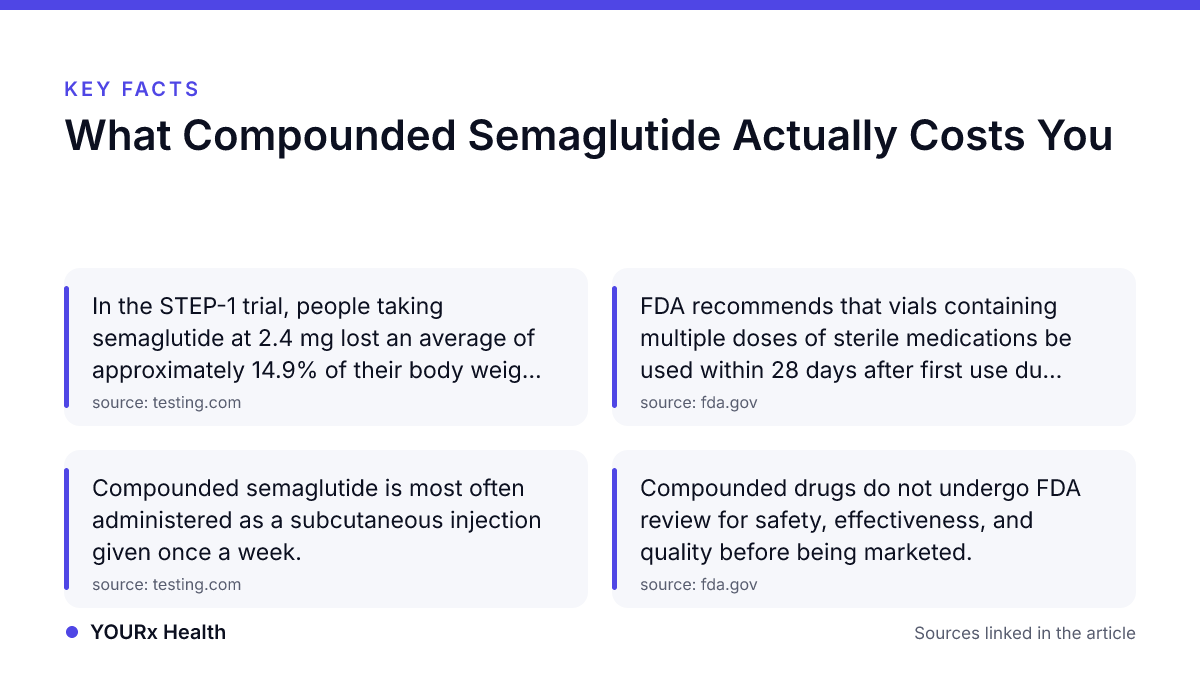
- In the STEP-1 trial, 2.4 mg semaglutide produced an average 14.9% body weight loss at 68 weeks, per Testing.com. For a 200-pound person, that average works out to roughly 30 pounds.
- Compounded drugs never get FDA review for safety, effectiveness, or quality before they’re sold, according to the FDA. Your pharmacy is the quality control.
- The FDA recommends discarding multi-dose sterile vials 28 days after first use. A single vial advertised as a three-month supply cannot be used safely down to the last dose.
- In our practice, legitimate programs that include physician oversight run roughly $150 to $400 a month. Do the 68-week math before you decide anything is a bargain.
Dave is 44, lives outside Dayton, two kids and a desk job and thirty pounds he couldn’t shake no matter how clean he ate. He saw an Instagram ad for semaglutide at $99 a month, no doctor visit required. Filled out the form. Nine days later a vial showed up in his mailbox with a label he couldn’t fully read, no dosing instructions beyond a sticky note, and nobody to call when the nausea started on day three.
Thank you for reading this post, don't forget to subscribe!
That story plays out thousands of times a week right now. It’s why compounded semaglutide has become one of the most searched and most misunderstood terms in weight loss medicine.

Table of Contents
- Can You Still Get Compounded Semaglutide?
- Is the FDA Banning Compounded Semaglutide?
- What Are the Risks and Side Effects of Compounded Semaglutide?
- How Do You Find a Legitimate Compounding Pharmacy or Telehealth Provider?
- What Does Compounded Semaglutide Actually Cost?
- How Is YOURx Health Different From the Ad Dave Clicked?
- Frequently asked questions
Can You Still Get Compounded Semaglutide?
Yes. Compounded semaglutide remains available in the United States through licensed compounding pharmacies, but only when a patient has a documented clinical reason to need a compounded version rather than the FDA-approved product.
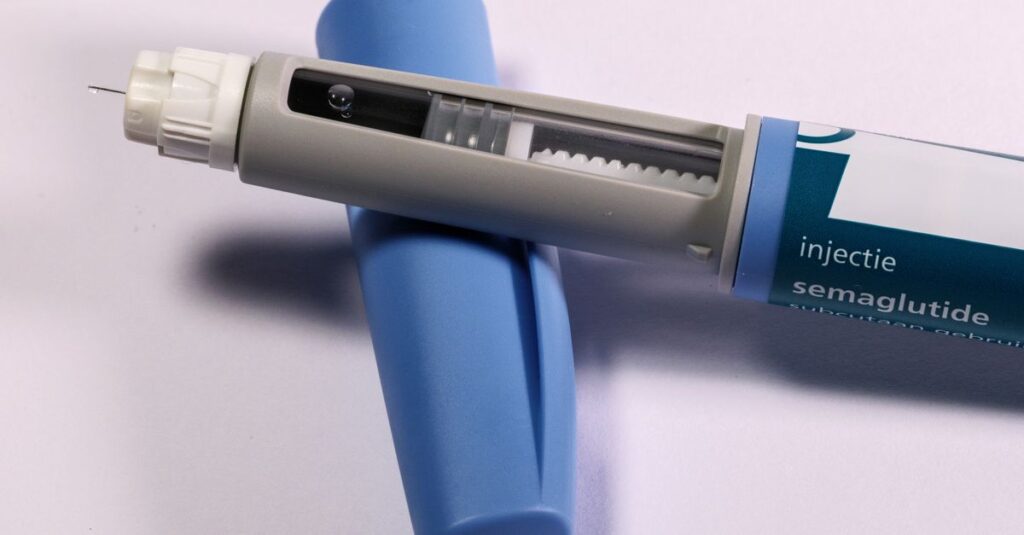
Compounded semaglutide is the same active ingredient found in Ozempic and Wegovy, prepared by a licensed pharmacy instead of manufactured by Novo Nordisk. It’s most often given as a once-weekly subcutaneous injection, the same route as the brand drugs, according to Testing.com. The mechanism doesn’t change between brand and compounded: semaglutide slows stomach emptying so you stay full longer, signals the brain’s satiety center to dial down appetite, and improves how your body handles blood sugar.
Worth knowing: semaglutide came out of diabetes research, not weight loss. It was developed for type 2 diabetes, and it isn’t an insulin replacement, so it plays no role in type 1 diabetes treatment. The appetite effects were a discovered benefit, not the original target.
Compounding itself is old, boring pharmacy work. Pharmacies have prepared custom strengths, dye-free formulas, and combination preparations for decades. What changed in 2023 and 2024 was volume. Once Ozempic and Wegovy became impossible to keep in stock, hundreds of online operations stood up semaglutide programs overnight, and plenty of them have never behaved like actual pharmacies.
Is the FDA Banning Compounded Semaglutide?
No, but it has narrowed the legal window considerably. Federal law only permits a pharmacy to compound a copy of an approved drug when that drug is listed in shortage, or when an individual patient has a documented clinical need the commercial product can’t meet, such as an allergy to an inactive ingredient.
Once semaglutide injection products came off the FDA shortage list, the legal basis for mass-producing compounded versions for general weight loss evaporated in most situations. The FDA has been public about what it’s seeing since: unapproved GLP-1 products using salt forms that were never in the approved drug, products with added ingredients nobody has studied in combination, and products with no verifiable US pharmacy behind them at all. The agency laid this out in its own statement.
Here’s what that shift looks like from inside a clinic. Reputable pharmacies tightened their intake requirements and started asking prescribers to document the specific clinical justification for a compounded preparation. Sloppy operators didn’t change a thing. So the gap between the best and worst providers in this space got much wider over the past 18 months, not narrower, and the price tag tells you almost nothing about which side you’re on.
What Are the Risks and Side Effects of Compounded Semaglutide?
The side effects patients report on compounded semaglutide look like the brand drug’s: nausea, constipation, fatigue, sulfur burps, sore injection sites. The extra risk comes from manufacturing, not from the molecule. Because compounded drugs never undergo FDA review for safety, effectiveness, and quality before they’re marketed, per the FDA, everything rides on the pharmacy that mixed it.
What actually goes wrong:
- Concentration drift between batches. Compounded vials aren’t made on a pharmaceutical production line. If a pharmacy’s process isn’t tight, the milligrams per milliliter can vary from one fill to the next. Underdosing wastes months; overdosing lands people in urgent care with vomiting and dehydration, and these are exactly the kinds of semaglutide dosing mistakes that stall progress.
- Units versus milligrams confusion. This is the single most common patient error we see. The vial is labeled in mg/mL. The insulin syringe is marked in units. Patients who are told “draw 10 units” and later switch to a vial at a different concentration can double or halve their dose without realizing it. Ask your prescriber to write both numbers on your instructions, every time your concentration changes.
- Vials kept open past 28 days. The FDA recommends discarding multi-dose sterile vials within 28 days of first use because contamination risk climbs the longer a vial sits punctured. Weekly dosing means four doses in 28 days. A vial holding 12 weekly doses runs 84 days, putting your final dose 56 days past the FDA’s window.
- Additives nobody has studied together. B12, glycine, and other add-ins get marketed as energy boosters or nausea reducers. None of them appear in the trials that established semaglutide’s safety profile.
- Wrong salt form. The FDA has specifically flagged semaglutide sodium and semaglutide acetate, which are not what’s in the approved drug and have not been shown to work the same way.
- No screening for contraindications. A personal or family history of medullary thyroid carcinoma, MEN2, active gallbladder disease, or prior pancreatitis all change the calculus. An intake form that approves everyone screens for nothing.
Pro tip: if the vial arrives without a lot number, beyond-use date, concentration in mg/mL, and the compounding pharmacy’s name printed on the label, don’t inject it. Also check the shipping box. Semaglutide should show up cold, with an ice pack that still has some firmness to it. A warm package that spent a weekend in a distribution center is a refund conversation, not a “probably fine” situation.
How Do You Find a Legitimate Compounding Pharmacy or Telehealth Provider?
Verify the pharmacy, not the brand on the website. The company charging your card and the facility mixing your medication are frequently two different businesses, and only one of them holds a license.
- Get the pharmacy’s name in writing. A real provider answers this in one sentence. Hesitation is your answer.
- Check the state board of pharmacy. Every US compounding pharmacy is licensed in its home state and usually in every state it ships to. Most boards have a public lookup that takes about two minutes. Ask whether the facility is a 503A pharmacy or a 503B outsourcing facility; 503B sites register with the FDA and are subject to inspection, which is a meaningful difference.
- Ask for the certificate of analysis. Serious pharmacies test their API lots for potency, sterility, and endotoxins, and they’ll send you the CoA if you ask. The ones that can’t produce one usually stop replying.
- Confirm a licensed physician reviews your history before prescribing. Not a chatbot. Not a questionnaire that auto-generates an Rx while you’re still typing.
- Look for follow-up built into the plan. Titration, check-ins, and labs are where GLP-1 therapy either works or quietly fails. A provider who ships once and vanishes is running fulfillment, not a medical practice.
| What to check | Legitimate telehealth + pharmacy | Red-flag operator |
|---|---|---|
| Physician involvement | Board-certified doctor reviews history and labs before prescribing | Auto-approval questionnaire, no doctor contact |
| Pharmacy transparency | Named US-licensed pharmacy, verifiable on the state board site | Pharmacy name withheld or “our partner lab” |
| Vial labeling | Lot number, beyond-use date, mg/mL concentration printed | Blank, handwritten, or research-use-only label |
| Ongoing care | Scheduled check-ins, dose titration, lab monitoring | One-time purchase, no follow-up |
| Quality documentation | Certificate of analysis available on request | No testing records, no response |
| Pricing | Roughly $150–$400/month, consistent with real compounding costs | Far below market with no explanation |
That’s why our physicians at YOURx Health build every weight loss protocol around a consult first. You talk to a doctor, not a form, before anything ships. The full process is laid out on our treatments page.
What Does Compounded Semaglutide Actually Cost?
In our experience, legitimate compounded semaglutide programs run about $150 to $400 a month once physician visits and monitoring are included. Brand-name Ozempic and Wegovy without insurance typically run several times that. Current street pricing moves constantly, so check a tracker like GoodRx against whatever a provider quotes you.
The number that matters isn’t monthly. It’s the full course.
Here’s the math, using an illustrative scenario you can re-run with your own quotes. The formula: monthly price × treatment months = total cost. STEP-1 followed patients for 68 weeks, which is 68 ÷ 4.33 = 15.7 months. That’s a reasonable planning horizon.
Compounded plan at $250/month:
$250 × 15.7 = $3,925
Brand-name at an assumed $1,300/month cash price:
$1,300 × 15.7 = $20,410
Difference: $20,410 − $3,925 = $16,485 over the same stretch.
Swap in your real numbers. If your insurance covers Wegovy with a $75 copay, the brand side becomes $1,178 for 15.7 months and compounding loses on price outright. That happens more often than people expect, and it’s the first thing worth checking before you shop compounded at all.
Pro tip: here’s the threshold we use. If the monthly price can’t plausibly cover a physician’s time, sterile compounding, cold-chain shipping, and at least one lab panel, something is being skipped. At $99 a month, the thing being skipped is usually the doctor.
How Is YOURx Health Different From the Ad Dave Clicked?
Every YOURx Health patient speaks with a board-certified physician by video before anything is prescribed, and stays with that same team for monitoring, labs, and dose adjustments. Our founder, Vincent Broussard, built the practice after years managing AMN (adrenomyeloneuropathy), a rare genetic condition that taught him exactly how much outcomes depend on someone reading your labs over time instead of filling an order. That story is on our about page.
For a patient like Dave, the difference shows up in the first visit. A real intake catches his history. A physician asks whether GLP-1 therapy is even the right first move, or whether low testosterone is driving the fatigue and stalled body composition, since low energy, reduced muscle mass, and low libido cluster with metabolic slowdown in men in their forties more often than most guys realize. If semaglutide is right, he gets a written titration schedule with both the mg and the syringe units on it, medication from a named pharmacy, and a scheduled check-in to adjust based on how he actually tolerates it. Dosing specifics live on our Ozempic and Zepbound protocol pages, and the rest of what we offer, including peptide therapies like BPC-157, is on our health hub.
Apply the same standard to anyone, including us. Real physician, named pharmacy, ongoing monitoring. If you’re comparing several telehealth companies, ask each one the same five questions from the checklist above and put the answers side by side. How we handle consults, shipping, and refills is spelled out on our FAQ page.
Frequently asked questions
Does compounded semaglutide with added B12 or glycine work better?
There’s no trial evidence that it does. Those combinations are marketed for nausea control or energy, but they weren’t part of the research that established semaglutide’s safety and effectiveness. Ask what evidence specifically supports the add-in. “Our patients like it” is a testimonial, not data.
Is there a compounded semaglutide pill instead of an injection?
Compounded semaglutide is almost always a once-weekly subcutaneous injection, matching how the clinical research was conducted, according to Testing.com, which is why so many patients ask whether semaglutide pills actually work for weight loss before choosing an injection instead. An FDA-approved oral semaglutide exists for diabetes (Rybelsus), but compounded oral versions aren’t standard. Absorption of oral semaglutide is notoriously finicky, so anyone selling a compounded pill owes you a serious answer on dosing accuracy.
Should I trust what I read about compounded semaglutide on Reddit?
Forums are genuinely useful for injection technique and what side effects feel like week to week. They’re useless for deciding your dose. Bring what you read to your physician as a question, not as a protocol.
Before you book anything, ask the provider one question: what’s the name of the pharmacy that fills my prescription? If you want that answer plus a same-day consult with a board-certified physician and a plan built on your actual labs, start on our contact page.