
TL;DR
- In-house telehealth means the practice employs its own licensed physicians. Outsourced telehealth means contracting a staffing agency or provider network that rotates clinicians in per visit or per month.
- Telehealth costs less per visit than in-person care in most cases, but how much less depends on whether the clinic carries physician salaries or pays a third party by the encounter.
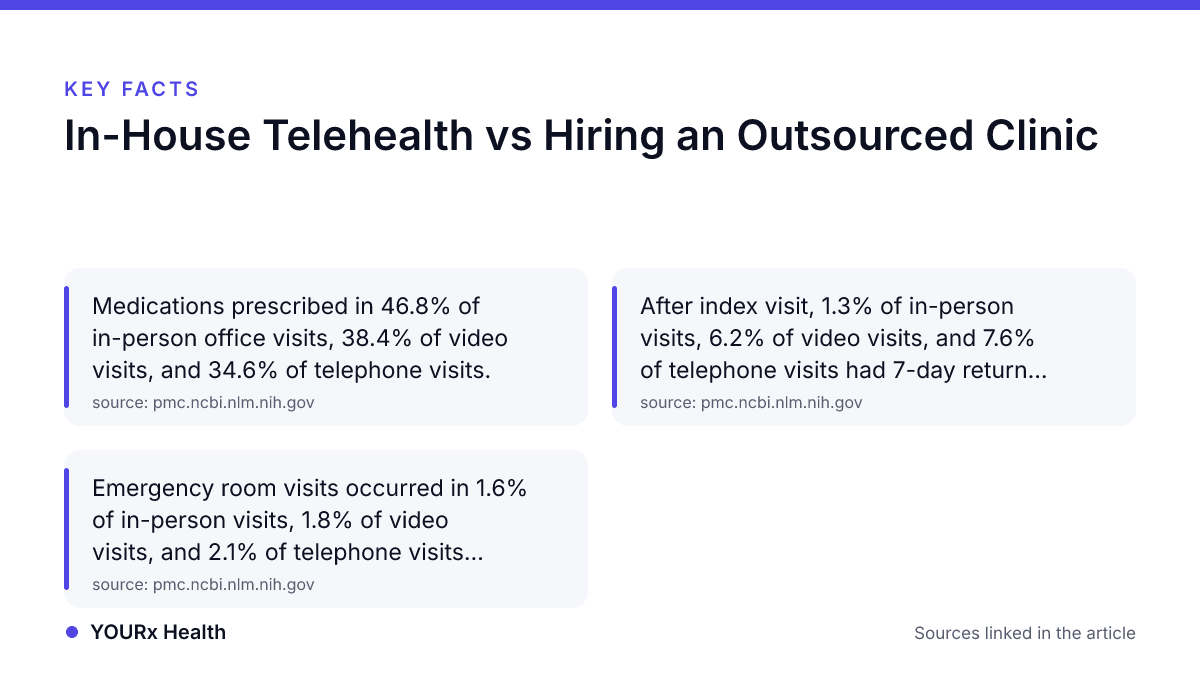
- Video visits end in a prescription 38.4% of the time versus 46.8% in person, and 6.2% of video visits need an in-person follow-up within 7 days compared to 1.3% of in-person visits, according to a peer-reviewed comparison of primary care visit types.
- Using round illustrative figures, a $220,000 physician breaks even against a $70-per-visit network at roughly 3,143 visits a year, about 12 to 13 visits per business day.
- The 7-day window researchers measure says nothing about month three or month twelve, which is the window that matters for testosterone, GLP-1 dosing, and peptide protocols.
An in-house telehealth clinic hires and pays its own board-certified physicians. An outsourced one rents clinical capacity from a staffing agency or provider network, billed per encounter, which lowers fixed cost and breaks the link between a patient and one doctor. Volume and complexity decide the winner. High-volume, low-complexity care leans outsourced. Lab-monitored protocols that get adjusted over months lean in-house.
Thank you for reading this post, don't forget to subscribe!

We built YOURx Health as an in-house, physician-led practice on purpose. Our founder, Vincent Broussard, lives with AMN (Adrenomyeloneuropathy). He knows what it’s like to get bounced between clinicians who’ve never opened your chart before. That shaped how we think about this tradeoff, including the parts where outsourcing genuinely wins.
Table of Contents
- What’s the real difference between in-house and hired telehealth staffing?
- Is telehealth cheaper than in-person visits?
- Is it better to do telehealth or in-person care?
- What does it actually cost to run in-house versus outsourced telehealth staffing?
- What technology and compliance does each model require?
- Does the staffing model affect long-term outcomes, not just the first week?
- Which model should you choose, in-house or outsourced?
- Frequently asked questions
What’s the real difference between in-house and hired telehealth staffing?
It comes down to who employs the clinician and who owns the patient relationship. In an in-house model, the practice recruits, credentials, licenses, and pays its own physicians, and those same doctors handle visit after visit. In an outsourced model, the practice contracts a staffing agency or network whose clinician pool is shared across multiple client companies. A patient may log on to a different provider each time.
That’s not a back-office detail. Staffing agencies and in-house hiring solve different problems: agencies solve for speed and flexible headcount, in-house hiring solves for control and clinical accountability. Provider networks versus hiring your own clinicians is the same tradeoff from the other direction. A network buys you coverage in weeks. Your own clinicians buy you a doctor who remembers the last three lab panels.
- In-house physicians are direct employees, follow the practice’s own protocols, and adjust dosing off a patient’s own lab trend.
- Outsourced clinicians are contracted per visit or per month, often work several platforms at once, and tend to follow a standardized decision tree rather than a history they personally built.
- Hybrid setups keep a core in-house medical team on ongoing protocols and route overnight or surge demand to a network pool.
Pro tip: if you’re a patient trying to figure out which model you signed up for, ask one question on your consult: “Will I see you again at my follow-up?” A vague answer means you’re in a rotating queue, and if you want a checklist for vetting that before you book, our guide on how to choose a legit telehealth longevity clinic covers exactly what to ask.
Is telehealth cheaper than in-person visits?
Usually, yes. In-person visits carry exam rooms, front-desk staff, and lease payments, and those fixed costs get spread across every encounter no matter how simple the case. Telehealth deletes most of them.
The savings aren’t automatic, though. An outsourced network can undercut in-house staffing at low volume because nobody’s paying a salary between patients. Push volume up and the math inverts, since a fixed salary gets cheaper per visit the more visits it covers. The next section runs those numbers.
Then there’s the cost nobody puts in a per-visit price comparison: rework. The same NIH-hosted study found 6.2% of video visits and 7.6% of phone visits triggered an in-person primary care visit within 7 days, against 1.3% for visits that started in person. Each of those is a second encounter somebody pays for.
A few line items that surprise practice owners when they actually build the model, based on what we’ve seen running our own:
- Malpractice premiums scale by state and by scope. Adding two states to a physician’s coverage isn’t free, and a clinician prescribing controlled substances is underwritten differently from one who isn’t.
- EHR and e-prescribing are billed per provider seat. Rotating networks often shift that cost to you anyway, so “pay per visit” rarely means pay only per visit.
- Credentialing takes weeks, not days. In our experience, licensing a physician into a new state is a multi-week process even with a clean file, and that lead time is the real reason practices reach for a network first.
- Rework is a staffing cost, not a clinical footnote. If a cheap asynchronous visit ends in a repeat appointment, you paid twice for one problem.
Is it better to do telehealth or in-person care?
Depends what the visit is for. Medication management, hormone protocol check-ins, and reviewing labs already in hand all work well by video and save the patient an afternoon. Acute, undiagnosed, or physically complex complaints still favor an exam room, because a physician can palpate an abdomen or look in an ear instead of asking you to describe it.
The data splits along the same line:
| Outcome (within 7 days of visit) | In-person | Video visit | Phone visit |
|---|---|---|---|
| Medication prescribed at visit | 46.8% | 38.4% | 34.6% |
| Return in-person visit needed | 1.3% | 6.2% | 7.6% |
| ER visit | 1.6% | 1.8% | 2.1% |
Source: Telemedicine vs In-Person Primary Care, NIH/PMC
Read the middle column against the right one. The gap between video and phone matters nearly as much as the gap between telehealth and in-person. Video tracks closer to in-person on every row. That’s the case for choosing a practice that runs real video consults with a physician instead of a text intake form and a callback, which is how our model works.
Pro tip: if a service prescribes without ever putting you on camera, ask why. Sixty seconds of video catches jaundice, a flat affect, slurred speech, tremor, swelling. A questionnaire catches none of it.
What does it actually cost to run in-house versus outsourced telehealth staffing?
Almost nobody publishes real numbers here, so here’s an illustrative scenario with round figures you can swap for your own.
The formula: break-even visit volume = annual physician cost ÷ per-visit outsourced fee.
The scenario: an in-house board-certified physician costs an illustrative $220,000 a year in salary and benefits. An outsourced network charges an illustrative $70 per completed visit with no salary owed between patients.
$220,000 ÷ $70 = 3,142.9 visits per year. That’s roughly 262 visits a month, or about 12 to 13 visits per business day across 21 working days.
- Below that volume: outsourcing wins on cost, because you’re not funding idle salary.
- Above it: the in-house physician is cheaper per visit and continuity comes free. Same doctor, same testosterone panel, same A1C trend, visit after visit.
Twelve to thirteen visits a day is the number to sit with. That’s not a busy day for a physician, which is why the break-even arrives faster than most founders expect once marketing starts working.
Practices running complex ongoing protocols tend to go in-house well before they hit break-even anyway. A missed lab flag or a duplicated dose escalation costs more than the salary gap. Someone on a GLP-1 who’s also getting metformin support for metabolic issues needs a doctor who remembers what got changed last month, not a new provider skimming the chart in the first two minutes of the call.
What technology and compliance does each model require?
Both models answer to the same floor: HIPAA-compliant systems, encrypted video and messaging, secure storage for labs and prescriptions, and a valid medical license in the state where the patient is physically sitting. The difference is who owns that machinery.
- In-house: the practice owns the EHR, the HIPAA program, the business associate agreements, and the licensing pipeline. Every physician needs a license in every state they see patients in, plus separate DEA registration in each of those states to prescribe anything scheduled. Testosterone is Schedule III, so a hormone practice feels this immediately. It’s genuine administrative weight, and it also means you can see every link in the compliance chain yourself.
- Outsourced: the agency or network owns credentialing and licensing across its pool, which stands up fast. You inherit their interpretation of the rules, and you’ll find out how strict it was only if something goes wrong.
- Hybrid: you own core compliance and lease licensed capacity for overflow, which means the data-sharing agreement between the two systems has to be airtight before the first shared patient, not after.
Two practitioner details worth knowing. First, the Interstate Medical Licensure Compact speeds up multi-state licensure for eligible physicians, but not every state participates, so national coverage is never as simple as one application. Second, federal rules on prescribing controlled substances via telemedicine have been repeatedly extended and revised since 2020. Any telehealth operation touching scheduled medications should have a named person tracking that, and if you ask a provider who that is and get silence, that tells you something.
Pro tip: as a patient, one quiet tell of a real in-house practice is a same-day consult with a named physician rather than “next available provider.” Offering both speed and continuity means the practice staffed for demand instead of renting it. That’s harder to fake than a slick booking page.
Does the staffing model affect long-term outcomes, not just the first week?
Yes, and this is where the research stops being useful. Those 7-day return-visit and ER numbers are real, but a week tells you nothing about whether the patient was still on protocol in June or quit after one refill. For chronic and lifestyle-driven care, month six is the only interesting data point.
Continuity compounds:
- Dosing gets more precise when one physician has watched every prior draw and titrates off a trend instead of a single snapshot.
- Adherence holds better when a patient isn’t retelling their whole history to a stranger every appointment.
- Patterns get caught earlier. Fatigue plus low libido plus an odd cortisol reading looks like three unrelated complaints in three fifteen-minute visits with three different providers. It looks like a working hypothesis to the doctor seeing all three in one chart she’s been keeping for eight months. A growth-hormone-secreting pituitary tumor is the extreme version of that problem: easy to miss once, much harder to miss across repeat visits with one clinician.
- Refills stay boring. Same care team, same file, no re-verification cycle every time the prescription runs out.
That’s the whole argument for in-house on anything past episodic care. Networks are engineered for throughput, not relationships. A one-off antibiotic doesn’t need a relationship. Testosterone optimization, weight management, and peptide therapy that gets adjusted for a year do, and there the staffing model behind your care matters as much as the molecule.
Which model should you choose, in-house or outsourced?
No universal answer. It turns on complexity, volume, and how much continuity your patients actually need.
| Factor | In-house employed physicians | Outsourced staffing / provider network |
|---|---|---|
| Upfront cost | Higher: salary, benefits, per-state licensing and DEA | Lower: pay per visit or monthly subscription |
| Continuity of care | Same physician across every follow-up | Rotating clinicians, continuity depends on luck |
| Speed to scale | Weeks to license and credential each new state | Days to add coverage from an existing pool |
| Compliance control | Practice owns EHR, BAAs, and licensing directly | Network manages it; you inherit their standards |
| Best fit | Lab-monitored protocols: hormones, GLP-1, peptides | High-volume, episodic, low-complexity visits |
| Break-even (illustrative) | Cheaper above roughly 3,143 visits/year per physician | Cheaper below that volume |
Our take: if you’re a patient rather than a clinic owner, pick the practice that keeps you with one physician, especially for anything involving ongoing dosing or labs. If the question is video versus an exam room, video is fine for medication management and follow-ups, and in-person still wins for anything acute or undiagnosed. Our treatments, from weight loss protocols using Ozempic to peptides like BPC-157, run through the same in-house physician from first consult through every refill.
Want to see the process before committing? Our FAQs walk through it step by step, our oath states what we commit to as physicians, and our about page explains why we built it this way.
Frequently asked questions
Can a small or solo telehealth practice realistically go in-house?
Yes, though it usually pencils out only as volume approaches the break-even point above. Below it, per-visit outsourced staffing is the smarter short-term buy. Plenty of practices run hybrid for a year or two: a small in-house team on core ongoing patients, network coverage for after-hours and overflow.
Do patients actually notice the difference between in-house and outsourced telehealth?
They notice on visit two or three. Either the same physician picks up where you left off, or someone new opens your chart for the first time while you’re on camera. The first appointment feels identical. Refills, dose changes, and “quick question” follow-ups are where the models separate.
Does an in-house model mean slower access to a first appointment?
Not if the practice staffed for demand. A well-resourced in-house team can offer same-day consults. The real tradeoff isn’t speed versus continuity, it’s whether the practice bought enough physician capacity to deliver both, which is what we’ve built at YOURx Health.
Run the break-even math on your own numbers before you sign a staffing contract. And if you’re the patient in this equation, book a same-day consult with a board-certified physician who’ll still be your physician at the next check-in.