TL;DR
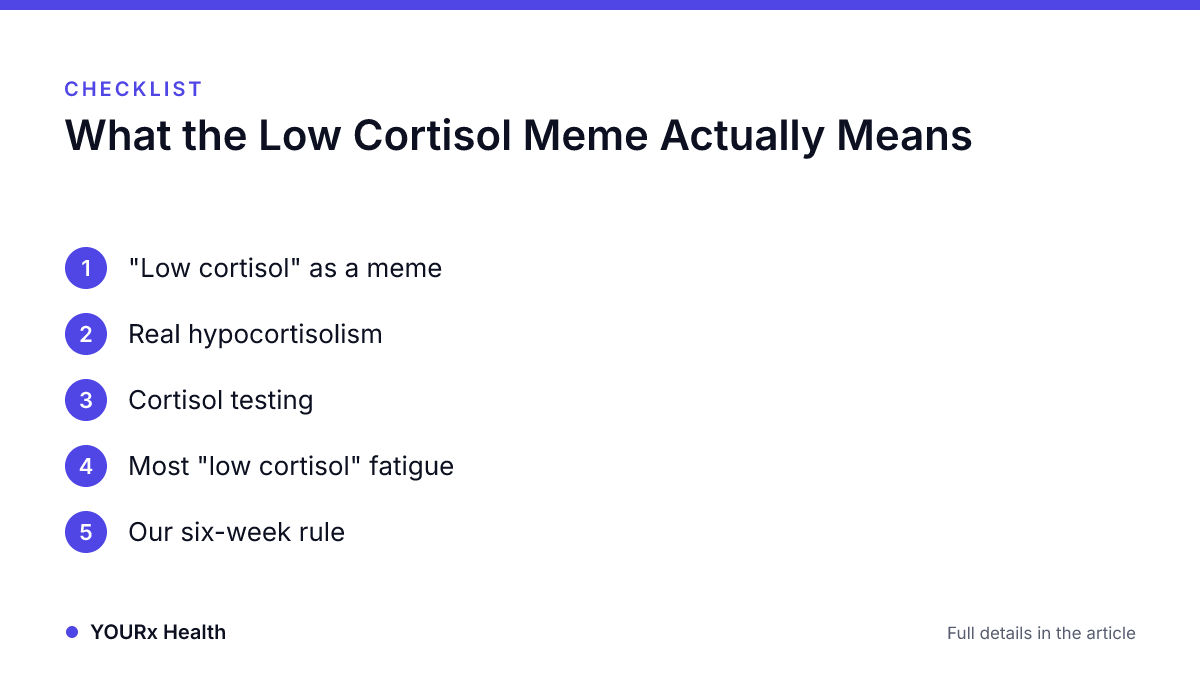
- “Low cortisol” as a meme is internet slang for someone who seems chill, flat, or unbothered under pressure. It has nothing to do with an actual hormone test.
- Real hypocortisolism (clinically low cortisol) ties back to adrenal insufficiency or Addison’s disease, and it shows up as deep fatigue, dizziness on standing, low blood pressure, and salt cravings.
- Cortisol testing starts with a morning blood draw. A genuinely low result usually gets followed up with an ACTH stimulation test, not a vibe check.
- Most “low cortisol” fatigue we see turns out to be sleep debt, chronic stress, or a separate hormone issue like low testosterone.
- Our six-week rule: if fatigue, low libido, or stubborn weight gain has outlasted six weeks of decent sleep and food, stop guessing and get bloodwork.
Derek is 42, runs a marketing team, and hasn’t slept past 5:45 a.m. since his second kid was born. One night he was scrolling TikTok in bed instead of sleeping, which he recognized as its own kind of problem, and landed on a video captioned “low cortisol girl doesn’t flinch when the group chat implodes.” Then another. Then a whole genre of “low cortisol baddie” clips: people responding to chaos with dead-eyed calm, slow blinks, zero urgency.
Thank you for reading this post, don't forget to subscribe!
He laughed. He sent it to his brother. Then he thought: wait, am I the opposite of this? Why do I feel wired and exhausted at the same time?
That’s the moment a meme turns into a real question. Worth untangling, because the internet version of “low cortisol” and the medical one are almost nothing alike.

Table of Contents
- What does it mean when you have a low cortisol meme?
- What does low cortisol level mean in slang?
- What is low cortisol in TikTok, and why did it go viral?
- What are the real symptoms of low cortisol (hypocortisolism)?
- Could it be low testosterone instead of low cortisol?
- How do you actually find out what’s going on?
- What’s the right next step if you suspect a real hormone problem?
- Frequently asked questions
What does it mean when you have a low cortisol meme?
A “low cortisol meme” is internet slang, not a medical term. On TikTok and Instagram, people use “low cortisol” to describe someone, often themselves, who reacts to stress or deadlines or outright chaos with no visible panic. Slow movements. Flat tone. An almost sedated calm.
The joke borrows the name of a real stress hormone. Your adrenal glands release cortisol when you’re under pressure. But the meme has nothing to do with a lab value. Someone actually diagnosed with low cortisol, which doctors call adrenal insufficiency or hypocortisolism, is usually wiped out, lightheaded standing up, and craving salty food. Roughly the opposite of the breezy persona the meme celebrates.
So the meme flipped the science. Clinically, low cortisol doesn’t make you calm. It makes you depleted. The TikTok version is actually describing someone with appropriately regulated cortisol, a person whose stress response isn’t spiking and crashing all day. And in our experience, the people posting “low cortisol” content about themselves tend to be the most stressed people in the thread, performing calm for the algorithm.
What does low cortisol level mean in slang?
In slang, “low cortisol” means unbothered, chill, emotionally detached. The person who doesn’t stress-eat, doesn’t snap at coworkers, doesn’t spiral the night before a deadline. It gets used as a compliment (“she’s so low cortisol, nothing rattles her”) and as self-deprecation (“I’m high cortisol pretending to be low cortisol”). Nearby you’ll find “cortisol face” for puffy, stressed-looking skin, “cortisol belly” for midsection weight, and “cortisol detox” routines selling supplements and cold plunges as the fix.
None of these are diagnoses. They’re shorthand for a feeling: wired, puffy, tired, stuck. People pin it on cortisol because cortisol is the hormone they’ve heard of. The real picture is usually messier, and it usually involves sleep debt, blood sugar swings, low-grade chronic stress, or a hormone imbalance that has nothing to do with the adrenals.
Pro tip: if you catch yourself explaining your own fatigue with a TikTok term, treat that as the cue to get labs. The slang isn’t wrong that something’s off. It’s just rarely naming the right culprit.
What is low cortisol in TikTok, and why did it go viral?
On TikTok, “low cortisol” became a personality trope. It’s a way to signal effortless calm and emotional detachment in a culture that’s anxious and permanently online. It caught because it gave people a hormone-flavored label for something they already envied: the coworker who doesn’t panic, the friend who shrugs at bad news. Wellness content had already made “cortisol” a household word on the high side, where it gets blamed for burnout, bloating, and bad sleep. Flipping it into an aspirational low-cortisol identity was the obvious next move.
It also stuck because it’s funny. Watching someone respond to a kitchen fire with total deadpan stillness is a good bit.
The trouble is that it borrows credibility from a real physiological concept, which muddies things for anyone genuinely dealing with fatigue, low libido, or weight they can’t shift. Our guide on low cortisol symptoms and what actually helps covers what real cortisol dysregulation looks like, separate from the meme entirely.
What are the real symptoms of low cortisol (hypocortisolism)?
Genuine low cortisol is a medical condition, and it looks nothing like the unbothered TikTok persona. Cortisol helps regulate blood pressure, blood sugar, inflammation, and your response to physical stress. When your adrenal glands don’t make enough of it, with Addison’s disease as the best-known form, the pattern tends to include:
- Persistent fatigue that doesn’t lift with sleep, a vacation, or a lighter week.
- Dizziness or lightheadedness on standing up quickly, driven by low blood pressure.
- Salt cravings, sometimes strong enough that people notice themselves eating salt straight.
- Unexplained weight loss and low appetite, which is the inverse of the usual “stress weight” complaint.
- Darkening skin in creases, knuckles, and old scars in autoimmune forms.
- Low blood sugar episodes with shakiness, sweating, or confusion.
That last cluster matters. If you’re gaining weight and eating constantly, you’re describing something other than hypocortisolism.
Diagnosis starts with a morning cortisol blood draw, typically between 7 and 9 a.m. when cortisol is naturally at its daily peak. If that number comes back low, the standard follow-up is an ACTH stimulation test, which checks whether your adrenal glands respond when they’re prompted to produce cortisol. Nobody confirms this from a trending sound.
Pro tip: if dizziness on standing and salt cravings are your two loudest symptoms, say both out loud to your physician in the same sentence. Together they’re far more suggestive of actual adrenal involvement than either one alone, and they’re the pair that tends to move a doctor from “let’s talk about your sleep” to “let’s draw labs.”
Could it be low testosterone instead of low cortisol?
For most people describing “low cortisol” fatigue, the likelier answer is low testosterone. We see it constantly in men in their 30s to 50s and in women moving through perimenopause, and it deserves ruling out before anyone goes chasing the adrenals.
| Factor | Meme “low cortisol” | Real hypocortisolism | Low testosterone |
|---|---|---|---|
| Energy | Calm, unbothered, relaxed | Deep fatigue, weak, drained | Flat energy, slow recovery |
| Mood | Chill, detached | Irritable and anxious under stress | Low motivation, brain fog |
| Libido | Not part of the joke | Reduced | Noticeably reduced |
| Body changes | Not addressed | Weight loss, salt craving | Muscle loss, midsection fat gain |
| Appetite | Not addressed | Low, with weight falling off | Normal or increased |
| How it’s confirmed | It isn’t, it’s a joke | Morning cortisol, then ACTH stim test | Morning total and free testosterone |
Derek’s case is a clean example. No dizziness. No salt cravings. No weight loss. He’d gained about 18 pounds over three years without changing how he ate, while his gym sessions got weaker and his libido quietly dropped off.
Run the arithmetic on that, because the rate tells you more than the total: pounds gained ÷ months elapsed = monthly drift. For Derek, 18 ÷ 36 = 0.5 pounds per month. That’s slow. It’s the kind of gain you don’t notice until a pair of pants stops closing. Illustrative numbers, but the shape is typical of what we see.
Here’s the rule of thumb we use. A slow drift under roughly a pound a month, paired with lower drive and worse recovery, reads hormonal far more often than dietary, because no one accidentally out-eats their diet by exactly 60 calories a day for three straight years. Fast gain points toward diet, medication, or thyroid. Weight loss with fatigue is the one that pulls the conversation toward adrenal territory. Derek’s bloodwork came back with total testosterone in the low-normal range, which explained the whole picture.
Men with low testosterone typically report reduced libido, more difficulty holding muscle, fat settling around the middle, worse recovery between workouts, and mental fog they usually blame on stress or getting older. Women get missed far more often, since most standard panels stop at estrogen and thyroid. Our piece on low testosterone symptoms doctors miss in women covers what actually shows up and why it slips past.
How do you actually find out what’s going on?
With bloodwork. And it moves faster than most people expect. A same-day telehealth consult can put a physician on your symptoms and a lab order in your hands the same week, instead of sitting on a primary care waitlist. At YOURx Health, you fill out a health profile, meet a board-certified physician by video, get labs drawn locally, and get an answer about whether this is testosterone, metabolic slowdown, or something else.
Our six-week rule: if fatigue, low libido, or weight gain has lasted longer than six weeks despite reasonable sleep and food, get labs. Six weeks is long enough to outlast a bad month, a virus, a brutal work sprint, or a stretch of broken sleep. Anything shorter and you’re usually just measuring a rough patch.
What the path typically looks like:
- Health intake first. Detailed questions about energy, sleep, libido, weight history, and stress. This is what shapes the lab order, so vague answers get vague panels.
- Video visit with a physician. No waiting room, often same-day.
- Targeted labs, usually testosterone and metabolic markers, plus cortisol if your symptom pattern actually points that way.
- A real protocol, whether that’s testosterone optimization, a GLP-1 weight loss plan, or a peptide approach when recovery and cellular energy are the sticking point.
- Ongoing check-ins and refills, so you’re not re-explaining your history every three months.
Pro tip: before your visit, write down when the symptoms started and what else changed around that time. New job, new medication, a diet, a baby, a schedule shift. That timeline is the single most useful thing you can hand a physician, and it beats a cortisol meme screenshot by a mile.
Not sure a telehealth clinic is worth handing your health history to? Our guide on how to choose a legit telehealth longevity clinic covers what to check before you sign up.
What’s the right next step if you suspect a real hormone problem?
Bloodwork and a physician conversation. Not another night of self-diagnosing off a trending sound.
Meme culture is good at naming a feeling and useless at explaining it. “Low cortisol” tells you nothing about whether your actual issue is testosterone, thyroid, blood sugar, or genuine adrenal insufficiency. Different conditions, different treatments, and chasing the wrong one costs you months.
If you feel like the opposite of a low cortisol TikTok, wired and tired and foggy and losing ground on energy, that’s a real signal. Book a same-day consult and get labs instead of a label.
Frequently asked questions
Can stress actually cause low cortisol over time?
Chronic stress tends to produce elevated or irregular cortisol patterns rather than true deficiency. The idea that stress alone wears the adrenals down into deficiency isn’t how mainstream endocrinology sees it, and in practice most fatigue blamed on “cortisol burnout” traces back to poor sleep, blood sugar swings, or low testosterone.
Is “adrenal fatigue” the same thing as low cortisol?
No. “Adrenal fatigue” is a wellness term, not a recognized diagnosis. Hypocortisolism and adrenal insufficiency are lab-confirmed conditions with clear diagnostic criteria. If someone tells you that you have adrenal fatigue without ordering a morning cortisol test or an ACTH stimulation test, get a second opinion.
Can low testosterone and low cortisol happen at the same time?
Yes, though it’s uncommon, and when it happens it usually points to a broader pituitary or adrenal problem rather than two unrelated issues. Both running low on the same panel deserves a more thorough workup, which is exactly the pattern a physician-led visit should catch instead of treating one number and ignoring the other.