TL;DR
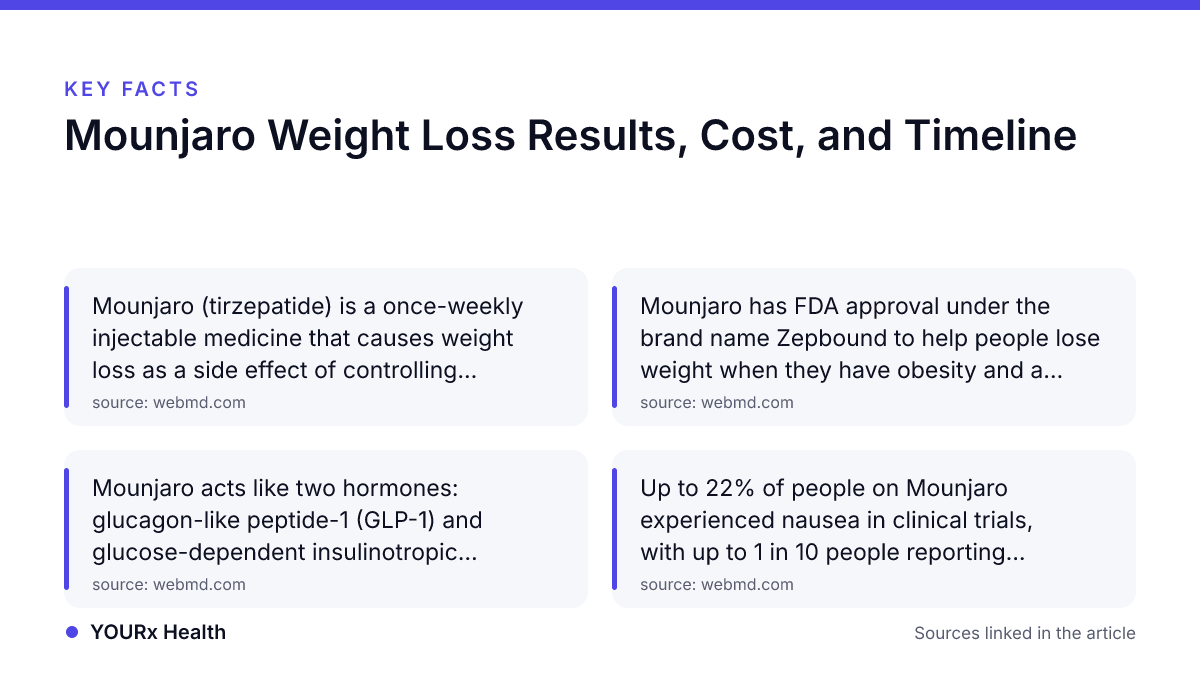
- Mounjaro (tirzepatide) is a once-weekly injectable built to control blood sugar in type 2 diabetes, and weight loss shows up as a side effect of that mechanism, per WebMD.
- The same molecule is FDA-approved for weight loss under the brand name Zepbound, for adults with obesity plus a weight-related condition like high blood pressure or high cholesterol (WebMD).
- Mounjaro acts on two hormone pathways, GLP-1 and GIP, while Ozempic and Wegovy only target GLP-1 (WebMD).
- GI side effects are the main reason people quit: up to 22% of trial participants had nausea, up to 1 in 10 vomited, and 12% to 17% had diarrhea (WebMD).
- Weight regain after stopping is common across this drug class, so budget for a maintenance phase, not a 12-week sprint.
Most people searching “Mounjaro weight loss” already believe it works. What they actually want to know is how much comes off, what it costs, and what happens the week they stop injecting.
Thank you for reading this post, don't forget to subscribe!
Here’s the straight version. Mounjaro is a dual-hormone medication approved for type 2 diabetes that produces weight loss as a side effect of blood sugar control. The same compound carries FDA approval for obesity treatment under the brand name Zepbound, specifically for adults with obesity and a related condition like hypertension or high cholesterol, according to WebMD. It mimics two gut hormones instead of one, GLP-1 and GIP, which is why it gets talked about as the heavier hitter in this category.

Table of Contents
- What’s actually documented about Mounjaro?
- How much weight can you expect to lose on Mounjaro?
- How much Mounjaro do you take to lose weight?
- Am I a good candidate for Mounjaro?
- What does Mounjaro cost, and does insurance cover it?
- What happens to your weight after you stop taking Mounjaro?
- What side effects come with Mounjaro weight loss?
- Your next step
- Frequently asked questions
What’s actually documented about Mounjaro?
Five things are established. Everything else you read online is interpretation, marketing, or someone’s anecdote.
| Documented fact | What it means for you | Source |
|---|---|---|
| Causes weight loss as a side effect of controlling blood sugar in type 2 diabetes | The appetite effect is downstream of metabolic control, not a cosmetic drug bolted onto a diet plan | WebMD |
| FDA-approved for weight loss as Zepbound, for obesity plus a weight-related condition | Your diagnosis, not your goal weight, determines which label you’re prescribed under | WebMD |
| Acts on GLP-1 and GIP; Ozempic and Wegovy act on GLP-1 only | Switching from a semaglutide product is a change in mechanism, so expect to re-titrate | WebMD |
| Up to 22% of trial participants had nausea; up to 1 in 10 vomited | Roughly one in five people should plan for a rough first week after a dose step | WebMD |
| 12% to 17% had diarrhea in clinical trials | Common enough that it’s worth asking your physician about it before it happens | WebMD |
How much weight can you expect to lose on Mounjaro?
There’s no honest single number, and anyone quoting you one is averaging over a lot of people who don’t look like you. Dose, duration, starting weight, insulin sensitivity, and whether you’re eating enough protein all move the result.
In our practice, the patients who do best treat the medication as the thing that quiets the constant food noise, not as the whole plan. That distinction shows up around month four, when the people who built habits keep going and the people who only injected stall out and quit.
A few patterns worth knowing before you start:
- Early weeks are about tolerance, not scale movement. Your body is adapting to appetite suppression and slower gastric emptying before the bigger changes arrive.
- Dose increases happen gradually under physician supervision. Jumping too fast is what produces the worst GI side effects, and it’s avoidable.
- Plateaus are normal and don’t mean the drug quit. A smaller body burns fewer calories. The plateau usually means your intake needs reassessing, not your dose.
- Muscle preservation matters as much as the scale. Fast weight loss without resistance training takes lean mass with it, which is the opposite of what most of our patients want, especially men already managing testosterone and energy.
Pro tip: Weigh yourself the same day each week, first thing, and track waist circumference and your working set weights alongside it. Water retention after a dose increase can hide two weeks of real fat loss, and that’s exactly when people decide the drug “stopped working.” Our GLP-1 dos and don’ts guide covers what to eat, avoid, and track to get a result that holds.
How much Mounjaro do you take to lose weight?
Dosing is individualized and always starts low, with your physician stepping it up over weeks to months based on tolerance, weight response, and labs. The whole point of titration is to keep nausea, vomiting, and diarrhea manageable during the dose steps where they cluster, per WebMD.
There is no correct dose that applies to everyone. A 240-pound man with insulin resistance and a 160-pound woman tightening up maintenance are on completely different trajectories, and a flat escalation schedule applied to both is lazy medicine.
Two practical things we tell patients every week. First, inject on the same day each week and pick a day where a rough following morning won’t wreck your schedule. Sunday evening is popular for a reason. Second, if a dose step hits you hard, holding at your current dose for an extra few weeks is a legitimate clinical decision, not a failure. Getting titration wrong is the single biggest reason people abandon treatment over side effects they never needed to tolerate, which is also why self-dosing from unverified sources goes badly so often.
Am I a good candidate for Mounjaro?
You’re a likely candidate if you have obesity, or excess weight plus a related condition. The weight-loss approval under the Zepbound name specifically covers adults with obesity and a weight-related health problem such as high blood pressure or high cholesterol (WebMD). Past that, candidacy depends on your full picture: thyroid history, pancreatitis history, pregnancy status, gallbladder issues, and what else you’re taking.
This is where people get mismatched. If your real problem is insulin resistance without much excess weight, metformin or a targeted insulin-resistance protocol may fit better than jumping to a GLP-1/GIP injectable. If the weight gain sits inside broader metabolic syndrome, read how weight loss actually reverses metabolic syndrome before assuming the injection alone solves it.
Pro tip: A real candidacy conversation includes fasting glucose, A1c, and a lipid panel, not just a number on a scale. If a provider is ready to prescribe before anyone has looked at your bloodwork, that tells you what kind of operation you’re dealing with.
What does Mounjaro cost, and does insurance cover it?
Coverage hinges on your diagnosis far more than your plan’s generosity. Insurers approve this molecule much more readily for type 2 diabetes than for weight loss under the Zepbound label, even though it’s the same drug. Plenty of patients end up paying cash for at least part of their treatment, which is where compounded alternatives and transparent telehealth pricing enter the picture. Our breakdown of what compounded semaglutide actually costs walks through how that pricing structure compares.
Illustrative example (hypothetical numbers, not a quoted Mounjaro price): say your monthly out-of-pocket cost lands around $450 during active titration, and you stay on treatment for 9 months before shifting to a lower maintenance dose at roughly half that cost for another 6 months. That’s (9 × $450) + (6 × $225) = $4,050 + $1,350 = $5,400 total for a full 15-month arc, or $360 a month averaged across it.
Now run it with your real quote. Take your monthly price, multiply by the months you expect to titrate and hold, then add half that monthly price times your planned maintenance months. If the total makes you flinch, that’s useful information before you start rather than after month three, because stopping mid-arc is the most expensive version of this decision: you’ve paid for the loss and then paid again in regain.
Pro tip: Ask for the all-in monthly number before you hand over a card: medication, consult fees, lab monitoring, and shipping. A quote covering the vial alone is not the cost of the program, and the gap between those two figures is usually where the surprises live.
What happens to your weight after you stop taking Mounjaro?
Regain is common across this drug class when there’s no maintenance plan. The appetite suppression that made the deficit feel easy leaves when the drug does, and the hunger that returns is real, not a willpower problem.
This is the most underreported part of the Mounjaro weight loss conversation. People treat it as a one-time fix instead of a tool with an exit strategy. Patients who hold their results usually do at least one of three things: taper to a lower maintenance dose instead of stopping cold, build habits that function without the drug (protein target hit daily, two or three strength sessions a week, consistent sleep), or fix the underlying driver that made gaining easy in the first place, whether that’s insulin resistance, low testosterone, or chronically elevated cortisol. If fatigue and a stalled metabolism were part of your original picture, our piece on low cortisol symptoms and what actually helps is worth your time, because cortisol dysregulation quietly undoes maintenance even on an otherwise solid protocol.
What side effects come with Mounjaro weight loss?
They’re gastrointestinal and dose-related. Up to 22% of people experienced nausea, up to 1 in 10 reported vomiting, and 12% to 17% had diarrhea, according to WebMD.
These symptoms cluster around dose increases, which is the whole argument for supervised titration over guessing your own schedule. Mounjaro works through the GIP and GLP-1 mechanisms described in Eli Lilly’s clinical overview, and slowed gastric emptying is what produces the appetite control and the nausea. Same pathway, two outcomes. In practice, the patients who struggle most are the ones eating the way they always did: large portions, high fat, late at night. Smaller meals, eating slowly, and stopping at the first sign of fullness handle a surprising amount of it.
Trade-offs worth weighing before you start:
| Consideration | What to know |
|---|---|
| GI side effects | Nausea (up to 22%), vomiting (up to 1 in 10), diarrhea (12% to 17%) in trials |
| Approval basis | FDA-approved for weight loss as Zepbound, for obesity plus a related condition |
| Mechanism | Dual GLP-1 and GIP action, broader than single-hormone options |
| Insurance | Far more consistent with a diabetes diagnosis than for weight loss alone |
| Timeline | Plan in 9 to 15 month arcs, including a maintenance phase |
| Long-term result | Depends on the taper and habits, not the peak dose you reached |
If GI tolerance is your main worry, compare how semaglutide pills stack up against injectables before you commit to either path. And if you’re weighing whether telehealth prescribing is trustworthy for this category at all, our guide to choosing a legit telehealth longevity clinic lists the red flags to check first.
Your next step
If your weight hasn’t moved on diet and exercise alone, the next move isn’t another month of calorie counting. It’s a lab-informed conversation with a physician who can tell you whether a GLP-1/GIP medication, a metabolic protocol, or something else fits what your bloodwork actually shows. Book a same-day video consult through our treatments page, where a board-certified physician reviews your health profile before anything gets prescribed.
Frequently asked questions
Can I take Mounjaro if I’m not diabetic?
Yes. Under the brand name Zepbound, the same medication is FDA-approved for weight loss in adults with obesity who also have a weight-related condition like high blood pressure or high cholesterol (WebMD). A physician still has to confirm you meet that criteria and review your full history first.
How is Mounjaro different from compounded semaglutide?
Mounjaro acts on GLP-1 and GIP, while semaglutide-based products like Ozempic and Wegovy act on GLP-1 only (WebMD). Compounded semaglutide is a different drug entirely and is often chosen for cost reasons. Our cost breakdown of compounded semaglutide explains how that pricing compares.
Can Mounjaro help with prediabetes, not just full diabetes or obesity?
Mounjaro’s approvals cover type 2 diabetes management and, as Zepbound, obesity with a related condition. Prediabetes on its own isn’t the approved indication, so that’s a direct conversation with your physician about whether you qualify another way. For people in the prediabetes range dealing with insulin resistance, the strategies in our insulin resistance weight loss guide are usually the better starting point.