
TL;DR
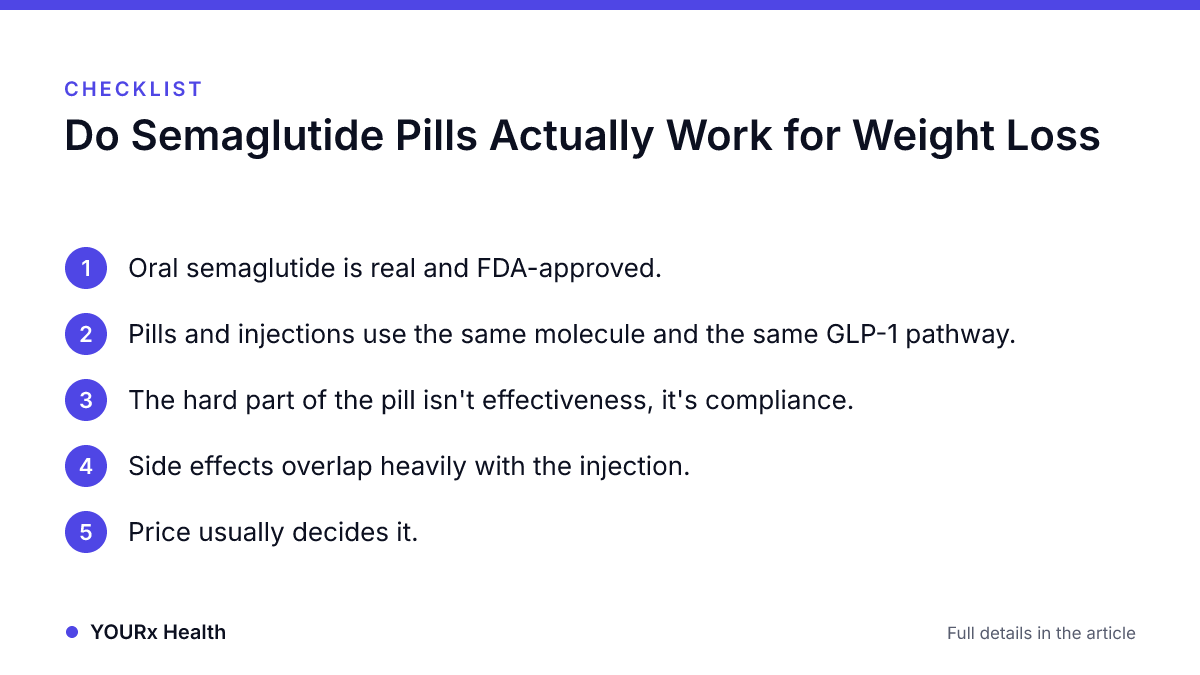
- Oral semaglutide is real and FDA-approved. The tablet (brand name Rybelsus) is cleared for type 2 diabetes and works by increasing insulin, lowering blood sugar, and slowing digestion, according to Cleveland Clinic.
- Pills and injections use the same molecule and the same GLP-1 pathway. What differs is how the drug gets in, which changes absorption, dosing frequency, and how much your morning routine has to bend.
- The hard part of the pill isn’t effectiveness, it’s compliance. Empty stomach, plain water only, a wait before food or other medications, every single day.
- Side effects overlap heavily with the injection. Nausea, diarrhea, stomach pain, and reduced appetite show up with both forms, per Mayo Clinic.
- Price usually decides it. Brand-name tablets versus compounded injectables can differ by thousands of dollars over a six-month protocol, and most insurers treat a diabetes diagnosis very differently from a weight-management one.
If you’ve been Googling “semaglutide pills” at 11 p.m., here’s the short answer. A pill form exists. It’s FDA-approved as Rybelsus for type 2 diabetes, it works through the same GLP-1 pathway as the weekly shot, and physicians also prescribe it off-label for weight management. The catch is that it asks a lot more of you every morning than an injection does once a week.
Thank you for reading this post, don't forget to subscribe!
Table of Contents
- Is there a pill form of semaglutide?
- Do semaglutide pills really work?
- What’s the difference in dosing between pills and injections?
- What are the disadvantages of oral semaglutide?
- How much do semaglutide pills cost, and does insurance cover them?
- How does YOURx Health prescribe and monitor semaglutide?
- Frequently asked questions
Is there a pill form of semaglutide?
Yes. Semaglutide tablets increase insulin levels, decrease blood sugar, and slow digestion, which is the core mechanism described in Cleveland Clinic’s clinical guidance. It’s the same GLP-1 receptor agonist molecule that’s in the injectable pens, formulated with an absorption enhancer so it survives the stomach long enough to reach your bloodstream.
That formulation is the whole trick. GLP-1 peptides are fragile. Stomach acid tears them apart before they can do anything useful, which is why injection was the only delivery route for years. The oral version pairs the drug with a carrier compound that briefly shields it during absorption. Clever chemistry, with one catch: the protection window is short, so the tablet only works if you take it the way it was designed to be taken.

Also worth separating two things people lump together. There’s the FDA-approved diabetes tablet, sometimes prescribed off-label for weight. And there are newer oral GLP-1 formulations, including investigational higher-dose oral semaglutide for obesity, which have moved through trials covered by outlets like JAMA. Ask whichever physician you’re working with exactly which product and dose they’re writing. “Semaglutide pill” isn’t one single thing.
Do semaglutide pills really work?
Oral semaglutide runs through the identical biological pathway as the injectable: slower gastric emptying, blunted appetite signals, better insulin response. That’s why it was built for blood sugar control in the first place and why it drew attention for weight, as Yale Medicine and JAMA have both covered in their reporting on GLP-1 pill research. In people with type 2 diabetes, semaglutide may also lower the risk of heart attack and stroke, per Cleveland Clinic. If cardiometabolic risk is part of why you’re looking at this drug, that matters.
Where people get confused is assuming pill and injection perform the same milligram for milligram. They don’t. Oral bioavailability is far lower, so a good share of each tablet never reaches your bloodstream. That’s why the oral route is dosed daily instead of weekly, and why tablet strengths are written in whole milligrams while injectable doses are fractions of one. Same drug, completely different absorption math.
What determines whether a semaglutide pill works for you:
- Consistency with the empty-stomach rule. Take it with coffee half the time and your absorption, and your results, will be erratic.
- Titration pace. Jumping to a higher dose early usually buys nausea, not faster progress.
- What surrounds the prescription. Protein intake, resistance training, and sleep change the outcome. The medication handles appetite; it doesn’t handle body composition.
- Underlying metabolic and hormonal status. Untreated thyroid issues, poorly controlled blood sugar, and chronic stress physiology all blunt GLP-1 response.
Pro tip: In our experience, oral response curves are slower and flatter than injectable ones at the start. If you’ve been genuinely consistent with timing for two to three months and the scale hasn’t moved, that’s a conversation with your prescriber about dose or formulation, not a reason to double up on your own.
What’s the difference in dosing between pills and injections?
The pill is daily, the injection is weekly, and the milligram numbers aren’t comparable because so much less of an oral dose absorbs. Both routes start low and step up over several weeks to limit GI side effects, which is standard practice described by Mayo Clinic for the oral route.
| Factor | Oral semaglutide (pill) | Injectable semaglutide |
|---|---|---|
| Dosing frequency | Once daily | Once weekly |
| Titration | Low start, stepped up over several weeks | Low start, stepped up roughly monthly |
| Administration | Swallowed whole on an empty stomach, before food or other oral meds | Injected under the skin, any time of day |
| Food and timing rules | Plain water only, then a wait before eating or taking anything else | None; take it with or without meals |
| Compounded availability | Uncommon; most compounding is injectable | Widely compounded by licensed 503A and 503B pharmacies |
| Common side effects | Nausea, diarrhea, stomach pain, decreased appetite | Nausea, diarrhea, stomach pain, decreased appetite |
| Best fit | Needle-averse patients with predictable mornings | Travelers, shift workers, anyone who wants to think about it once a week |
Here’s the practical version of the morning routine, the part the pharmacy printout buries. Tablet first thing, before your feet really hit the floor. A small sip of plain water, not a full glass, because flooding the stomach dilutes the absorption enhancer. Nothing else by mouth for roughly half an hour: no coffee, no protein shake, no levothyroxine, no multivitamin. Then eat. Patients who succeed on the pill build it into an existing anchor habit, usually taking it when they shut off the alarm and setting a second timer for breakfast. Patients who fail on the pill are almost always the ones who take it standing in the kitchen with their first cup of coffee already poured.
On compounded semaglutide: most compounding activity sits on the injectable side, where licensed pharmacies prepare semaglutide solutions. Compounded oral tablets exist but are far less common, and dosing accuracy and absorption vary more between compounding pharmacies than between standardized brand manufacturing lines. If someone offers you a compounded oral product, ask which pharmacy formulates it, whether it’s 503A or 503B, and how potency is verified. A prescriber who can’t answer that quickly is a prescriber to walk away from.
What are the disadvantages of oral semaglutide?
The real drawbacks are the strict administration rules, the daily burden, and absorption that’s lower and less predictable than the injection. Miss the empty-stomach window regularly and you’re effectively taking a smaller dose than your chart says you are.
Worth weighing before you choose pills over injections:
- Daily commitment. One weekly injection is a far easier habit to build than a precisely timed pill 365 mornings a year.
- Drug interaction timing. Other oral medications and supplements may need to be spaced apart from your dose. If you already take thyroid medication first thing, something has to move, and that’s a conversation with your physician before day one.
- GI side effects are still common. Nausea, diarrhea, constipation, and stomach pain show up with the oral route just as they do with injections, according to Mayo Clinic.
- Bigger numbers on the label. Because absorption is low, oral doses look much larger than injectable ones. Some patients see that and assume they’re taking “more drug.” They aren’t.
- Travel and irregular schedules. Red-eye flights, time zones, and rotating shifts wreck the dosing window. Shift workers tend to stay on injections long-term.
Pro tip: When nausea is the limiting factor, holding at the current dose an extra two to four weeks before stepping up resolves it for most patients. Rushing titration is the single most common unforced error we see, and it’s usually driven by someone comparing their first month to a friend’s sixth.
One thing nobody searching “semaglutide pills” gets told: persistent fatigue that doesn’t improve even as the weight comes off is sometimes a hormonal problem layered under the metabolic one, not a drug side effect. If energy stays flat while progress is steady, it’s worth ruling out adrenal and cortisol dysregulation. We break down what that looks like in our guide to low cortisol symptoms and what actually helps.
How much do semaglutide pills cost, and does insurance cover them?
Cost is where most pill-versus-injection decisions actually get made. It depends on whether you’re filling a brand-name prescription or a compounded one, and on how your plan codes the prescription. Coverage for GLP-1s prescribed for weight management remains inconsistent across US insurers. Plenty of plans pay readily when the diagnosis is type 2 diabetes, then deny the same molecule, or demand prior authorization and step therapy, when the indication is obesity alone.
Here’s an illustrative scenario so you can run your own numbers. These are hypothetical planning figures, not a quote from any pharmacy or insurer. Confirm your actual price before you start.
The formula is simple: monthly price × number of months in your protocol.
Say the brand-name tablet runs about $950 a month cash-pay and a compounded injectable runs about $350 a month through a telehealth-affiliated pharmacy. Over a six-month protocol:
- Brand tablet: $950 × 6 = $5,700
- Compounded injectable: $350 × 6 = $2,100
- Difference: $3,600 over six months, or $600 a month
Plug in your own quotes. If the gap comes out under roughly $100 a month, convenience and tolerance should decide. Above a few hundred a month, you’re paying a real premium for the pill, and it’s fair to ask your physician whether that premium buys you anything clinically. Usually it doesn’t. It buys you no needles.
Questions to ask before committing to a form or a pharmacy:
- Is this dose covered under my plan’s diabetes benefit, obesity benefit, or neither? Ask for the answer by NDC number, not by brand name.
- Does my prescriber work with a compounding pharmacy, and what’s the monthly difference?
- Are manufacturer savings programs active right now, and do they apply at my specific dose?
- What happens to my price when I titrate up? Some pricing stays flat across doses and some jumps at every step. Ask before step one, not after.
Pro tip: Get the all-in monthly number: physician visit, lab monitoring, and medication together. A cheap prescription with no monitoring isn’t cheap if it lands you on a dose that’s wrong for you.
How does YOURx Health prescribe and monitor semaglutide?
YOURx Health physicians prescribe GLP-1 protocols after a video consultation and a secure health intake, then follow you with scheduled check-ins and lab work. No single prescription and goodbye. You complete a health profile, meet a board-certified physician by video, often the same day, and get a plan built around your labs, your history, and your actual morning schedule.
What the process looks like:
- Intake and health history. Weight history, prior GLP-1 use, current medications and supplements, plus any GI or thyroid conditions that affect candidacy or dosing timing.
- Physician video visit. Your physician reviews the intake, talks through pill versus injection against your real routine, and sets a starting dose.
- Lab monitoring. Baseline labs show where your metabolic markers sit before treatment. Follow-up labs track the response and flag anything that calls for a dose change.
- Discreet delivery and refills. Medication ships to your door, and refills are built into your check-in schedule rather than requiring a fresh appointment each time.
- Ongoing check-ins. Titration, side effects, and results get reviewed on a set cadence instead of whenever you think to email someone.
If you’re comparing this model to a clinic-based weight loss program, our guide on how to choose a legit telehealth longevity clinic covers the questions to ask any provider about licensing, lab monitoring, and physician access before you hand over a card number. You can also see the full range of what we prescribe, including GLP-1 protocols and related peptide therapies, read about our approach on our about page, or check our FAQ page.
Frequently asked questions
Can I switch from the injectable form to the pill, or vice versa?
Yes, physicians do this routinely, but it requires a dose recalculation rather than a straight swap. Because oral and injectable semaglutide aren’t dosed on a matching scale, your physician will usually restart you conservatively on the new route and titrate up from there instead of trying to match your current dose.
Do semaglutide pills interact with other medications I take every morning?
They can, especially drugs that also need an empty stomach or that depend on stomach acidity to absorb. Thyroid medication is the most common conflict we see. Give your prescriber your complete list, supplements included, before your dosing schedule gets set. This is exactly why a real intake and physician review beats ordering from a site that skips both.
Will I regain weight if I stop taking semaglutide pills?
Regain is common after stopping any GLP-1 if the eating patterns, muscle mass, and metabolic factors underneath the weight gain haven’t changed. That’s why most physicians pair GLP-1 treatment with a nutrition and strength-training plan meant to outlast the prescription rather than treating the medication as the whole plan.
If you keep landing on “it depends” when comparing the pill to the weekly shot, that’s the honest answer. It depends on your mornings, your GI tolerance, your coverage, and what your labs say. Write down your current morning medication order and your cash-pay quotes for both forms, then bring both to a physician who can see your full picture. Start your intake with YOURx Health and you can be talking to a board-certified physician the same day.