
TL;DR
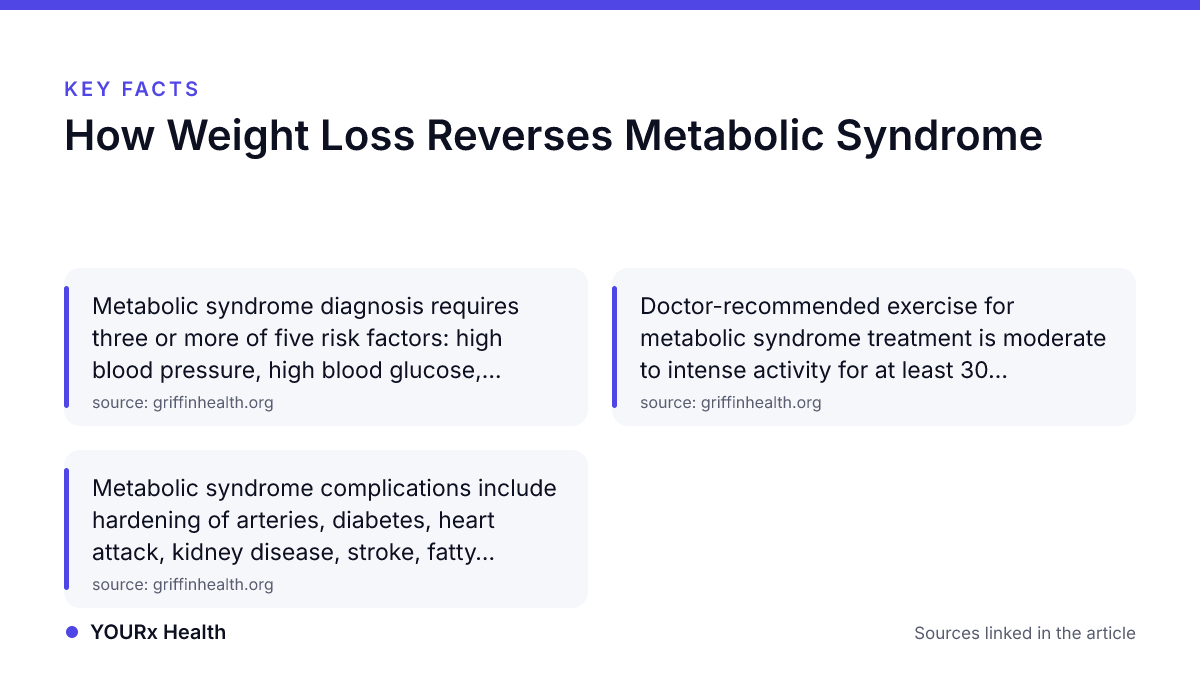
- Metabolic syndrome is diagnosed when you have three or more of five risk factors: high blood pressure, high blood glucose, excess abdominal fat, high cholesterol, or low HDL cholesterol, according to Griffin Health.
- Because it’s a cluster, not a single disease, improving even one component can drop you below the diagnostic threshold of three factors.
- Doctors recommend moderate to intense exercise 30 minutes a day, 5 to 7 days a week, as baseline treatment alongside any weight loss plan, per Griffin Health.
- Left untreated, metabolic syndrome raises your risk of hardened arteries, diabetes, heart attack, kidney disease, stroke, fatty liver disease, and peripheral artery disease.
- A 7% loss on a 220-pound frame is 15.4 pounds, roughly a pound a week over four months, and in our clinical experience that’s enough to move glucose, triglycerides, and blood pressure together.
Metabolic syndrome can be reversed. Weight loss is the one intervention that moves the most markers at the same time, and you don’t have to reach a “normal” BMI for it to work. Modest, sustained loss changes blood pressure, blood sugar, and cholesterol long before the mirror catches up.
Thank you for reading this post, don't forget to subscribe!
The harder question isn’t whether it works. It’s how much loss actually moves the needle, and what to do when diet and willpower aren’t getting you there.

Table of Contents
- Can Metabolic Syndrome Be Reversed With Weight Loss?
- How Is Metabolic Syndrome Diagnosed?
- How Much Weight Do You Need to Lose to Improve Metabolic Syndrome Markers?
- What’s the Step-by-Step Plan to Lose Weight and Reverse Metabolic Syndrome?
- What Medications Treat Metabolic Syndrome Beyond Diet and Exercise?
- Frequently asked questions
Can Metabolic Syndrome Be Reversed With Weight Loss?
Yes. Metabolic syndrome is a cluster of risk factors rather than one fixed disease, so improving any single component (blood pressure, fasting glucose, waist circumference, triglycerides, or HDL) can take you from three flags down to two. Two flags is not a diagnosis.
Research on short-term weight loss has found improvements across multiple components of the syndrome before patients reach a “normal” weight, per findings published via ScienceDirect and a weight loss program study on PubMed.
The catch is consistency. Dropping 10 pounds in a week on a juice cleanse and regaining it the next month does nothing for your long-term risk. Losing the same 10 pounds and holding it for six months is what changes your labs.
How Is Metabolic Syndrome Diagnosed?
You need three or more of five risk factors present at once: high blood pressure, high blood glucose, excess abdominal fat measured by waist circumference, high triglycerides or cholesterol, and low HDL cholesterol. That’s the standard outlined by Griffin Health and Michigan State University’s extension program.
One or two factors isn’t a diagnosis. It’s a warning.
Here’s what actually happens in practice: a patient gets told his blood pressure is “borderline” at a spring physical, hears his triglycerides are “a little high” eighteen months later, and nobody ever puts the two findings on the same page. The waist measurement is the piece most often skipped entirely. Most rushed office visits don’t include it, and BMI gets used as a stand-in, which hides the exact fat that matters.
If you want your own number, measure at the top of your hip bone, standing, at the end of a normal exhale, with the tape snug but not compressing skin. Don’t suck in.
Pro tip: If your chart already shows two of the five factors, say the words out loud at your next appointment: “Do I meet criteria for metabolic syndrome?” That question forces the dots to get connected. Waiting for a third flag to appear on its own usually means waiting years.
How Much Weight Do You Need to Lose to Improve Metabolic Syndrome Markers?
There’s no single magic number, but clinicians look for meaningful, sustained loss rather than a specific pound count. Run your own math with this formula: current weight × 0.07 = your 7% target.
Take a 220-pound man with three risk factors starting a physician-monitored protocol:
- 220 × 0.07 = 15.4 pounds
- Spread over four months, that’s 15.4 ÷ 17 weeks = 0.9 pounds per week
- Monthly checkpoints: roughly 216 lb, 212 lb, 208 lb, 205 lb
Under a pound a week. That’s the pace, and it’s deliberately unglamorous. Visceral fat, the fat packed around your organs that drives insulin resistance, comes off disproportionately early in weight loss compared with fat on your hips or arms. That’s why labs often improve before clothes do.
Run the same formula on 260 pounds and you get an 18-pound target. On 185 pounds, 13 pounds.
Pro tip: Don’t judge progress by the scale alone. Ask your physician to re-check waist circumference, fasting glucose, and a lipid panel at the same point you’d normally weigh in. Losing two inches off your waist while the scale barely moves is a win, not a plateau.
What’s the Step-by-Step Plan to Lose Weight and Reverse Metabolic Syndrome?
- Get an actual diagnosis and baseline labs. Fasting glucose, a lipid panel, blood pressure readings, and a waist measurement. Guessing based on how your jeans fit isn’t a baseline.
- Identify insulin resistance specifically. Losing weight with insulin resistance working against you is a different problem than losing weight with a normal insulin response. A fasting insulin or HOMA-IR test tells your physician which camp you’re in, and it changes which medications make sense.
- Set an exercise target and hit it boringly often. The clinical recommendation is moderate to intense activity for at least 30 minutes, five to seven days a week, according to Griffin Health. Walking fast enough that you can talk but not sing counts. No gym required.
- Rebuild your plate around protein, fiber, and fewer refined carbs. Protein at every meal, vegetables with real volume, water instead of soda. You’re flattening glucose spikes so insulin isn’t chronically elevated. Nobody has to give up bread forever.
- Ask about medication early, not as a last resort. If your labs haven’t budged after a few months, or your insulin resistance is significant, a GLP-1 medication, metformin, or both may change the trajectory. That’s a medical decision, which is why a prescribing physician matters. Browse our full range of treatments to see what’s available.
- Recheck labs every 8 to 12 weeks. These markers move faster than an annual physical captures. Quarterly check-ins let your physician adjust dosing before you sit in a stall for six months.
- Treat sleep and stress as part of the protocol. Short sleep and chronic stress push cortisol up, and cortisol works against insulin sensitivity and fat loss. If fatigue and stubborn weight persist while you’re doing everything else right, our guide on low cortisol symptoms and what actually helps is worth a read.
What Most People Miss
Most people treat metabolic syndrome like a discipline problem. It’s a hormonal one.
They cut calories hard, lose 12 pounds, then stall at week nine. Not because effort dropped off, but because insulin resistance and shifting hormones are pulling in the other direction. Men over 40 frequently have declining testosterone layered on top, which shows up as the same fatigue and midsection gain they’re blaming on the diet.
The other common mistake: losing weight fast with zero resistance training. You’ll hit the scale target and arrive with less muscle than you started with, which is the exact tissue that handles glucose. Two sessions a week of anything heavy protects it.
If low energy and a thickening waist showed up together, testosterone gel vs injections for busy men covers how that side of the picture gets treated.
What Medications Treat Metabolic Syndrome Beyond Diet and Exercise?
A physician matches the drug to whichever risk factors are worst, which is why two patients with the same diagnosis can leave with different prescriptions.
GLP-1 medications like semaglutide reduce appetite, slow gastric emptying, and improve insulin sensitivity, and if pills rather than injections are your preference, our breakdown of whether semaglutide pills actually work for weight loss covers what the oral form can realistically do. They’re titrated upward over months rather than started at a full dose, specifically because the nausea and GI side effects hit hardest when you escalate too quickly. Patients who push for faster increases usually regret it.
Metformin improves insulin sensitivity and lowers glucose production in the liver. It’s often prescribed before a formal diabetes diagnosis. Take it with food, and if the stomach upset is intolerable, ask about the extended-release version before you abandon the drug, because that switch solves the problem for a lot of people.
Blood pressure and cholesterol medications sometimes get layered in short-term. HDL in particular is slow to respond, so it’s reasonable to treat other markers while you wait on it.
| Approach | Typical mechanism | Best fit |
|---|---|---|
| Lifestyle changes alone | Diet and exercise cut visceral fat and improve insulin sensitivity gradually | Early-stage risk, one or two factors present |
| GLP-1 medication (e.g., semaglutide) | Reduces appetite, slows gastric emptying, improves insulin response | Significant excess weight, little movement on diet alone |
| Metformin | Improves insulin sensitivity, lowers liver glucose production | Insulin resistance or prediabetes alongside weight gain |
| Combined medication + lifestyle | Addresses appetite, insulin, and visceral fat together | Three or more factors present, prior diet attempts stalled |
Pro tip: If you’ve counted calories and walked most days for three to six months and your labs look the same, that’s not a signal to try harder with the identical plan. It’s a signal to bring in a physician. Our guide on how to choose a legit telehealth longevity clinic covers what separates real prescribing care from a supplement subscription.
Untreated, this condition progresses. Hardening of the arteries, diabetes, heart attack, kidney disease, stroke, fatty liver disease, and peripheral artery disease are the documented complications, per Griffin Health. That list is the argument for treating it now instead of watching it for another few annual physicals.
Start with numbers, not another diet you’ve already failed once. YOURx Health’s physicians handle labs, prescribing, and ongoing monitoring by video, with medication shipped to your door. A same-day consult tells you exactly how many of the five factors you’re carrying.
Frequently asked questions
Is losing weight with insulin resistance harder than normal weight loss?
Usually, yes. Insulin resistance makes fat harder to release and can blunt the results you’d expect from a calorie deficit. Test fasting insulin before you conclude a diet “isn’t working,” because the right medication treats the resistance itself rather than just the arithmetic.
Can you have metabolic syndrome at a normal weight?
Yes, though it’s less common. Waist circumference and visceral fat matter more than total body weight, so someone with a normal BMI, significant abdominal fat, and elevated blood pressure or glucose can still meet three of the five criteria.
How fast do metabolic syndrome labs typically improve after starting treatment?
In our experience, blood pressure and triglycerides are the first to move, often visible at the 8-to-12-week recheck. HDL cholesterol is the slow one and can take several months of sustained change before it shifts meaningfully. Don’t panic if HDL lags while everything else improves.