
TL;DR
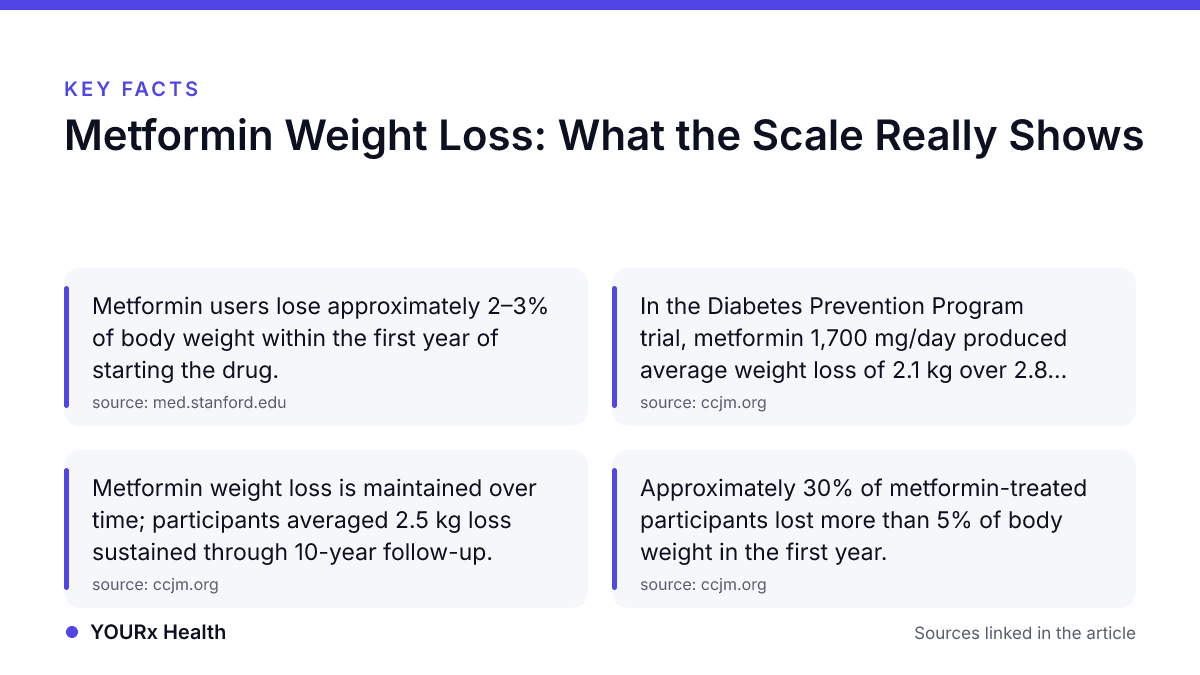
- Typical weight loss on metformin is 2–3% of body weight in the first year. For a 200-lb person, that’s roughly 4 to 6 pounds, far less than what patients see on GLP-1 medications (Stanford Medicine).
- About 30% of metformin users lose more than 5% of body weight in year one, so response varies widely, largely tracking with how insulin-resistant you were to begin with (CCJM).
- Metformin doesn’t target belly fat. It lowers circulating insulin, and visceral fat tends to respond first, which is why waistlines often change before the scale does.
- The loss is slow and it sticks. The Diabetes Prevention Program trial showed 2.1 kg average loss over 2.8 years, with 2.5 kg still held at the 10-year mark (CCJM).
- For faster or larger results, most physicians pair metformin with GLP-1 therapy or skip it. A doctor can tell you whether metformin alone fits your labs or whether you’re a better candidate for a medical weight loss protocol.
If you’ve read that metformin melts fat and started picturing before-and-after photos, pump the brakes. The weight loss is real and well documented. It’s also small. People lose an average of 2 to 3% of their body weight in the first year, and that holds whether they have diabetes, prediabetes, or neither (Stanford Medicine). For a 180-pound adult, that’s roughly 4 to 5 pounds over twelve months.
Thank you for reading this post, don't forget to subscribe!
Meaningful? Yes, especially if insulin resistance is driving your weight, and pairing realistic expectations with the right approach to losing weight with insulin resistance matters more than the number on the scale. Dramatic? No.

Table of Contents
- How much weight do you lose on metformin per month?
- Can you lose belly fat with metformin?
- Does metformin work fast enough to count as a real weight loss drug?
- What does a realistic metformin dosing and timeline look like?
- How does metformin compare to GLP-1s like semaglutide for weight loss?
- Who should avoid metformin, and what are the side effects?
- What’s the smartest way to use this information?
- Frequently asked questions
How much weight do you lose on metformin per month?
There’s no dependable monthly number, because metformin’s effect accumulates over months rather than showing up week to week. Most of the loss in published research happens in the first 6 to 12 months, then flattens out. In the Diabetes Prevention Program trial, patients taking 1,700 mg/day lost an average of 2.1 kg (about 4.6 lbs) over 2.8 years, and that loss was maintained through 10 years of follow-up, averaging 2.5 kg long-term (CCJM).
Run that out per month and the reality gets clear fast: 2.1 kg ÷ 2.8 years = 0.75 kg per year, which is about 1.65 lbs per year, or roughly 0.14 lbs a month. That’s less than the fluctuation you’d see from one salty dinner. Monthly weigh-ins are the wrong measuring stick for this drug.
Here’s the math worth running on your own numbers. Multiply your current weight by 0.02 and 0.03. That range is your realistic first-year target:
- 200 lbs × 0.02 = 4 lbs; × 0.03 = 6 lbs → expect 4–6 lbs over 12 months
- 160 lbs × 0.02 = 3.2 lbs; × 0.03 = 4.8 lbs → expect 3–5 lbs
- 240 lbs × 0.02 = 4.8 lbs; × 0.03 = 7.2 lbs → expect 5–7 lbs
If you’re two or three months in and searching for other people’s month-by-month results, nothing is wrong with you. Appetite usually shifts before the scale does. Metformin stimulates production of lac-phe, an appetite-suppressing molecule your body also releases after hard exercise (Stanford Medicine). Patients often describe it as food simply feeling less interesting around week 6 to 8. That’s the mechanism doing its job.
Pro tip: track waist circumference alongside weight, same spot, same time of day, once a month. We regularly see patients lose an inch at the navel while the scale barely moves, particularly those with metabolic syndrome or PCOS. If you only own a scale, you’ll conclude the drug failed when it didn’t.
Can you lose belly fat with metformin?
Indirectly, yes, and that’s part of a bigger picture of how weight loss reverses metabolic syndrome by easing the insulin resistance driving visceral fat storage. Metformin lowers circulating insulin and improves how your cells respond to it, and visceral fat is usually the tissue that reacts first. That’s why so many anecdotal “belly fat before and after” reports exist alongside underwhelming scale numbers.
What metformin doesn’t do is spot-reduce. There’s no mechanism in the drug that seeks out abdominal tissue. What happens is more mundane: when insulin drops, the metabolically active fat around your organs releases stored fatty acids more readily than the subcutaneous fat on your hips and thighs. Your belt notices before your bathroom scale does.
This distinction has real consequences for who benefits. A 42-year-old with a fasting insulin of 18 µIU/mL, a 40-inch waist, and a family history of type 2 diabetes has a lot of insulin-driven fat for metformin to act on. A lean 60-year-old who’s gained ten pounds from losing muscle mass has almost none. Same drug, same dose, completely different result. Before we prescribe metformin for weight, we want to see fasting insulin or a HOMA-IR estimate, not just a BMI, because BMI tells us nothing about whether insulin is the problem.
Does metformin work fast enough to count as a real weight loss drug?
No, and that’s the biggest misconception about it. Metformin received FDA approval in 1994 as a type 2 diabetes treatment and became first-line therapy for glucose control, not for obesity (PMC). Its weight reputation was an accident of observation. Doctors noticed patients on metformin lost a little weight instead of gaining it, which stood out because plenty of older diabetes drugs push weight the other direction.
People confuse “consistent” with “significant.” Metformin is genuinely consistent: it rarely causes weight gain, and roughly 30% of users drop more than 5% of body weight in year one (CCJM). But consistency isn’t speed. If someone in your gym dropped 30 pounds in a season, they weren’t doing it on metformin alone.
What does a realistic metformin dosing and timeline look like?
Physicians start low and titrate up over several weeks, almost entirely to avoid the GI side effects that make people quit in month one.
| Timeframe | Typical dose | What to expect |
|---|---|---|
| Week 1–2 | 500 mg once daily, with food | Loose stool, gas, mild nausea; no weight change yet |
| Week 3–4 | 500 mg twice daily or 1,000 mg once daily | Appetite starts to quiet for many patients |
| Month 2–3 | 1,000–1,500 mg/day, extended-release often preferred | First visible loss for many; waist often changes first |
| Month 6 | 1,500–2,000 mg/day | Slow, steady loss continues; A1c and B12 rechecked |
| Month 12 | Maintenance dose | Averages 2–3% total body weight lost; plateau is normal |
Pro tip: take it with your largest meal, not on an empty stomach and not with a coffee. That single change resolves most early GI complaints we hear about. The second most common fix is moving the evening dose to dinner instead of bedtime, which cuts the overnight nausea that wakes people up.
Metformin is an ongoing therapy, not a course you finish. And the effect doesn’t compound. Losing 3% in year one doesn’t buy you another 3% in year two; you hold what you lost, which is exactly what the 10-year follow-up data shows.
How does metformin compare to GLP-1s like semaglutide for weight loss?
Metformin produces modest, steady loss through improved insulin sensitivity and a gentle appetite signal. GLP-1 medications produce substantially larger loss by slowing gastric emptying and acting directly on appetite centers in the brain. Here’s how they stack up in practice:
| Factor | Metformin | GLP-1 (semaglutide/tirzepatide) |
|---|---|---|
| Average weight loss | 2–3% of body weight in year one | Substantially larger, commonly a double-digit percentage |
| Speed of results | Gradual over 6–12 months | Noticeable within the first few weeks |
| Mechanism | Improves insulin sensitivity, boosts lac-phe appetite signal | Mimics gut hormones, suppresses appetite, slows digestion |
| FDA-approved for weight loss | No; used for diabetes, prediabetes, PCOS | Yes, for specific formulations |
| Cost and access | Low-cost generic, widely stocked | Higher cost, requires supervised titration |
| Best fit | Insulin resistance, prediabetes, PCOS, mild metabolic syndrome | Larger weight goals, higher BMI, shorter timeline |
| Combined use | Added for metabolic benefit and glucose control | Usually the primary driver of weight loss in the pair |
For patients managing type 2 diabetes and weight together, metformin is often the starting point because it’s already indicated for glucose. If the main goal is losing a significant amount of weight on a reasonable timeline, few physicians will recommend metformin by itself. These days it more often shows up as an adjunct to a GLP-1 protocol. The two work through different pathways, so they don’t cancel out, and plenty of patients tolerate the combination well.
If you’re weighing options, our physicians walk through the full menu of medical weight loss treatments, including how Zepbound and semaglutide-based protocols compare to metformin, during your first video consult.
Who should avoid metformin, and what are the side effects?
Metformin is well tolerated by most people, but it isn’t risk-free, and anyone taking it off-label for weight should know what they’re signing up for. The common complaints are gastrointestinal: nausea, diarrhea, gas, cramping, mostly in the first two to four weeks while the dose climbs. They usually fade with time and better food timing.
The less common issues matter more:
- B12 deficiency with long-term use. Metformin reduces B12 absorption over months to years. We check levels at baseline and annually. Our B12/MIC support is sometimes paired with metformin for this reason, and the tingling-hands complaint people blame on aging is occasionally just a low B12.
- Lactic acidosis in patients with kidney impairment. Rare but serious, which is why eGFR is checked before you start and rechecked periodically.
- Significant liver disease, heavy alcohol use, or advanced kidney disease. Standard contraindications your prescriber screens for. Be honest about drinking; this is the one question patients underreport most.
- Contrast dye for imaging. Metformin is typically held around CT scans with contrast. Tell the imaging tech you’re on it, every time.
Pro tip: if immediate-release metformin wrecks your stomach, ask about extended-release before you abandon the drug. In our experience, ER resolves the tolerability problem for the large majority of patients who were ready to quit.
None of this makes metformin dangerous for the right patient. It makes it a prescription that needs labs and follow-up, not something to buy from an overseas website and self-dose.
What’s the smartest way to use this information?
Decide what problem you’re actually solving. If you have insulin resistance, prediabetes, or PCOS and stubborn weight that hasn’t budged with diet changes, metformin is a cheap, low-risk, well-studied tool worth a conversation, provided you go in expecting 2 to 3%, not 20%. If your goal is losing 40 pounds before a wedding in the fall, metformin alone will disappoint you and you’ll waste six months finding out.
The honest test we use with patients: if your fasting insulin is elevated and your waist-to-height ratio is above 0.5, metformin has something to act on. If those look fine and you simply want to weigh less, a GLP-1 protocol is the better conversation.
Start with bloodwork, not a forum thread. Fasting insulin, A1c, kidney function, and B12 will tell a physician more in ten minutes than a year of guessing. You can do the whole thing from your phone: complete a health profile, meet a board-certified physician by video, and get a plan built on your labs. Read our FAQs or our approach to longevity medicine before booking a same-day consult.
Frequently asked questions
Does metformin help with weight loss in PCOS specifically?
Yes. Metformin is one of the most commonly prescribed off-label treatments for PCOS-related weight gain, because PCOS and insulin resistance travel together and improving insulin sensitivity often helps both weight and cycle regularity. Expect results in the same modest range seen in broader research, with more response in patients who were more insulin-resistant at baseline.
Do you regain the weight if you stop taking metformin?
Some regain is common. The appetite effect and the insulin sensitivity improvement both end when the medication does. That’s why physicians frame metformin as ongoing management for insulin resistance rather than a short course you finish at a goal weight.
Is metformin 500 mg enough to cause weight loss on its own?
Usually not much. 500 mg is a starting dose, and most of the weight data comes from patients titrated to 1,500–2,000 mg per day; the Diabetes Prevention Program used 1,700 mg/day. Your physician will step the dose up over several weeks based on how your stomach handles it before judging whether it’s working.