TL;DR
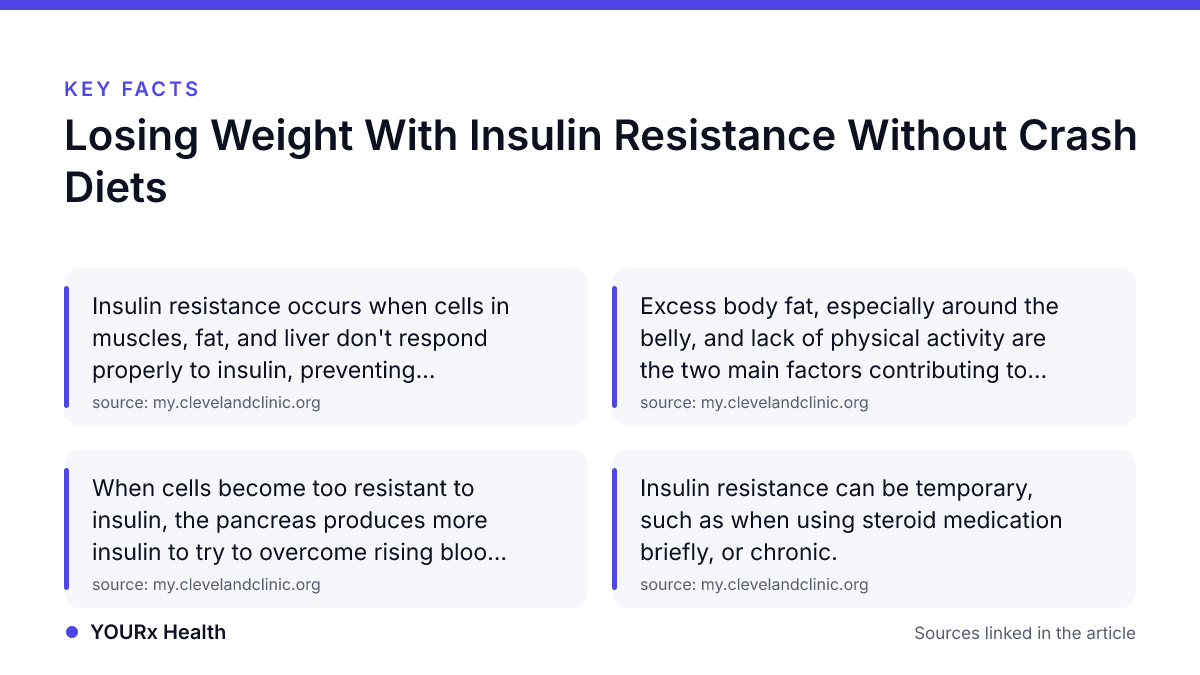
- High insulin is a fat-storage signal. When cells stop responding to insulin, the pancreas pumps out more of it (hyperinsulinemia), which works directly against fat loss (Cleveland Clinic).
- Excess belly fat and low physical activity are the two main drivers of insulin resistance, so body composition and movement are also your two strongest levers for reversing it.
- Untreated, it can progress to prediabetes and Type 2 diabetes, and it’s associated with cardiovascular disease, fatty liver disease, metabolic syndrome, and PCOS.
- Protein, fiber, and slower-digesting carbs at every meal beat calorie slashing. Yale School of Medicine points to consistent activity plus limiting processed carbohydrates, not a branded diet.
- A realistic pace: 1–1.5% of body weight per month on a physician-monitored GLP-1 protocol. For a 220-lb starting weight, that’s roughly 16.5 lbs over six months. The math is worked out below.
Most people with insulin resistance don’t have a discipline problem. They have a hormone problem that looks exactly like a discipline problem from the outside.
Thank you for reading this post, don't forget to subscribe!
Here’s the mechanism. When your cells stop responding properly to insulin, your pancreas compensates by releasing more of it, and elevated insulin is one of the most storage-friendly hormonal states your body can sit in (Cleveland Clinic). So you cut calories, you walk every day, you swap the soda for sparkling water, and the scale barely twitches. That’s not willpower failing you. That’s biochemistry, and it needs a plan that accounts for it.
Table of Contents
- What is insulin resistance, and why does it stall weight loss?
- What is the best diet to reverse insulin resistance?
- What are some good foods to eat if I have insulin resistance?
- How does GLP-1 medication help with weight loss and insulin resistance?
- How do you monitor progress while losing weight with insulin resistance?
- How long does weight loss with insulin resistance realistically take?
- Get started with a physician-guided plan
- Frequently asked questions
What is insulin resistance, and why does it stall weight loss?
Insulin resistance happens when cells in your muscles, fat, and liver stop responding properly to insulin, so glucose can’t be used for energy or stored efficiently and builds up in the bloodstream instead (Cleveland Clinic). Your pancreas sees blood sugar climbing and does the one thing it can: makes more insulin. Over time that becomes hyperinsulinemia, a chronically elevated insulin state. Insulin’s whole job is to tell your body to store energy. Ask it to release stored fat while that signal is blaring and you’re fighting yourself.
This also explains why the weight question cuts both ways. Insulin resistance itself tends to drive weight gain, especially around the abdomen, because high circulating insulin favors storage and makes stored fat harder to reach. That’s a completely different situation from someone with Type 1 diabetes who loses weight because unmanaged high blood sugar forces the body to burn muscle and fat for fuel it can’t otherwise access, a mechanism we break down in our explainer on insulin therapy for Type 1 diabetes. If you’re on insulin therapy and dropping weight unexpectedly, call your endocrinologist. That’s not a diet question.
One thing patients find genuinely reassuring: insulin resistance isn’t always permanent. It can be temporary, like during a short course of steroid medication, or chronic. Left alone, though, the resulting hyperglycemia can progress to prediabetes and eventually Type 2 diabetes (Cleveland Clinic). It’s also associated with obesity, cardiovascular disease, metabolic dysfunction-associated steatotic liver disease, metabolic syndrome, and PCOS. That last one is why so many women arrive at this topic through a PCOS diagnosis rather than a weight goal. The underlying mechanism doesn’t care how you got here.
| What’s happening | Why it matters for weight loss |
|---|---|
| Muscle, fat, and liver cells respond poorly to insulin | Glucose isn’t used or stored efficiently and stays in the blood |
| The pancreas overproduces insulin (hyperinsulinemia) | High insulin promotes storage and blocks fat release |
| Excess belly fat and inactivity are the two main drivers | Both are modifiable, which is why lifestyle changes work |
| The condition can be temporary or chronic | Short-term triggers like steroids may resolve on their own |
| Untreated hyperglycemia progresses | Prediabetes and Type 2 diabetes become the timeline |
| Linked to obesity, heart disease, fatty liver, metabolic syndrome, PCOS | Fat loss here is cardiovascular and liver risk reduction too |
All facts above per Cleveland Clinic.
What is the best diet to reverse insulin resistance?
The best diet for insulin resistance is the one that keeps insulin spikes low and steady: protein, fiber, and fat anchoring every meal, with refined carbohydrates and added sugar kept small. Yale School of Medicine points to consistent physical activity and limiting processed carbohydrates as the core evidence-backed strategy, not a named plan you have to buy (Yale School of Medicine).
Notice what that isn’t. It isn’t 900 calories a day. Severe restriction tends to backfire here, and research on non-obese women found insulin resistance itself influenced how effectively participants lost weight, independent of how strict the diet was (PMC). Structure beats scarcity.
Four moves do most of the work:
- Front-load protein at breakfast. In our practice, patients who hit 30 grams or more before 10 a.m. report far fewer 3 p.m. crashes than the ones starting on cereal or a muffin. Eggs, Greek yogurt, cottage cheese, leftover chicken. It doesn’t have to be breakfast food.
- Never send a carb out alone. Toast with almond butter behaves very differently in your bloodstream than toast with jam. Same slice of bread, different insulin response.
- Lift something twice a week. Muscle is the largest glucose sink you own. More of it means more capacity to clear blood sugar without a big insulin release, which is why resistance training outperforms cardio-only routines for this specific problem.
- Put your biggest meal earlier. Insulin sensitivity generally runs better in the morning than at 9 p.m. A 700-calorie lunch and a light dinner tends to work better than the reverse.
Pro tip: Track meal spacing, not only macros. Grazing from 8 a.m. to 10 p.m. keeps insulin elevated almost continuously, and it’s one of the quieter reasons “I eat so clean” doesn’t move the scale. Three real meals with genuine gaps between them often outperforms six perfect small ones.
What are some good foods to eat if I have insulin resistance?
Foods that release glucose slowly: non-starchy vegetables, legumes, fatty fish, eggs, nuts, seeds, olive oil, and whole grains in modest portions with protein alongside. The Obesity Medicine Association frames these as part of a broader eating pattern that supports insulin sensitivity and gradual fat loss rather than any single miracle food (Obesity Medicine Association).
A plate that actually works, in practical terms: half the plate non-starchy vegetables, a palm-sized portion of protein, a cupped handful of slower carbs, a thumb of fat. Build that same shape three times a day and you’ve done more than any supplement stack will.
Foods that generally help:
- Leafy greens and cruciferous vegetables (spinach, broccoli, kale): high volume, low glycemic impact, and they make a smaller carb portion feel like a full meal.
- Fatty fish (salmon, sardines, mackerel): omega-3s support the inflammatory side of metabolic health.
- Legumes and lentils: fiber and protein together, which is why a cup of black beans lands so differently than a cup of white rice.
- Berries: lower sugar load than most fruit, plus fiber to slow it down.
- Nuts and seeds: fat and protein with minimal blood sugar impact. Portion them out; a jar of almonds on the counter is a 600-calorie afternoon.
- Plain Greek yogurt or cottage cheese: high protein, genuinely filling, easy to keep stocked.
Foods that generally work against you:
- Sugary drinks and juice: the fastest possible insulin spike with none of the fiber to slow it. Orange juice counts. So does the “healthy” green smoothie with three fruits in it.
- White bread, pasta, and pastries: stripped of the fiber that would buffer the response.
- Fried and heavily processed snacks: refined carbs plus inflammatory fats is a rough combination for insulin sensitivity.
One thing we tell patients who hate meal planning: pick two breakfasts and two lunches and eat them on rotation for a month. Decision fatigue is what breaks most diets by week three, not hunger. Save the variety for dinner.
Pro tip: People searching for supplements to reverse insulin resistance usually want a way around food quality. Magnesium and berberine can support a solid plan. Neither will rescue a bad one. If you want to understand where micronutrients actually fit, our physicians go deeper on our magnesium page.
How does GLP-1 medication help with weight loss and insulin resistance?
GLP-1 medications like semaglutide slow gastric emptying, reduce appetite, and improve how your body handles glucose after meals, which lowers how much insulin your pancreas has to release in the first place. Torrance Memorial Medical Center describes insulin resistance as a central reason weight loss “feels impossible” for patients who are genuinely trying, because the hormonal environment is fighting the deficit they’re creating (Torrance Memorial). GLP-1 therapy changes that environment instead of asking you to out-discipline it.
At YOURx Health, physicians start low and titrate up over several weeks, consistent with how semaglutide-based Ozempic protocols and Zepbound are dosed in standard clinical practice. Start low, increase roughly every four weeks based on tolerance and response. Someone with pronounced insulin resistance and a higher A1C often needs a slower titration and tighter monitoring than someone using it mainly for appetite control.
Metformin comes up here constantly. It isn’t a competitor to GLP-1 therapy. Metformin works primarily on the liver’s insulin response, GLP-1s work on appetite and post-meal insulin demand, and for patients with metabolic syndrome a physician may reach for one, the other, or both. Different tools, same problem.
Let’s run the math on a realistic scenario. This is illustrative, not a promise, and it’s precisely why physician oversight matters.
A patient starts at 220 lbs, on a GLP-1 protocol with the food structure above and resistance training twice a week. Suppose she loses 1–1.5% of body weight per month once she’s on an effective dose, a pace many patients see:
- 220 lbs × 1.25% (midpoint) = 2.75 lbs per month
- 2.75 lbs × 6 months = 16.5 lbs
- 16.5 ÷ 220 = 7.5% of starting body weight
That 7.5% is roughly where lab improvements in insulin sensitivity tend to show up, not just a smaller number on the scale. Run your own version: starting weight × expected monthly percentage × months. If the answer looks slow to you, that’s useful information before you start, not after you quit in week five.
How do you monitor progress while losing weight with insulin resistance?
Track labs and body composition together, because insulin sensitivity often improves before the scale reflects anything. The labs that matter most are fasting insulin, fasting glucose, HbA1c, and a lipid panel, typically rechecked every 8 to 12 weeks during active treatment.
- Fasting insulin and fasting glucose together. The standard calculation, HOMA-IR, is fasting insulin (µU/mL) × fasting glucose (mg/dL) ÷ 405. A patient with fasting insulin of 18 and glucose of 100 comes out at 18 × 100 ÷ 405 = 4.4. Three months later at insulin 12 and glucose 94: 12 × 94 ÷ 405 = 2.8. Same-ish glucose, far less insulin needed to hold it there. Your physician interprets the absolute number in context, so don’t diagnose yourself off a cutoff you found online. Watch the direction of your own trend instead.
- HbA1c. Slower moving, reflects roughly three months of average blood sugar, and it’s the number that tells you whether you’re heading out of the prediabetic range.
- Lipid panel. Insulin resistance is associated with cardiovascular disease, so improving triglycerides and HDL alongside fat loss counts as a real win.
- Waist circumference. Belly fat is one of the two main drivers of insulin resistance, so a waistband loosening while the scale sits still is meaningful progress, not a plateau.
- Hunger and energy patterns. Steadier afternoons and fewer sugar cravings usually arrive weeks before visible change. That’s insulin starting to settle.
In our experience, reversal shows up in a predictable order: fewer post-meal crashes first, then reduced between-meal hunger, then better sleep, then lab movement, then visible loss around the midsection. If nothing at all has shifted after 8 to 12 weeks of genuine consistency, that’s the moment to adjust dosing or rework the plan with your physician instead of grinding out another month.
Pro tip: If daily weigh-ins wreck your mood, weigh weekly. Same day, same time, same conditions, and judge the trend line rather than the reading. Water retention alone can hide two weeks of real fat loss.
At YOURx Health, this monitoring is built into the GLP-1 program: check-ins, lab review, and dose adjustments happen without scheduling a separate in-person visit for every change.
How long does weight loss with insulin resistance realistically take?
Expect the first few weeks to look slower than they would for someone without insulin resistance. The hormonal resistance has to ease before fat loss picks up speed, and in our experience the pace noticeably changes somewhere between weeks 6 and 12 of a consistent, monitored protocol. That timing explains a very common story: “I did keto for a month and gave up.” A month is often the exact window before things start compounding.
| Approach | Timeline to meaningful change | What drives the result |
|---|---|---|
| Diet and exercise alone | 3–6 months for measurable lab improvement | Demands high consistency; insulin resistance can blunt early results (PMC) |
| Metformin plus lifestyle changes | 2–4 months for improved insulin markers | Targets liver insulin response; supports diet changes, doesn’t replace them |
| GLP-1 plus lifestyle changes | 4–8 weeks for early signals, 3–6 months for significant fat loss | Cuts appetite and post-meal insulin demand directly |
| Crash dieting, unsupervised | Fast initial loss, frequent rebound within months | Muscle loss and metabolic slowdown often leave you worse off |
Every “how I fixed my insulin resistance” story we hear in consults has the same three ingredients: sustained fat loss in the 5–10% of body weight range, resistance training to protect muscle, and enough time for the pancreas to stop overcompensating. Months, not weeks. There’s no trick in there anywhere. It’s a stack of small, repetitive, frankly boring behaviors, sometimes supported by medication, that eventually produces a different hormonal environment.
For a wider view of how medical weight loss protocols are built, our weight loss program page covers how GLP-1 treatment sits alongside metabolic and hormone health, and our treatments overview connects it to peptide therapy and other longevity-focused options.
Get started with a physician-guided plan
If diet and exercise haven’t moved the needle, you’re not lacking discipline. Your metabolism needs a different lever pulled. YOURx Health pairs board-certified physicians with lab monitoring and GLP-1 protocols built for patients dealing with insulin resistance, metabolic syndrome, or a metabolism that’s slowed down, all handled by video visit with medication shipped to you. Check the specifics on our FAQ page or read about our approach on our about page, then book a same-day consult.
Frequently asked questions
Can you reverse insulin resistance without losing weight?
Partially. Resistance training and less sitting improve insulin sensitivity somewhat on their own, because muscle contraction pulls glucose out of the bloodstream with very little insulin involved. But excess body fat, especially around the belly, is one of the two main drivers of insulin resistance, so most patients need at least some fat loss for a full reversal (Cleveland Clinic).
Is insulin resistance the same thing as metabolic syndrome?
No. Insulin resistance is one of the mechanisms underneath metabolic syndrome, which gets diagnosed on a cluster of markers: waist circumference, blood pressure, triglycerides, HDL cholesterol, and fasting glucose, and our guide on how weight loss reverses metabolic syndrome walks through how those markers tend to improve as fat loss progresses. You can have insulin resistance without meeting the full criteria, though it raises your odds of getting there.
Do I need a diagnosis before starting a weight loss program for insulin resistance?
No formal diagnosis is required to start a physician-guided program, but a basic metabolic panel plus fasting insulin gives your physician what they need to pick the right starting protocol and dose. A same-day telehealth consult is usually enough to decide which labs make sense before treatment begins.