TL;DR
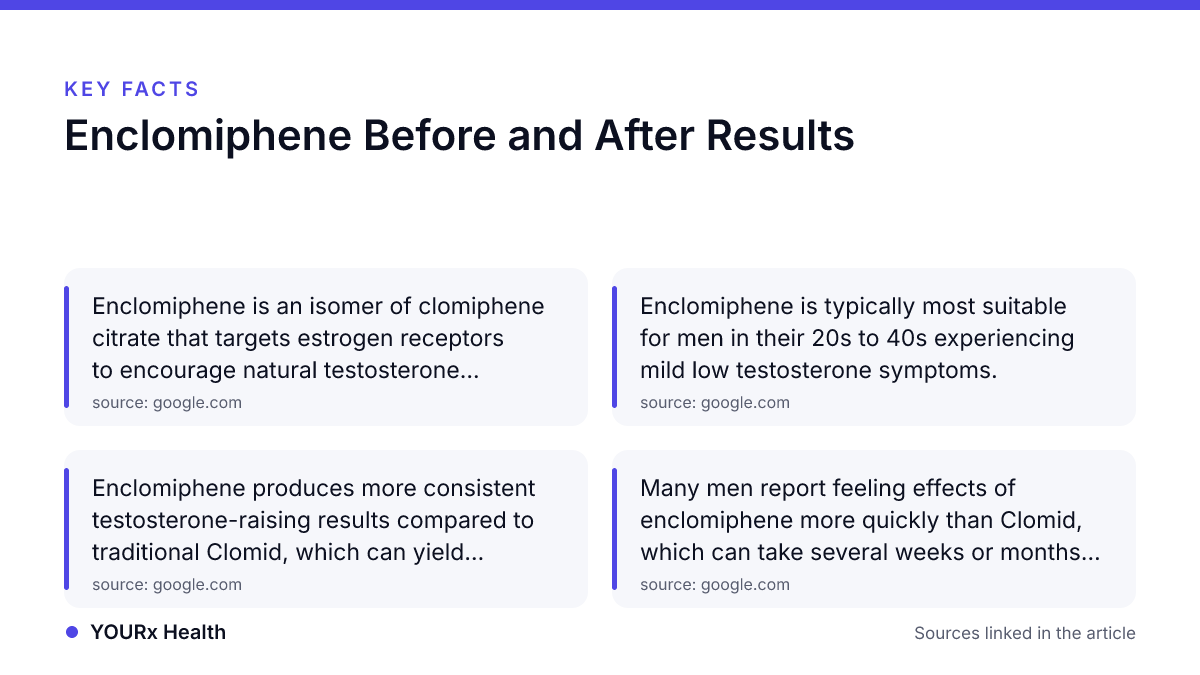
- Enclomiphene isn’t a steroid. It’s an isomer of clomiphene citrate that acts on estrogen receptors to push your own body to make more testosterone, which is why most men describe the change as “the old me came back” instead of a synthetic surge.
- The typical candidate is a man in his 20s to 40s with mild low-T symptoms, according to Gameday Health’s clinical guidance. Severe hypogonadism is a different conversation.
- Men generally feel it sooner than with traditional Clomid, which can take several weeks or months to produce noticeable results.
- Fertility stays intact. Enclomiphene raises natural testosterone without suppressing sperm production. Injectable testosterone does the opposite.
- The lab trend beats the mirror. Dose and duration should follow bloodwork at set checkpoints, not a fixed calendar or how you feel on a good Tuesday.
Every man starting enclomiphene asks the same question: what actually changes, and when? Here’s the honest version. This isn’t a mirror-selfie transformation. It’s energy, libido, mood, and lab numbers moving in the right direction over a few weeks, with your own testes doing the work instead of a syringe doing it for them.
Thank you for reading this post, don't forget to subscribe!

Table of Contents
- What does enclomiphene before and after actually look like?
- How fast does enclomiphene work?
- What’s the best way to take enclomiphene?
- How long do you stay on it, and how often do you need labs?
- Is enclomiphene a steroid, and how does it compare to TRT?
- Who’s the best candidate for enclomiphene?
- What should you expect from your own before and after?
- Frequently asked questions
- Start with numbers, not a guess
What does enclomiphene before and after actually look like?
The “before” is usually a guy in his 30s who’s sleeping fine but waking up tired, whose lifts have been stuck for a year, and whose total testosterone came back under range on a morning draw. He’s otherwise healthy. That’s the frustrating part.
The “after,” measured at a follow-up lab draw roughly 4 to 8 weeks in, is testosterone climbing back toward a normal physiological range alongside the stuff you can feel: morning energy, gym output, sex drive. Because enclomiphene stimulates your own production rather than supplying an outside hormone, those numbers reflect what your testes can do once the brain-to-testicle signal gets reopened. Different mechanism than TRT entirely. Less dramatic in the mirror, more sustainable in the bloodwork.
One thing we see constantly: men expect the physical change first. It’s usually last. Libido and morning energy move early, training capacity follows, and visible body composition lags by a couple of months because that depends on what you do in the gym and kitchen once you finally have the energy to show up.
Pro tip: Don’t judge progress off one symptom. Score three things weekly in a notes app, rated 1 to 10: energy on waking, gym performance, libido. Labs tell you what’s happening inside. That three-point score tells you what it feels like. By week 6 the two should be moving together, and if your labs jumped but your score didn’t budge, say so at your check-in. It changes the conversation.
How fast does enclomiphene work?
Many men report feeling effects of enclomiphene well before Clomid would have done anything, which can take several weeks or months to produce noticeable results. Energy and libido tend to shift first, often inside the first two weeks. Measurable testosterone change on paper generally shows up at the 4-to-6-week recheck.
That timeline isn’t universal. Age, baseline testosterone, body fat, and whether you actually take the tablet every day all move the needle. If you’re still flat at week 6, that doesn’t mean enclomiphene failed. It means your prescriber has data to adjust the dose, which is exactly why ongoing monitoring is the standard of care and a one-and-done prescription isn’t.
What’s the best way to take enclomiphene?
Once daily, by mouth, at the same time every day, at a dose set by your baseline labs and adjusted off your follow-up labs. Most protocols start low and only titrate up if symptoms and bloodwork both justify it. More is not better here. Overshoot and you can push estradiol into a range that creates its own problems, which is a miserable way to learn the lesson.
- Take it consistently. Same hour, with or without food as directed, so your lab trend reflects the medication instead of erratic dosing.
- Don’t double up on a missed day. Skip it, resume on schedule. Doubling doesn’t speed anything up and it distorts your hormone curve right before a draw.
- Report side effects the day they start. Mood changes, vision disturbances, or unusual headaches go to your care team immediately. Vision complaints in particular are the one symptom we never tell someone to “wait and see” on.
- Get your labs drawn in the morning. Testosterone follows a daily rhythm. An afternoon draw compared against a morning baseline will make you think the medication isn’t working when it is.
Run the cost math before you commit
Price per month is the wrong number to compare. Price per dose is the right one, because protocols differ.
Here’s the formula in plain words: monthly price divided by the number of tablets in the fill equals cost per dose. Then multiply by how many doses your protocol actually calls for in 30 days.
Illustrative scenario, not a quote: say a 30-tablet fill is priced at $120. That’s $120 ÷ 30 = $4.00 per tablet. On a daily protocol, 30 doses × $4.00 = $120 per month. On an every-other-day protocol, you only use 15 doses, so 15 × $4.00 = $60 of medication burned per 30 days, and that fill lasts you 60 days instead of 30.
Plug in your own quoted numbers. The rule of thumb: if two providers quote the same monthly price but one assumes daily dosing and the other every-other-day, the every-other-day option is effectively half the cost of the same drug. Ask which protocol the quote assumes before you compare anything. And budget for labs separately, because baseline plus two follow-up panels is a real line item that cash-pay men routinely forget.
Pro tip: Anchor the tablet to something you already do without thinking, like your first coffee or brushing your teeth. Adherence shapes your before-and-after more than the exact hour you dose.
How long do you stay on it, and how often do you need labs?
There’s no fixed stopping point. Most men run it for a period of months, with labs rechecked roughly every 6 to 8 weeks at first and then quarterly once levels settle.
Your baseline panel should include total and free testosterone, estradiol, and LH/FSH. Skip the baseline and you’ve thrown away the only comparison that matters. The LH and FSH values are the ones most men ignore and the ones a good physician watches closely, because they show whether the pituitary signal is actually responding or whether something further upstream is the real problem.
Here’s how monitoring typically plays out. These numbers are illustrative, used to show the shape of the trend, not a promised outcome:
| Timepoint | Total testosterone (illustrative) | What happens at this visit |
|---|---|---|
| Baseline, pre-treatment | ~280 ng/dL | Confirm low testosterone, review symptoms, check LH/FSH and estradiol |
| Week 4–6 recheck | ~450 ng/dL | Dose reviewed, estradiol checked, symptom score compared to baseline |
| Week 8–12 | ~550–600 ng/dL | Dose usually holds if labs and symptoms agree |
| Month 6 reassessment | Stable in normal range | Continue, adjust, or plan a taper |
The practical lesson: no single draw tells the story. Your real before-and-after is a trend line across two or three checkpoints. If you’re mapping out a broader plan, reading up on testosterone deficiency symptoms in men first helps you and your physician set an honest baseline before anything gets prescribed.
Is enclomiphene a steroid, and how does it compare to TRT?
No. Enclomiphene is a selective estrogen receptor modulator. It blocks estrogen feedback at the brain, the pituitary responds by releasing more luteinizing hormone, and the testes make more testosterone on their own. That’s the opposite of an anabolic steroid, which supplies the hormone from outside and shuts your own production down. An anavar before-and-after comes from an external compound driving fast strength and muscle change, with fertility and natural production as the trade. Enclomiphene’s change is quieter and slower, and your own signaling stays on.
Against TRT, the advantage is specific: if you want biological children or you don’t want to be on injections indefinitely, enclomiphene preserves the pathway rather than overriding it. TRT often delivers a faster, more visible change in strength and size. It also suppresses natural testosterone and sperm production, which enclomiphene does not.
Clomid works through a similar pathway but tends to give mixed results, and it can cause vision problems, headaches, and other adverse reactions. Enclomiphene produces more consistent testosterone-raising results with fewer side effects. If you’re weighing it against HCG instead, our breakdown of enclomiphene vs. HCG covers how each one acts on the testes.
Who’s the best candidate for enclomiphene?
Men in their 20s to 40s with mild low testosterone symptoms: fatigue, flat libido, muscle that’s harder to hold onto. Not men with severe hypogonadism or a structural testicular problem.
If your labs come back far below range with heavy symptoms, a good physician may steer you toward TRT or a combined approach instead, and you should take that seriously rather than shopping for the answer you wanted. Enclomiphene needs a working pituitary and functional testes to push on. If either one is the bottleneck, stimulating harder won’t produce much.
This is why a video consult beats a forum thread. Your age, your labs, your fertility plans, and how bad your symptoms actually are all determine the starting point. If low energy comes bundled with poor stress tolerance and broken sleep, it’s also worth ruling out adrenal involvement, and our guide on low cortisol symptoms and what actually helps covers where that overlaps with hormone fatigue.
What should you expect from your own before and after?
Three checkpoints, not one transformation:
- Weeks 1–3: Subtle energy and libido shifts for many men. No labs yet, so this is a symptom-tracking window. Write the scores down, because you will not remember accurately in six weeks.
- Weeks 4–8: First follow-up labs and the first real dose decision. This is the clearest early signal of whether the medication suits your biology.
- Months 3–6: Stable dosing, consistent symptom improvement, and a decision on continuing, adjusting, or tapering.
One practical detail most men miss: take a front and side photo at baseline in the same light, same time of day, and don’t look at it again until month three. Daily mirror checks destroy your ability to see a gradual change, and by month three the comparison is usually more convincing than anything you remember feeling.
If body composition is part of the goal, pairing hormone work with a structured weight approach makes the change far more visible, and our guides on GLP-1 do’s and don’ts and Mounjaro weight loss results, cost, and timeline are useful companions when low energy has wrecked your training consistency. Still comparing providers? Read how to choose a legitimate telehealth longevity clinic before you hand over a card number.
Frequently asked questions
Can you still have children while taking enclomiphene?
Yes. Enclomiphene raises natural testosterone without suppressing sperm production, which is the main reason men who want to preserve fertility choose it over TRT.
What happens if you stop taking enclomiphene?
Testosterone typically drifts back toward your pre-treatment baseline, because the medication stimulates your own production rather than replacing it. Most physicians want one more lab draw a few weeks after you stop, so you know where your levels actually land before deciding what’s next.
Is enclomiphene covered by insurance?
Coverage varies a lot, and many men pay cash through telehealth because enclomiphene is often prescribed off-label for low testosterone. Ask for the exact cash price per fill and the assumed dosing schedule up front. That number is usually more predictable than chasing a prior authorization.
Start with numbers, not a guess
Flat energy, dead libido, and stalled lifts are symptoms, not a diagnosis. Book a same-day video consult through YOURx Health, get a baseline panel ordered with total and free testosterone, estradiol, and LH/FSH, and have a board-certified physician read your actual numbers before anything gets prescribed. If enclomiphene fits, you’ll have a real baseline to measure against in six weeks. If it doesn’t, you’ll know that too.