
TL;DR
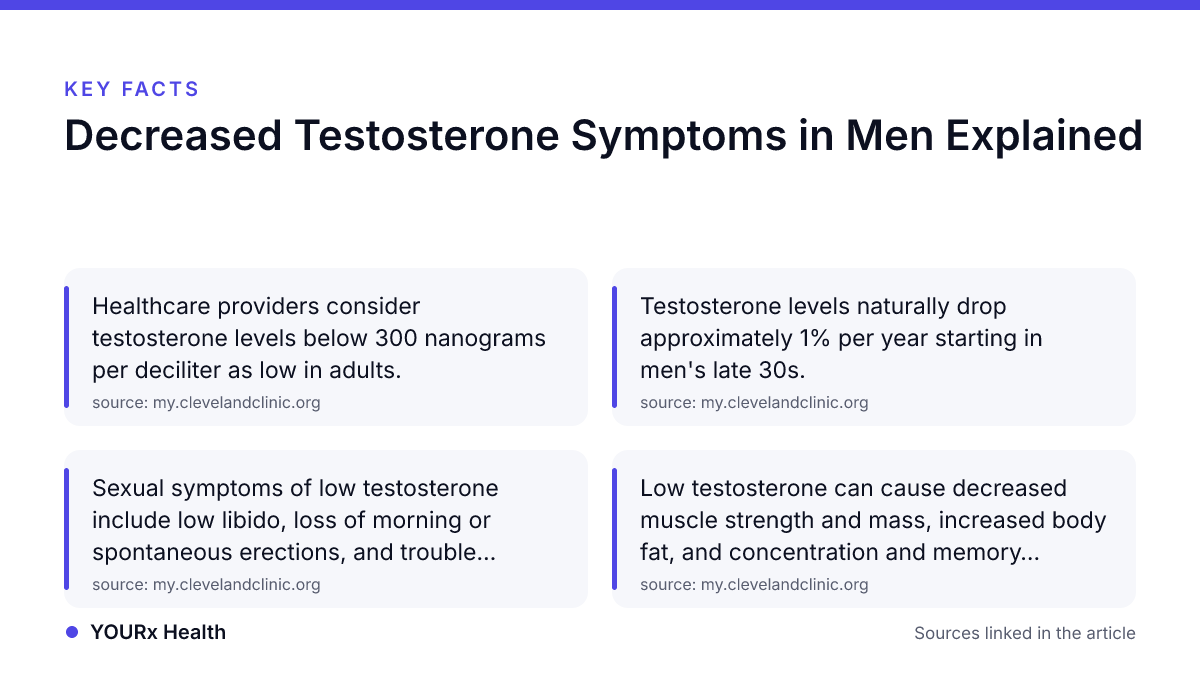
- Decreased testosterone symptoms cluster in three places: sexual (low libido, loss of morning or spontaneous erections, trouble getting or keeping an erection), physical (less muscle strength and mass, more body fat), and cognitive (concentration and memory problems) (Cleveland Clinic).
- Providers flag adult testosterone below 300 ng/dL as low, and levels fall about 1% a year starting in a man’s late 30s, so the real question is whether your symptoms are running ahead of that curve (Cleveland Clinic).
- A real workup means a morning draw, two separate tests on different days, and free testosterone plus SHBG alongside total. A single afternoon number proves almost nothing.
- If three months of testosterone replacement therapy hasn’t moved your symptoms, TRT is less likely to help you and the plan needs to change (MedlinePlus).
- TRT carries real risks: infertility, blood clots, sleep problems, and worsening cardiovascular disease (MedlinePlus). That’s why it belongs under physician monitoring, not in a supplement aisle.
You’re flattened by 2 p.m. most days. Your libido quietly checked out sometime last year. The muscle you used to put on in six weeks isn’t sticking anymore. Those are textbook decreased testosterone symptoms: low sex drive, loss of morning or spontaneous erections, trouble attaining or maintaining an erection, decreased muscle strength and mass, increased body fat, and trouble with concentration and memory (Cleveland Clinic). Healthcare providers consider levels below 300 nanograms per deciliter low in adults, and that number, not how you feel on a rough Tuesday, is where any honest treatment conversation starts.
Thank you for reading this post, don't forget to subscribe!
Table of Contents
- What are decreased testosterone symptoms in men?
- How do I test for low testosterone?
- What should I do about decreased testosterone symptoms?
- What do most men get wrong about low T?
- Can I live a normal life with low testosterone?
- How can I raise testosterone naturally?
- Frequently asked questions
What are decreased testosterone symptoms in men?
They show up in three categories, and most men have symptoms in at least two before they ever get tested.
Sexual: low libido, the disappearance of morning or spontaneous erections, and difficulty getting or keeping an erection (Cleveland Clinic). The morning erection piece is the one men dismiss most often and the one physicians weight heavily, because it’s harder to explain away with stress or a bad marriage.
Physical: decreased muscle strength and mass, increased body fat, and reduced body hair. A common pattern in our practice: training volume hasn’t changed, protein intake hasn’t changed, but waist size is up two inches over 18 months and the bench press has been stuck for a year.
Cognitive: concentration and memory issues, plus the flatter mood and dropped motivation that usually come with them.
The tricky part is the pace. Testosterone deficiency rarely announces itself. It’s a slow leak. A guy notices his lifts stall, then his libido dips, then he’s short-tempered for no obvious reason, and nine months pass before anybody connects those three dots. If that sounds familiar, our breakdown of testosterone deficiency symptoms in men goes deeper on which combinations actually warrant a lab order.
Worth saying plainly: women can have low testosterone too, and it gets discussed far less. Low libido, fatigue, and mood changes overlap heavily with perimenopause, which is exactly why guessing at this from a symptom list is a bad idea in either direction.
Pro tip: Rate four things 1 to 5 every day for two to three weeks before your appointment: energy, libido, sleep quality, and training performance. Physicians move much faster on a dated pattern than on “I’ve just felt off lately.” It also surfaces the obvious confounders, like the fact that your bad days all follow nights with four hours of sleep.
How do I test for low testosterone?
With a blood draw, and the timing matters more than most men realize. Testosterone peaks in the morning, so a draw before 10 a.m. reflects reality. An afternoon draw can read artificially low in a perfectly healthy man, which is how guys end up either misdiagnosed or dismissed. We ask for two separate morning draws on different days before calling anything a diagnosis, because a single number swings more than you’d think.
A complete panel checks more than one value:
- Total testosterone. The headline number, compared against the 300 ng/dL threshold. Note that assay methods and lab reference ranges vary, so 295 at one lab isn’t the same verdict as 295 at another.
- Free testosterone. The fraction not bound to protein and actually available to your tissues. Two men with identical total testosterone can have very different free levels and very different symptoms. If you have the option, equilibrium dialysis is a more reliable measure than the calculated version many panels default to.
- LH and FSH. These tell your physician whether the signal is failing in the testes or upstream in the pituitary. That distinction changes the entire treatment plan.
- SHBG. High SHBG binds up testosterone and drops your free level while total still looks fine on paper. This is the single most common reason a symptomatic man gets told his labs are “normal.”
- A metabolic and thyroid panel. Thyroid disease, insulin resistance, and cortisol problems produce symptoms nearly identical to low T.
One more practical detail: don’t get drawn during or right after an acute illness, and mention every medication and supplement you take, including anything you’ve used from a gym bag. Prior anabolic steroid use suppresses natural production and completely changes how a result should be read.
You don’t always need a urologist for this first step. Plenty of men get an accurate diagnosis through primary care or a telehealth physician. We laid out when a specialist genuinely is necessary in do you need a urologist for low testosterone.
What should I do about decreased testosterone symptoms?
Here’s the sequence, start to finish.
- Track symptoms for two to three weeks before testing. Daily notes on energy, libido, sleep, mood, and gym performance. This separates a genuinely bad quarter from a real decline.
- Book the draw between 7 and 10 a.m. Afternoon testing is the most common reason a result is useless.
- Ask for free testosterone and SHBG by name. Many default orders return total only. Say it at the order, not after the results come back, or you’ll pay for a second draw.
- Rule out the conditions that mimic low T. Sleep apnea, depression, hypothyroidism, and cortisol dysfunction all produce fatigue, low libido, and brain fog that look the same from the outside. If cortisol looks like a factor, our guide to low cortisol symptoms and what actually helps is the right next read before you assume testosterone is the culprit.
- Pull the lifestyle levers in parallel. Sleep, body fat, alcohol, and training all move testosterone production. They don’t replace treatment when levels are genuinely low, but skipping them means fighting your own biology while paying for a prescription.
- Confirm on two separate tests before starting anything. One low reading is a reason to retest, not a diagnosis.
- Set a three-month checkpoint on day one. If symptoms show no change after three months of TRT, it’s less likely to benefit you, and the plan should shift rather than drift (MedlinePlus). Write the recheck date on the calendar at the first visit.
- Build in ongoing labs, not a one-and-done script. Therapy requires periodic bloodwork to watch red blood cell count, PSA, and hormone levels. Telehealth treatment plans with lab monitoring and refills included spare you the repeat clinic visits a traditional model demands.
What do most men get wrong about low T?
They treat “low T” as one diagnosis instead of a symptom cluster with several possible causes. That’s where things go sideways.
- They skip the retest. One low number from a rushed 3 p.m. draw gets treated as settled fact.
- They ignore the risk profile before starting. TRT carries risks including infertility, blood clots, sleep problems, and worsening cardiovascular disease (MedlinePlus). If you want more children in the next few years, say so before your first injection, because fertility is a conversation to have up front rather than two years in.
- They confuse aging with pathology. Your testosterone is lower than it was at 25. Almost certainly. The question is whether it’s low enough, and symptomatic enough, to treat.
- They assume cost blocks them before checking. In our experience, plans frequently cover testing when a physician documents symptoms, and many cover treatment once hypogonadism is confirmed. A five-minute call to your insurer beats guessing.
- They quit the moment they feel normal. This is a managed condition, not a cured one. Stop without a plan and symptoms usually creep back.
Can I live a normal life with low testosterone?
Yes. Identified and managed, low testosterone sits alongside blood pressure or cholesterol as a condition you maintain rather than one that derails your life.
A composite of patients we see regularly: a 44-year-old with a confirmed morning total of 280 ng/dL, 35 pounds heavier than he was at 30, snoring loud enough that his wife moved to the guest room. Sleep study comes back positive for apnea. He starts CPAP, drops 18 pounds over five months, lifts three days a week, and his symptoms improve enough that the TRT conversation gets a lot more nuanced. That’s not a trick ending where testosterone turns out not to matter. It’s the reality that untreated apnea and excess body fat were doing a share of the damage, and nobody checked.
Untreated over a decade, the picture is less forgiving: continued muscle loss, rising body fat, and the downstream cardiovascular and bone consequences that follow. The quality-of-life gap in year one is usually small. It compounds. That’s the argument for dealing with it now instead of calling it stress for another five years.
How can I raise testosterone naturally?
Sleep, strength training, fat loss, and less alcohol will genuinely support your levels. None of them will fix clinically low testosterone caused by a pituitary or testicular problem. Treat them as the foundation under medical treatment, or as step one if you’re borderline rather than clearly low.
- Sleep 7 to 9 hours. Chronic short sleep makes every symptom on this list worse, and it’s the first thing we ask about before anything else (Geisinger).
- Lift heavy compound movements three to four times a week. Squats, deadlifts, presses, rows. Isolation work and steady-state cardio alone won’t do the same job.
- Drop visceral fat. Fat tissue converts testosterone to estrogen via aromatase, so excess weight actively works against you.
- Cut heavy drinking. Regular heavy alcohol use suppresses testicular production directly, separate from what it does to your sleep and waistline.
- Manage chronic stress. Sustained cortisol elevation suppresses the signaling that drives testosterone production.
There’s no legitimate overnight fix, and anyone selling one is telling you something about themselves. The fastest honest change comes from clearing sleep debt and training consistently, which men typically feel within two to four weeks even though lab shifts take longer.
Run the math on your own decline
Testosterone falls roughly 1% per year starting in a man’s late 30s (Cleveland Clinic). The formula in plain words: baseline level × 1% × years elapsed.
Take an illustrative 38-year-old at 650 ng/dL. That’s 650 × 0.01 = 6.5 ng/dL lost per year. Over 17 years to age 55: 6.5 × 17 ≈ 110 ng/dL. He lands near 540 ng/dL, comfortably inside the normal range, yet down a noticeable chunk from where he started. He can feel that. His lab report will never flag it.
The rule of thumb we use: if your symptoms arrived over six to twelve months, aging didn’t cause them. A 1%-per-year slide can’t produce a sudden change. Fast-onset symptoms point to sleep, medication, illness, weight gain, or something upstream in the pituitary, and that’s the direction your workup should go.
| Symptom | Could point to low testosterone | Could point to something else |
|---|---|---|
| Persistent fatigue | Common with low T, usually alongside low libido | Sleep apnea, anemia, thyroid disease, cortisol problems |
| Low libido | Classic sexual symptom of low T | Depression, SSRIs, relationship stress |
| Stubborn weight gain | Low T increases body fat | Insulin resistance, hypothyroidism, calorie creep |
| Muscle loss despite training | Low T decreases muscle strength and mass | Too little protein, too little recovery, normal aging |
| No morning erections | Strong tell, hardest to explain away | Vascular disease, medication side effects |
| Brain fog, poor focus | Concentration and memory issues are documented low-T symptoms | Poor sleep, ADHD, nutrient deficiency |
On cost: in our experience a basic panel runs anywhere from fully covered (insurance, with a documented symptom visit) to roughly a couple hundred dollars out of pocket, depending on your plan and whether free testosterone and SHBG are included. Treatment pricing swings wider based on medication, dose, and whether labs and follow-ups are bundled. That bundling is the thing to compare. A model with included monitoring tends to be far more predictable than paying per visit. Our guide to how to choose a legit telehealth longevity clinic covers what separates a real medical practice from a prescription mill.
Frequently asked questions
What is a dangerously low testosterone level?
There’s no single emergency cutoff. Levels well under the 300 ng/dL threshold combined with severe symptoms, such as significant muscle wasting, profound fatigue, or signs of pituitary dysfunction like vision changes or headaches, warrant prompt evaluation rather than a routine follow-up in three months. Very low numbers can point to a pituitary or testicular problem that needs its own workup, not just hormone replacement.
What causes low testosterone in young men specifically?
Under 35 or 40, age-related decline shouldn’t be the explanation, so physicians dig harder for a cause. The usual suspects are prior or current anabolic steroid use, obesity, chronic illness, opioid use, pituitary or testicular conditions, and sustained severe stress. A low result in a 29-year-old is a reason to investigate, not a reason to write a prescription.
Can decreased testosterone symptoms come back after starting treatment?
Yes. Stop treatment or let doses lapse and symptoms typically return within weeks to a few months, because TRT manages the condition rather than curing it. Scheduled labs and check-ins matter as much as the initial prescription.
Your next concrete move: call and book a blood draw before 10 a.m., and ask the ordering physician for total testosterone, free testosterone, SHBG, LH, FSH, plus a thyroid and metabolic panel. Then start the daily symptom log while you wait for the appointment. Walking in with three weeks of data and the right panel ordered is the difference between a real answer and another year of wondering.