TL;DR
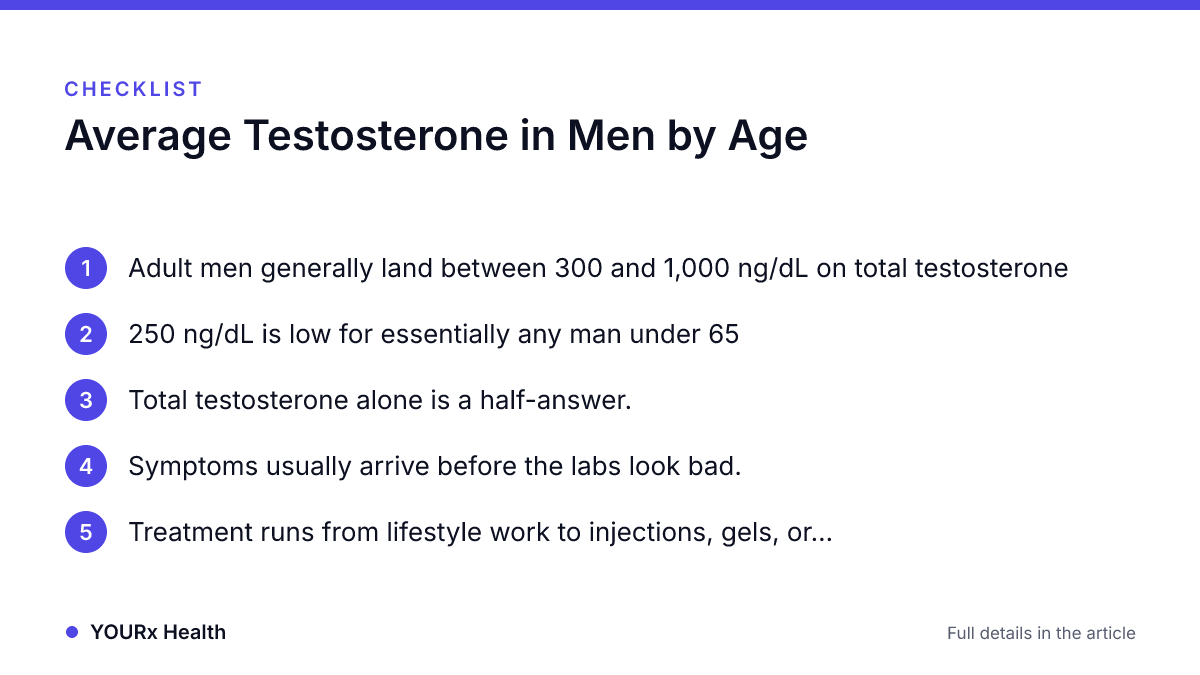
- Adult men generally land between 300 and 1,000 ng/dL on total testosterone, and the realistic middle of that range slides down with each decade: most healthy men in their 20s test in the 600-900 range, while men in their 60s often sit between 300 and 600.
- 250 ng/dL is low for essentially any man under 65 and deserves a repeat draw plus LH, FSH, and prolactin before anyone writes a prescription.
- Total testosterone alone is a half-answer. Two men can both show 450 ng/dL and feel completely different depending on SHBG and free testosterone.
- Symptoms usually arrive before the labs look bad. Fatigue that sleep doesn’t fix, flat mood, shrinking strength numbers, and lost libido are the pattern we see most.
- Treatment runs from lifestyle work to injections, gels, or fertility-sparing protocols like enclomiphene and hCG, and the right one depends heavily on whether you want kids in the next few years.
A healthy 25-year-old and a healthy 65-year-old can both be perfectly normal and still be 300 ng/dL apart. That’s the part most testosterone articles skip. They quote one range for every adult male on earth, which is how a 29-year-old with a 380 gets told he’s fine and a 72-year-old with a 340 gets talked into therapy he doesn’t need. Average testosterone in men is a moving target, and where you fall matters a lot less than whether your number lines up with your age, your symptoms, and the rest of your panel.
Thank you for reading this post, don't forget to subscribe!
Table of Contents
- What Is a Normal Testosterone Level for Men?
- Is 250 Testosterone Low?
- What Are the Symptoms of Low Testosterone in Men?
- How Do You Know If You Need Testosterone Treatment?
- What Are the Treatment Options for Low Testosterone?
- When Do Lifestyle Changes Work, and When Do You Need Treatment?
- Frequently asked questions
What Is a Normal Testosterone Level for Men?
Normal depends on which decade you’re in. Testosterone peaks in the late teens and twenties, holds for a while, then drifts down by a percent or two a year from the thirties onward. That slow slide is ordinary aging, not a disease. Reference ranges compiled by Atlantic Urology Clinics and the University of Rochester Medical Center line up closely with what we see on patient panels week to week.
| Age range | Typical total testosterone (ng/dL) | Where we start calling it low |
|---|---|---|
| 20-29 | 600-900 | Below 300 |
| 30-39 | 500-800 | Below 300 |
| 40-49 | 400-700 | Below 300 |
| 50-59 | 350-650 | Below 300 |
| 60-69 | 300-600 | Below 250-300 |
| 70+ | 250-550 | Below 200-250 |
Labs don’t agree with each other, either. One reports “normal” starting at 264 ng/dL, the next starts at 300, and your result can flip from flagged to unflagged just by switching which draw site your clinic uses.
The total number also doesn’t tell you how much hormone your body can actually use. Most testosterone in your blood is bound up and unavailable. The free fraction, the part that’s biologically active, usually runs in the neighborhood of 1-2% of total, which matches the reference interval work published on PubMed.
Run the math on a real panel. Say your total comes back at 450 ng/dL and your free fraction sits at 2%:
450 × 0.02 = 9 ng/dL free testosterone
A commonly used optimal window for free testosterone is roughly 9-30 ng/dL. So a total of 450, which no lab is going to flag, puts you at the absolute floor of usable hormone. That’s the guy who gets told his labs are normal and walks out still exhausted. Re-run that formula on your own numbers before you accept “you’re fine.”
Is 250 Testosterone Low?
Yes. At 250 ng/dL you’re below the cutoff most clinical guidelines use, including the roughly 300 ng/dL threshold referenced by Aultman Health, and you’re low for any man under 65. Pair that number with fatigue, dead libido, or strength that keeps sliding despite consistent training, and most physicians will talk treatment rather than watch and wait.
What a good clinician does next is more interesting than the number itself. A 250 gets a second morning draw to confirm it, plus LH and FSH to sort out where the problem lives. High LH with low testosterone points at the testes. Low or normal LH with low testosterone points upstream at the pituitary, and that changes everything about treatment. If the number comes in under about 150, prolactin gets checked too, because a pituitary adenoma is rare but worth ruling out before you commit someone to lifelong therapy.
The one real exception: a man in his seventies with a 250 and no symptoms. That’s often just age doing what age does.
What Are the Symptoms of Low Testosterone in Men?
Low testosterone almost never shows up as one dramatic sign. It arrives as a cluster of changes men chalk up to stress, work, or getting older. Our breakdown of testosterone deficiency symptoms in men covers each one in depth.
- Fatigue that sleep doesn’t fix. Eight hours in bed, still flat at 2 p.m.
- Low libido or fewer spontaneous erections. Usually the first thing men notice and the last thing they mention out loud.
- Strength going backward. Same program, same effort, and your working weights keep dropping.
- Fat gain around the midsection with no change in how you eat.
- Mood flatness. Not sadness exactly. More like nothing registers as exciting anymore.
- Gynecomastia. Breast tissue growth can appear when testosterone falls relative to estrogen, because the ratio shifted and estrogen’s effects start to dominate.
Pro tip: Track your symptoms for two or three weeks before the blood draw, not just the morning of. One rough week of sleep or a weekend of drinking can drag a number down and make a temporary dip look like a chronic problem.
How Do You Know If You Need Testosterone Treatment?
The sequence matters. Skip steps and you either overtreat a bad month or ignore a real deficiency for a decade.
- Get drawn between 7 and 10 a.m. Testosterone peaks in the morning. An afternoon draw can read substantially lower than your true level and produce a false “low.”
- Order total testosterone, free testosterone, and SHBG together. High SHBG men are the ones who get missed. Their total looks respectable while their free testosterone sits in the basement.
- Confirm with a second draw. Sleep, stress, illness, and alcohol all move the number. One low result is a hint, not a diagnosis.
- Compare against your age bracket. A 55-year-old at 420 ng/dL is doing fine. A 28-year-old at 420 probably isn’t.
- Rule out reversible causes before anything else. Untreated sleep apnea, heavy drinking, obesity, and chronic stress all suppress testosterone. Our guide on low cortisol symptoms and what actually helps covers how stress hormones and sex hormones pull on each other.
- Match labs to symptoms with a physician, not a forum. Numbers without context push men in both wrong directions.
- Pick a provider who keeps monitoring. The first panel is the easy part. Our piece on how to choose a legit telehealth longevity clinic covers what separates a real practice from a prescription mill.
What most men never get ordered
Most guys stop after step one. They get a single total testosterone, see “in range” on the PDF, and move on while still feeling terrible. Three things get skipped almost every time in a standard annual physical: SHBG, estradiol (which drives both gyno risk and mood), and any accounting for what the last month of sleep and drinking looked like. If total testosterone is the only hormone on your results page, you don’t have a complete picture yet.
What Are the Treatment Options for Low Testosterone?
Treatment depends on how low you are, your age, your goals, and whether fertility is on the table in the next few years.
- Injections (cypionate or enanthate). Weekly totals commonly land somewhere between 100 and 200 mg, usually split into two smaller shots to flatten the peaks and crashes. Here’s what that looks like in practice: 140 mg a week becomes 70 mg Monday and 70 mg Thursday. At the standard 200 mg/mL concentration, 70 ÷ 200 = 0.35 mL per shot, which is a third of a syringe with an insulin needle. Energy and libido usually respond in the first month or so. Body composition takes a few months.
- Topical gels. Steady daily dosing, no needles, but absorption varies with your skin and transfer to a partner or a kid who hugs you is a genuine risk you have to manage. Our comparison of testosterone gel vs injections for busy men breaks down which suits which schedule.
- Enclomiphene or hCG protocols. These push your own production rather than replacing it, which is the move for men who want to stay fertile.
- Peptide support. Something like sermorelin can sit alongside TRT for men focused on recovery and sleep quality rather than testosterone in isolation. More on our sermorelin page.
Pro tip: Insist that estradiol gets tracked alongside testosterone at every recheck. Estrogen climbing from aromatization is the single most common reason a man on TRT ends up bloated, moody, and nipple-sensitive instead of feeling better. It’s also the easiest thing to fix early and the most annoying to fix late.
When Do Lifestyle Changes Work, and When Do You Need Treatment?
Lifestyle work moves borderline numbers. It rarely rescues a genuine deficiency that’s been building for years.
Strength training a few times a week, seven-plus hours of sleep, dropping excess body fat, and pulling back on alcohol all nudge testosterone upward. Stacked together over a few months, we’ve seen men go from the high 200s into the 350-400 range without any prescription at all. Alcohol is the one most men underestimate. Three or four drinks most nights will flatten a number on its own, and cutting that alone sometimes buys back more than any supplement on the shelf.
Weight loss carries the most leverage, because fat tissue converts testosterone into estrogen. Our article on how weight loss reverses metabolic syndrome explains the mechanism. If body weight looks like the bigger driver of your fatigue and low libido than your hormone panel does, working with a GLP-1 focused telehealth practice like Top Weight Loss Med before starting TRT is a defensible first move.
Here’s the threshold we use: give it 90 to 180 days of honest effort, then retest. Honest means sleep you’d actually defend, training you logged, and a real reduction in drinking. If the number hasn’t budged after that, the problem is structural rather than behavioral, and more willpower isn’t going to produce a different result.
Your next move: book a morning draw that includes total testosterone, free testosterone, SHBG, and estradiol, then sit down with a physician who reads the whole panel instead of one line. You can start that from home through our treatments page, or read through our FAQ page first if you want to know what the process looks like before you commit.
Frequently asked questions
Does TRT shut down natural production or affect fertility?
It does. Testosterone from outside your body suppresses the signals your brain sends to your testes, which drops natural production and sperm count for as long as you’re on it. Men who want to stay fertile generally use enclomiphene, hCG, or a combination protocol instead of straight replacement.
How often do I need bloodwork once I start?
Expect a recheck about six to eight weeks after starting or changing a dose, then every three to six months once you’re stable. That cadence catches dosing problems early and keeps estradiol from quietly climbing.
Can women have low testosterone symptoms too?
Yes. Women produce testosterone in much smaller amounts, and low levels can bring the same fatigue, low libido, and loss of muscle tone, especially through perimenopause and after. Target ranges and dosing are entirely different, so it needs its own evaluation rather than male reference ranges applied sideways.