TL;DR
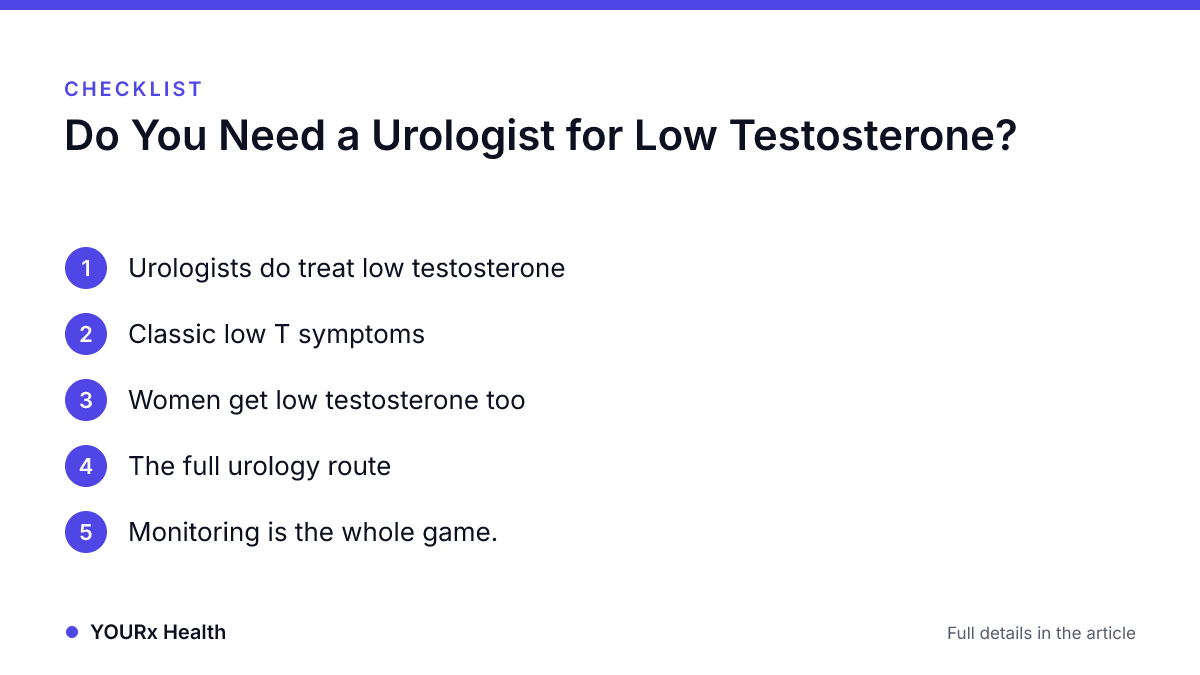
- Urologists do treat low testosterone, and they’re the right call for structural or fertility-related problems, but hormone optimization is usually a side practice in a surgical caseload.
- Classic low T symptoms (low energy, weak libido, lost muscle, brain fog, flat mood) overlap heavily with low cortisol and thyroid problems, which is why testing beats guessing.
- Women get low testosterone too, and it’s routinely missed because most panels and reference ranges were built around male physiology.
- The full urology route commonly runs 7 to 9 weeks and a few hundred dollars in copays and labs before the first dose. Telehealth compresses that into days.
- Monitoring is the whole game. Testosterone without repeat labs in the first 6 to 12 weeks is how men end up with side effects instead of results.
Short answer: yes, urologists treat low testosterone. If your main complaint is fatigue, dead libido, shrinking muscle, and the sense that you aged a decade in two years, a urology referral isn’t always the fastest or most complete route to feeling better.
Thank you for reading this post, don't forget to subscribe!
Table of Contents
- Do urologists actually treat low testosterone?
- What are the symptoms of low testosterone in men?
- Can women have low testosterone too?
- Urologist vs. telehealth low T clinic: what’s actually different?
- What does a full urology work-up for low T cost in time and money?
- When does low testosterone overlap with low cortisol?
- How do you get started with testosterone therapy online?
- Your next step
- Frequently asked questions
Do urologists actually treat low testosterone?
Yes. Urology is one of the traditional specialties for male hormone issues, right alongside endocrinology. Urologists are surgeons by training, and their practice centers on the reproductive and urinary tract: prostate, bladder, kidneys, fertility. The testes fall squarely in their territory, so testosterone comes with the job.
The complication is bandwidth. A urologist’s day is dominated by prostate screening, kidney stones, and the OR schedule. Hormone optimization, meaning the ongoing dial-in of testosterone, estrogen, and SHBG until you actually feel different, tends to be a side practice rather than the main event. You see it in the wait times, in how many minutes you get per visit, and in how quickly someone adjusts your dose when labs come back off target.
An endocrinologist treats testosterone as one piece of a larger picture that includes thyroid, cortisol, and insulin. A physician-led telehealth practice built around hormone and longevity medicine sits somewhere in between: narrower than a general urology clinic, far easier to get into than a specialist with a three-month book.

What are the symptoms of low testosterone in men?
Broad enough that most guys file them under “getting older” for years before anyone draws blood. The ones we hear most:
- Low energy that sleep doesn’t fix. Eight hours in bed, still flat at 10 a.m.
- Reduced libido and softer erections. Not always full erectile dysfunction. Often just less interest, less intensity.
- Muscle loss and slower recovery. Same weights on the bar, smaller arms in the mirror.
- Midsection fat gain with no real change in diet.
- Mood flatness, irritability, or a low-grade depression with no obvious trigger.
- Brain fog. Trouble holding focus through an ordinary workday.
- Chest tenderness or gynecomastia, a sign your testosterone-to-estrogen ratio has drifted. We cover that in our piece on gyno in men and why it happens.
Pro tip: Symptoms alone aren’t a diagnosis, and neither is one number. Most lab reports draw the “low” line somewhere around 300 ng/dL, but we’ve seen men at 350 feel every bit as wrecked as men at 240, usually because their SHBG is high and their free testosterone is in the basement. If a provider only orders total testosterone, you’re getting half the story. Ask for free T and SHBG on the same draw, and get it done before 10 a.m., since levels drift down as the day goes on.
Can women have low testosterone too?
Yes, and it’s one of the most under-diagnosed hormone problems in women’s health. Women produce testosterone in smaller amounts, and it drives libido, muscle tone, mood, and energy the same way it does in men.
The miss usually happens one of two ways. Either nobody orders the test at all, because estrogen and thyroid dominate the differential, or it gets ordered on a standard assay that isn’t sensitive enough at female concentrations and comes back as a vague “normal.” A woman at the very bottom of the female range can be told everything looks fine while she’s lost her sex drive entirely, can’t hold muscle in the gym, and feels emotionally muted. That’s a real finding, not a normal result. We go deeper in low testosterone symptoms doctors miss in women, which is worth reading if you’ve been told your labs are fine and your body disagrees.
Urologist vs. telehealth low T clinic: what’s actually different?
The medication barely changes. Testosterone cypionate, enanthate, gel, or pellets are the same molecules no matter who writes the script. What changes is access, speed, and how closely anyone watches you afterward.
| Factor | Urologist | Telehealth hormone clinic | Primary care |
|---|---|---|---|
| Time to first appointment | Often 4 to 8 weeks for a new-patient referral | Same day to a few days | Usually faster than a specialist, slower than telehealth |
| Visit focus | Broad surgical and urologic caseload | Hormones are the entire practice | General health; hormones are a small slice |
| Labs | Ordered separately, extra visit to review | Typically bundled into the program | Basic panel, often skips free T and SHBG |
| Medication delivery | Pharmacy pickup | Shipped to your door | Pharmacy pickup |
| Follow-up cadence | Varies; sometimes 6+ months between checks | Scheduled check-ins built into the protocol | Often annual and reactive |
| Cost structure | Copays plus separate lab billing | One flat, known price | Copay-based, less predictable |
Pro tip: Ask any provider, urologist or otherwise, one question before you commit: how soon after I start will you recheck my labs? If the answer is six months, walk. Dosing testosterone is iterative. Trough levels, hematocrit, and estradiol should get looked at in the first 6 to 12 weeks, because that’s when the dose actually gets right.
What does a full urology work-up for low T cost in time and money?
Let’s walk one realistic scenario end to end. The figures below are illustrative, since insurance and regional pricing swing both numbers hard, but the shape of it matches what patients tell us constantly.
A 42-year-old, call him Marcus, sees his primary care doctor for fatigue and a libido that’s gone quiet. The PCP runs a basic panel, sees a low total testosterone, and sends him to urology.
- Referral wait: 5 to 6 weeks for a new-patient urology slot.
- First urology visit: specialist copay of roughly $60 to $80, plus a repeat draw because the PCP’s panel skipped free T and SHBG. Call that $100 to $300 depending on coverage.
- Second visit to review results and start treatment: another $60 to $80 copay, typically 2 to 3 weeks later.
- Follow-up labs at 8 to 12 weeks: one more draw, one more copay.
Run the arithmetic on the low end: $60 + $60 + $100 + $60 = $280. On the high end: $80 + $80 + $300 + $80 = $540. Time to first dose: 5 weeks plus 2 weeks on the fast version, 6 plus 3 on the slow one, so 7 to 9 weeks.
So Marcus is somewhere between $280 and $540 out of pocket and two months in before any medication reaches his bloodstream. Medication cost is on top of that.
Now re-run it on your own plan. Take your specialist copay, double it, add your lab deductible exposure, and add one more copay for follow-up. If that number lands above what a flat-rate telehealth program charges for the same three months, the insurance route isn’t actually saving you money. It’s just spreading the bill out and adding six weeks of waiting. In a physician-led telehealth model, the health profile, the video visit, and the lab requisition usually all happen inside one week, medication ships to your house, and follow-ups are priced into the program instead of billed per visit.
When does low testosterone overlap with low cortisol?
More often than most men expect. The symptom lists are nearly identical: fatigue, low libido, brain fog, and a body that doesn’t bounce back from stress or hard training. Both hormones run through the same control center in the brain, the hypothalamus and pituitary, and both get flattened by chronic stress, bad sleep, and ongoing inflammation.
This is the exact blind spot of a narrow visit focused on one hormone. Here’s the pattern we watch for: a man starts testosterone, feels noticeably better for about four to six weeks, then slides back toward baseline even though his repeat labs look great. His testosterone is fixed. His energy isn’t. That’s the tell that something else, often cortisol, was driving a chunk of the problem from the start, and a morning cortisol with ACTH should have been on the original draw. If stress intolerance and flat mood sit high on your symptom list, read our guide on low cortisol symptoms and what actually helps before you assume testosterone is the entire answer.
How do you get started with testosterone therapy online?
Simpler than most men expect, and no referral required.
- Complete a secure health history covering symptoms, prior labs if you have them, and relevant medical background.
- Meet a board-certified physician by video to talk through symptoms, risks, and whether testosterone is the right tool or whether a peptide protocol or cortisol-focused approach fits better.
- Get lab work ordered, at an in-network draw site or by at-home kit, confirming total and free testosterone, SHBG, and related markers before anything is prescribed.
- Start treatment with medication shipped to you, discreetly packaged, with clear dosing and timing instructions.
- Stay on a monitoring schedule so your dose gets tuned to how you’re actually responding instead of set once and forgotten.
If you want to know what a legitimate program looks like versus an outfit mailing vials with no real oversight, our guide to choosing a legit telehealth longevity clinic lists the red flags worth checking before you hand over a card number. You can compare delivery methods, including testosterone gel vs. injections for busy men, on our treatments page.
Your next step
Pull up your most recent bloodwork. If it doesn’t include free testosterone and SHBG drawn before 10 a.m., you don’t yet have enough information to decide anything, no matter who ordered it. Start a health profile, book a same-day video consult, and get the right panel on the calendar this week. You’ll know where you actually stand in days rather than two months.
Frequently asked questions
Is testosterone therapy a one-time fix or something I stay on?
It’s ongoing for most men. Think of it like thyroid or blood pressure medication: a maintenance protocol with periodic dose adjustments driven by labs and symptoms, not a short course that corrects the problem permanently.
Can I combine testosterone with peptides like sermorelin or BPC?
Plenty of men do, usually for recovery and tissue repair. It needs to be coordinated by a physician watching your full panel, because stacking treatments changes which markers need tracking and how often.
Will insurance cover testosterone therapy from a telehealth provider?
Coverage swings widely by plan and diagnosis code. Many telehealth hormone programs run on flat self-pay pricing precisely so the cost stays predictable regardless of your insurance. Ask about billing structure before you enroll, not after.