
TL;DR
- Gynecomastia (gyno) is glandular breast tissue growth in men, driven mainly by a shift in the testosterone-to-estrogen ratio, not by fat alone.
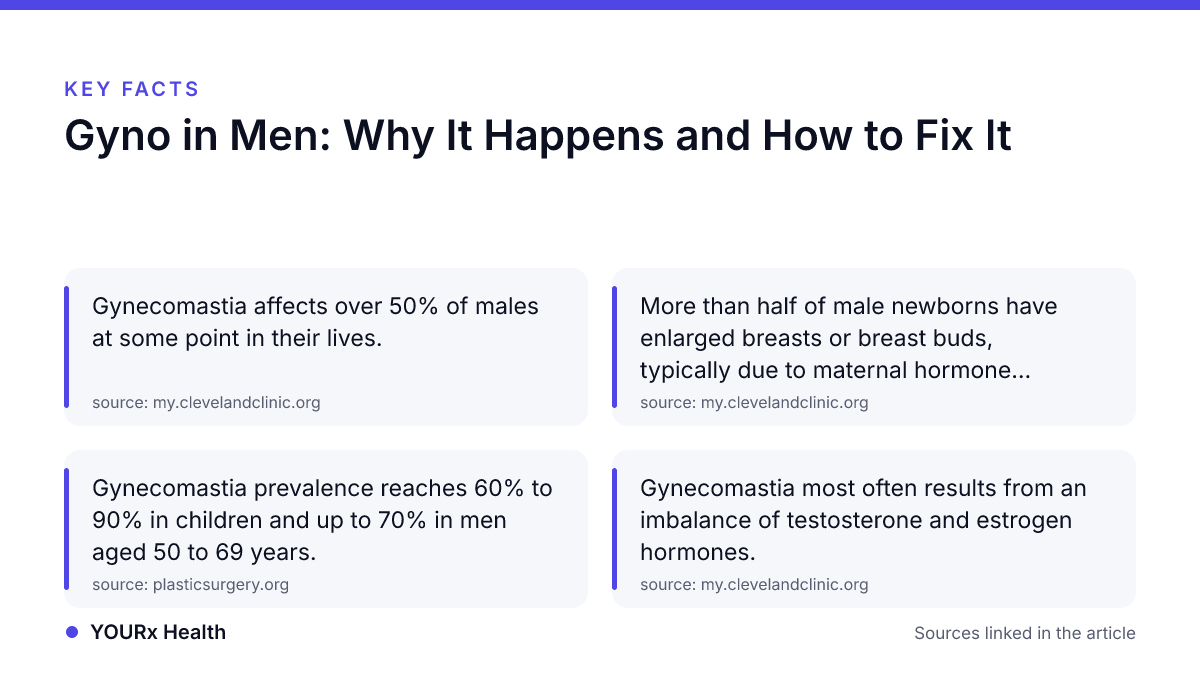
- It’s far more common than most men realize. Prevalence reaches 60% to 90% in children and up to 70% in men aged 50 to 69, according to the American Society of Plastic Surgeons.
- True glandular gyno from a hormone imbalance can often be treated with medication (TRT protocols, anastrozole, weight management) before surgery becomes necessary.
- Fat-only chest puffiness (pseudogynecomastia) responds to weight loss. Firm glandular tissue that’s been there for years usually needs surgical removal.
- A telehealth physician can order the labs, read the ratio, and start treatment without you ever sitting in a waiting room.
Mark is 44, works sales, and hasn’t skipped a leg day in fifteen years. Last spring his shirts started fitting differently. Not around the gut. Around the chest. Tender, slightly swollen, worse on the left. He chalked it up to stress-eating through a bad quarter.
Thank you for reading this post, don't forget to subscribe!
It wasn’t that. His labs came back with testosterone at the low end of normal and estradiol running high. That combination is the real story behind most cases of gyno in men, and it’s the part most articles skip over in favor of vague talk about “hormones.”

Table of Contents
- What Is Gyno in Men, Exactly?
- What Is the Main Cause of Gyno in Men?
- Is Male Gyno Reversible?
- How Do Men Fix Gynecomastia?
- What Does the Math on Hormone Ratios Actually Look Like?
- What Does Gynecomastia Treatment Cost, and Is It Covered?
- How Does a Telehealth Physician Actually Diagnose and Manage This?
- When Should You Actually See a Doctor About It?
- Frequently asked questions
What Is Gyno in Men, Exactly?
Gynecomastia is enlarged breast tissue in men. It happens when glandular tissue behind the nipple grows in response to a hormonal imbalance, most often too much estrogen relative to testosterone.
According to the Cleveland Clinic, gynecomastia most often results from an imbalance between testosterone and estrogen. Estrogen also suppresses luteinizing hormone, the signal your testicles need to release testosterone in the first place. So it feeds itself: rising estrogen pushes testosterone down, and falling testosterone lets estrogen’s effect on breast tissue run unchecked.
This is not a rare condition. Cleveland Clinic notes that more than half of male newborns have breast buds from maternal hormone exposure. It shows up again during puberty, and again later in life as testosterone declines. Gynecomastia affects over half of males at some point.
Pro tip: Pinch the tissue directly behind the nipple between your thumb and forefinger. A firm, rubbery disc about the size of a quarter or larger points to true glandular gynecomastia. Fat (pseudogynecomastia) feels soft and evenly spread across the whole chest with no distinct edge. That thirty-second test changes which treatment lane you belong in.
What Is the Main Cause of Gyno in Men?
The main cause is a hormonal shift toward estrogen dominance, and it usually comes from more than one direction at once. The most common triggers:
- Age-related testosterone decline. Testosterone tends to drift down year over year starting in your 30s, while estrogen production doesn’t fall at the same pace. The absolute numbers matter less than the ratio between them.
- Excess body fat, especially visceral fat. Fat tissue contains aromatase, the enzyme that converts testosterone into estrogen. More belly fat means more conversion, which is why weight gain and gyno so often arrive together.
- Certain medications. Some blood pressure drugs, anti-androgens, anabolic steroid use (the crash after cycling off is a classic one), and certain anti-anxiety medications can all trigger breast tissue growth.
- Underlying conditions. Thyroid problems, kidney or liver disease, and testicular issues disrupt the same balance.
- Puberty. Teenage gyno is extremely common and usually temporary, driven by the hormone swings of adolescence.
If you’re also dealing with low libido, flat energy, muscle that’s harder to build than it used to be, or foggy concentration, that cluster of symptoms for low testosterone in men travels with gyno for a reason. Same root cause.
Is Male Gyno Reversible?
Often, yes. The timeline depends on what caused it and how long it’s been sitting there.
Puberty-related gyno usually resolves on its own as hormones settle, typically within a year or two. Adult gyno driven by low testosterone, high estradiol, or heavy aromatization from body fat frequently improves once the imbalance is corrected, and in our experience the men who come in within a few months of noticing the change get the best results.
The hard cases are the old ones. Glandular tissue that’s been present for a year or more can fibrose, meaning it stiffens into something closer to scar tissue than active gland. Here’s the practical tell: fresh glandular tissue is usually tender and moves a little under the skin. Fibrosed tissue is typically painless, hard, and feels anchored in place. Once it gets there, medication can stop the growth and reduce the surrounding fat, but shrinking the gland itself generally takes excision.
That’s the part most general health sites leave out. The clock matters more than the size.
How Do Men Fix Gynecomastia?
By treating the cause rather than the tissue, which means the right first move is bloodwork, not a gym program or a surgery consult. A physician typically checks total testosterone, free testosterone, estradiol (ideally a sensitive assay, since standard assays are unreliable at male-range levels), and SHBG. From there, treatment falls into three lanes:
- Hormone optimization. If testosterone is low, a physician-guided TRT protocol restores levels into a healthy range, and for men who don’t want to deal with needles, comparing testosterone gel vs injections is worth doing before you commit to a delivery method. If estradiol is disproportionately high, some physicians add low-dose anastrozole for men, an aromatase inhibitor that blocks the conversion of testosterone into estrogen, and what anastrozole really does for men is worth understanding fully before you start on it.
- Weight and metabolic management. When body fat is driving aromatization, a supervised weight loss protocol, including GLP-1 medications through a program like our weight loss treatments, cuts down the tissue doing the converting. This matters more for men managing type 2 diabetes and weight loss together, since insulin resistance and visceral fat compound the same problem.
- Surgical correction. For long-standing, fibrosed tissue that no longer responds, a plastic surgeon removes it through liposuction, gland excision, or both. It’s a legitimate option. It’s just not the first move for tissue that’s still hormonally reversible.
Pro tip: Don’t start anastrozole on your own, and be skeptical of anyone who prescribes it without a sensitive estradiol test. Crashed estrogen is its own misery: dead libido, achy joints, and long-term bone density risk. Men who self-dose off a forum protocol usually overshoot, feel worse than they did with gyno, and blame the wrong hormone.
What Does the Math on Hormone Ratios Actually Look Like?
Here’s an illustrative walkthrough of how physicians think about the numbers, using the testosterone-to-estradiol ratio as shorthand. This is for understanding, not a formula to self-apply.
Say a 44-year-old’s labs come back with total testosterone at 320 ng/dL and estradiol at 48 pg/mL. Divide testosterone by estradiol: 320 ÷ 48 = 6.7. Reading that against his symptoms, body composition, and full panel, a physician might judge the picture too estrogen-heavy for his age and goals, then build a protocol combining testosterone support with a low-dose aromatase inhibitor.
Now imagine he responds over 90 days. Testosterone rises to 620 ng/dL, estradiol drops to 32 pg/mL through therapy and roughly 12 pounds of fat loss. New ratio: 620 ÷ 32 = 19.4.
That’s the direction you want. Testosterone climbing, estradiol falling, glandular stimulation easing off. There’s no universal target number, because it depends on baseline, age, and how you actually feel, which is precisely why this needs a physician reading your panel instead of a chart you found on Reddit.
What Does Gynecomastia Treatment Cost, and Is It Covered?
Cost is where the two paths split hardest. Surgical correction is almost always classified as cosmetic by insurers unless there’s documented pain, infection, or another medical necessity, so most men pay out of pocket. Medication-based hormone management is an ongoing monthly cost covering labs, physician visits, and prescriptions, spread over time rather than dropped on a credit card in one afternoon.
Run the comparison yourself with this formula: monthly program cost × months before you reassess = your medication-path spend. Compare that against the surgeon’s all-in quote, which should include surgeon fee, anesthesia, facility, and compression garment.
An illustrative scenario with made-up but realistic numbers: a hormone program quoted at $199/month, run for six months before a full reassessment, comes to $199 × 6 = $1,194. A gynecomastia excision quoted all-in at $6,500, paid entirely out of pocket. The medication path is about 18% of the surgical path ($1,194 ÷ $6,500 = 0.18). Even if hormone correction only partially works, you’ve spent under a fifth of the surgical price and you now know your actual hormone status, which the surgeon will want anyway.
The threshold I’d use: if the gland has been there less than a year and your labs are off, correct hormones first. If it’s been years, it’s hard and painless, and your labs come back clean, stop delaying and book the surgical consult.
| Factor | Medication-based approach | Surgical approach |
|---|---|---|
| Best suited for | Recent onset, hormone-driven, or fat-related gyno | Long-standing, fibrosed glandular tissue |
| Typical timeline | 3 to 6 months to see meaningful change | One procedure, then weeks of recovery |
| Insurance coverage | Varies; tied to hormone therapy coverage, not gyno | Rarely covered; usually classified as cosmetic |
| Effect on tissue | Can shrink or resolve it if caught before fibrosis | Physically removes existing tissue |
| Ongoing commitment | Regular labs and check-ins to hold the balance | Minimal after recovery, unless imbalance persists |
| Invasiveness | Bloodwork, medication, monitoring | Anesthesia, incisions, downtime |
Pro tip: Ask any surgeon whether they’ve reviewed your hormone panel before scheduling. If they haven’t, get one first. Removing the gland without fixing the imbalance that grew it is how men end up paying twice.
How Does a Telehealth Physician Actually Diagnose and Manage This?
The same way an in-person endocrinologist would, minus the waiting room: health history, video consult, targeted labs at a local draw site, then a monitored plan that gets adjusted as your numbers move.
At YOURx Health, you complete a secure health profile, meet a board-certified physician by video, get bloodwork ordered locally, and receive a plan built around your actual results. That might be testosterone optimization, a metabolic approach through our weight loss protocols, or a peptide-based recovery add-on. Medications ship discreetly. Follow-up labs confirm the ratio is genuinely moving instead of you guessing from how you feel on a Tuesday.
If you don’t know where your levels sit, our guide on how to increase testosterone covers the lifestyle levers worth pulling alongside medication. Sleep, resistance training, and body composition all push on the same ratio.
Our founder built this company after living with a chronic hormonal condition himself. That’s a large part of why the model leans so hard on lab monitoring instead of one-size-fits-all prescribing. You can read that story on our about page.
When Should You Actually See a Doctor About It?
See a doctor if the tissue hurts, is growing fast, shows up on only one side, or comes with nipple discharge. Those warrant ruling out causes beyond hormones, as both the Mayo Clinic and the Cleveland Clinic note.
Even when nothing’s urgent, gyno is worth addressing instead of hiding under looser shirts. In adult men it’s frequently the visible marker of an imbalance that’s already costing you energy, libido, and muscle, which is what most guys actually want fixed. Book a same-day consult through YOURx Health’s treatment programs and get labs ordered before you decide anything else.
Frequently asked questions
Can gyno come back after surgery?
Yes, if the underlying imbalance that caused it isn’t corrected. Surgery removes the existing gland, but if testosterone stays low or estradiol stays elevated, new tissue can develop. That’s why physicians increasingly want hormone testing both before and after surgical correction.
Does gyno always show up on both sides equally?
No. It’s common for one side to be noticeably worse, especially early on. Uneven presentation by itself isn’t alarming. If one side is dramatically larger, firmer, or painful compared to the other, have a physician examine it directly to rule out other causes.
Will losing weight alone get rid of gyno?
Depends on whether you’re dealing with fat or gland. Weight loss shrinks the fat component and reduces the aromatization feeding the imbalance. A firm, rubbery disc behind the nipple won’t disappear from dieting and needs hormone correction or surgical removal.
Before you assume it’s just weight, get your testosterone and estradiol checked. Start a consult with YOURx Health and find out what your ratio is telling you.