
TL;DR
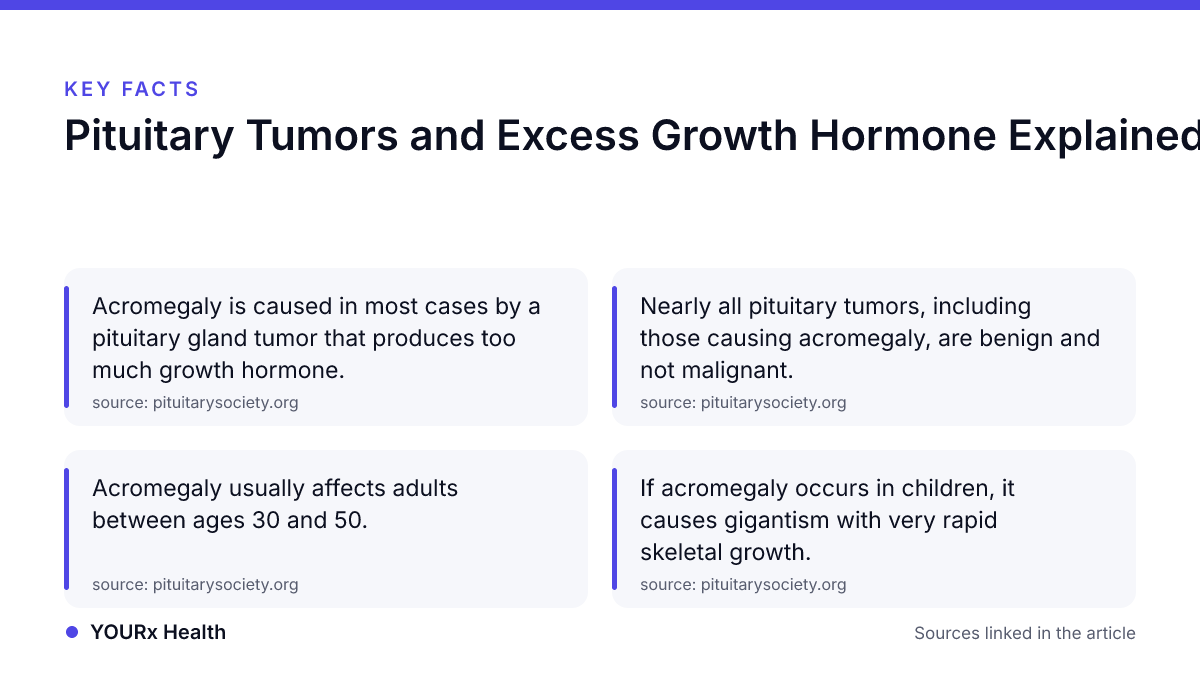
- Nearly all pituitary tumors, including the ones that cause growth hormone excess, are benign, not cancerous. The condition is serious, but it isn’t a cancer diagnosis.
- Growth hormone-secreting pituitary tumors typically show up in adults between ages 30 and 50. In children, the same tumor causes gigantism instead of acromegaly, because growth plates are still open.
- Excess growth hormone drives up IGF-I, and IGF-I is what actually causes the bone and tissue overgrowth doctors look for.
- Left untreated, it raises real risk for diabetes, high blood pressure, heart disease, and colon polyps, plus nerve compression problems like carpal tunnel syndrome.
- Diagnosis requires an endocrinologist and imaging. No telehealth hormone protocol treats this, but telling it apart from ordinary age-related hormone decline matters if you’re chasing fatigue, low libido, or stubborn weight gain.
You renew your driver’s license, glance at the old photo, and something is off. The jaw looks wider. Your wedding ring stopped sliding off two years ago and you blamed salt. Your shoe size went up at 41.
Thank you for reading this post, don't forget to subscribe!
Those three details together are a pattern, and the phrase behind it is one you’ve probably hit while searching: pituitary gland tumors can secrete excess amounts of growth hormone. That’s acromegaly in adults, gigantism in kids, and it’s identifiable once you know what you’re looking at.

Table of Contents
- Can a pituitary tumor cause growth hormone problems?
- What happens if the pituitary gland produces too much growth hormone?
- What are the warning signs you shouldn’t ignore?
- How is excess growth hormone from a pituitary tumor diagnosed?
- What are the treatment options and what outcomes can you expect?
- How does growth hormone excess affect metabolic health and longevity?
- Is this different from normal age-related hormone decline?
- Frequently asked questions
Can a pituitary tumor cause growth hormone problems?
Yes. A pituitary tumor is the cause in the overwhelming majority of cases. The Pituitary Society states that acromegaly, the medical term for growth hormone excess in adults, is caused in most cases by a tumor on the pituitary gland producing too much growth hormone.
The pituitary sits at the base of your brain and normally releases growth hormone in controlled pulses, mostly during deep sleep. A tumor ignores that rhythm entirely and keeps secreting.
Here’s the part that surprises people. These tumors are rarely malignant. The Pituitary Society is explicit that nearly all pituitary tumors, including the ones causing acromegaly, are benign. That doesn’t make the condition harmless. Untreated growth hormone excess reshapes your skeleton, strains your heart, and wrecks your metabolism for years before most people get diagnosed. But the conversation with your doctor is about management and often cure, not oncology.
What happens if the pituitary gland produces too much growth hormone?
Excess growth hormone pushes the liver and other tissues to overproduce IGF-I (insulin-like growth factor 1), and IGF-I is what actually drives the bone and soft tissue growth seen in acromegaly, according to the Pituitary Society. The growth hormone is the signal. IGF-I does the damage: thickened bone, enlarged organs, stiff joints.
The clinical picture depends entirely on when it starts:
- In adults (typically ages 30–50): growth plates have already closed, so bones don’t lengthen. They thicken. That’s why you see enlarged hands, feet, jaw, and brow rather than a height increase.
- In children: growth plates are still open, so the same excess hormone causes gigantism, with rapid and excessive skeletal growth, per the Pituitary Society.
- Beyond bone and muscle: growth hormone also acts on the liver (where IGF-I is produced), the heart, the kidneys, and the skin, a point covered in standard physiology coursework on hormone targets, per A&P lab materials on Quizlet.
| Fact | Detail | Source |
|---|---|---|
| Cause | Nearly always a pituitary tumor overproducing growth hormone | Pituitary Society |
| Malignancy | Nearly all of these tumors are benign, not cancerous | Pituitary Society |
| Typical onset | Adults, usually ages 30–50 | Pituitary Society |
| In children | Causes gigantism with rapid skeletal growth | Pituitary Society |
| Mechanism | Excess GH raises IGF-I, driving bone and tissue growth | Pituitary Society |
| Health risks | Diabetes, high blood pressure, heart disease, colon polyps | Pituitary Society |
| Nerve effects | Hand tissue overgrowth can compress nerves, causing carpal tunnel | Pituitary Society |
What are the warning signs you shouldn’t ignore?
Acromegaly builds so slowly that it hides in plain sight. The changes arrive a fraction at a time, and both patients and doctors file them under normal aging. Watch for these as a cluster, not one by one:
- Hands and feet that outgrow old rings and shoes. A ring that has to be cut off, or a shoe size climbing in your 30s or 40s with no weight change, is a classic early flag.
- New tingling or pain in the hands. Overgrown hand tissue compresses the nerves at the wrist and produces carpal tunnel syndrome, one of the more specific signs the Pituitary Society points to.
- A face that’s restructuring. Teeth drifting apart so your bite changes, a heavier jaw or brow, a thicker nose. Dentists sometimes notice this before physicians do, because they’re the ones tracking your bite over a decade.
- Deeper voice and louder snoring. Airway soft tissue thickens too, which is why sleep apnea travels with this condition so often.
- Joint pain that doesn’t match your activity level. Cartilage and bone changes cause real chronic discomfort, not just wear and tear.
- New or worsening blood sugar problems. Growth hormone drives insulin resistance directly, which is a big part of why diabetes shows up as a complication.
Pro tip: pull your driver’s license renewals, or any set of photos spaced five to ten years apart, and line them up side by side. Structural change across that span is objective evidence you can hand a physician. “My jaw and brow look different in these three photos” gets a referral. “I don’t look like myself” gets a shrug.
How is excess growth hormone from a pituitary tumor diagnosed?
Diagnosis starts with a blood test for IGF-I. It’s a stable marker of average growth hormone activity, so it doesn’t depend on catching a hormone pulse that a random draw would miss. If IGF-I comes back elevated, the usual next step is a glucose suppression test. You drink a glucose solution, and a healthy pituitary responds by dropping growth hormone output. A secreting tumor doesn’t suppress the way it should.
Once the labs point to excess growth hormone, imaging finds the source. An MRI of the pituitary shows the tumor, its size, and whether it’s pushing on nearby structures like the optic nerves. Lab evidence plus imaging is the standard pairing for diagnosing hormone-secreting pituitary tumors, a process laid out in the NCBI StatPearls overview of hyperpituitarism.
One practical note: ask that the MRI be ordered as a dedicated pituitary protocol with thin slices. A routine brain MRI can read as normal while a small secreting adenoma sits there unseen. If your labs say one thing and a standard brain scan says another, the scan is often the weaker piece of evidence.
This is not a diagnosis you manage on your own. If your primary care physician or endocrinologist suspects it, expect a coordinated workup with endocrinology and neurosurgery.
What are the treatment options and what outcomes can you expect?
Treatment usually combines approaches, chosen on tumor size, location, and how much hormone it’s pumping out:
- Surgery (transsphenoidal resection). The tumor comes out through the nasal cavity. For many patients this is first-line and can normalize hormone levels outright, especially with smaller, well-contained tumors.
- Medication. Somatostatin analogs and growth hormone receptor antagonists control hormone output when surgery isn’t fully curative or isn’t an option. Often used long-term.
- Radiation therapy. Held in reserve for tumors that persist after surgery or can’t be fully removed. It works gradually, shrinking tissue and lowering secretion over months to years.
Outcomes hinge on how early the tumor is caught. According to Mayo Clinic, pituitary tumors in general are common and often treatable, and bringing IGF-I back to normal stops further tissue overgrowth while cutting cardiovascular and metabolic risk.
What treatment can’t do is undo structural change that has already happened. Enlarged bone doesn’t shrink back. Soft tissue swelling in the hands and face often improves once hormone levels drop, but a widened jaw stays widened. That gap between what’s reversible and what isn’t is the entire argument for pushing on symptoms now instead of giving it another five years.
How does growth hormone excess affect metabolic health and longevity?
It’s one of the clearest examples of a single hormone imbalance dismantling metabolic health. Excess growth hormone drives insulin resistance directly, which is why diabetes shows up so consistently as a complication, alongside high blood pressure and elevated cardiovascular risk, per the Pituitary Society. The body stops responding properly to its own insulin — a mechanism that overlaps with what’s at work when the pancreas can’t produce insulin at all, as explained in our guide to insulin therapy for type 1 diabetes. Blood sugar climbs — a pattern worth understanding alongside the broader differences covered in our type 1 vs type 2 diabetes explainer — and the heart carries extra load, year after year.
Now sit with the contrast. This is too much growth hormone activity causing metabolic harm. The far more common problem we see in adults in their 30s through 50s is the mirror image: hormone levels that are too low, feeding weight gain, fatigue, and blood sugar trouble. If insulin resistance or stubborn weight gain is your actual concern, it’s usually driven by that opposite pattern. Our guides on losing weight with insulin resistance and metformin’s real effect on the scale walk through what that looks like and how it’s treated medically.
Cortisol tells a related story. Like growth hormone, it runs on a feedback loop that can break in either direction, and both extremes hit energy, sleep, and metabolic function in their own way. If fatigue is your main complaint and you want to know whether cortisol is part of it, our cornerstone guide on low cortisol symptoms and what actually helps covers that side of the equation.
Is this different from normal age-related hormone decline?
Almost always, yes, and the distinction matters enormously if you’re a man in your 30s or 50s dealing with low energy, low libido, or muscle loss.
A growth hormone-secreting pituitary tumor causes an excess of hormone activity with a specific fingerprint: enlarging hands and feet, carpal tunnel, facial restructuring. What most men in that age range actually have is the opposite problem. Testosterone and growth hormone output decline with age, producing fatigue, reduced libido, and lost muscle through a completely different mechanism. Same complaints, reversed cause, different treatment.
That’s exactly why you get a proper workup before self-treating with over-the-counter “GH boosters” or unregulated peptides bought online. If your labs point to low testosterone rather than a pituitary tumor, it’s worth understanding testosterone gel versus injections before you pick a route. If peptide therapy is what you’re curious about for recovery and cellular energy, our breakdown of what peptide injections actually do explains the mechanism without the hype. Women aren’t exempt from hormone-driven fatigue and low libido either. The presentation differs and it gets missed constantly, which is why we wrote about low testosterone symptoms doctors miss in women.
Pro tip: if a doctor calls your symptoms “just aging” without ordering IGF-I, testosterone, and a thyroid panel, ask for those three by name. Say you want them documented in the chart either way. A five-minute conversation and one blood draw is the difference between guessing and knowing.
Frequently asked questions
What size pituitary tumor needs to be removed?
Size alone doesn’t decide it. Doctors weigh the tumor’s size against whether it’s actively secreting excess hormone, pressing on the optic nerves, or causing other symptoms. A small tumor aggressively producing growth hormone may need treatment sooner than a larger, hormonally silent one. An endocrinologist and neurosurgeon make that call together from your specific imaging and labs.
Besides bone and muscle, what other organs does growth hormone target?
The liver, first and foremost, since that’s where most IGF-I gets produced. It also acts on the heart, kidneys, and skin, a point commonly covered in anatomy and physiology coursework on hormone regulation, per this A&P flashcard set. That range of targets is why untreated excess eventually shows up as cardiovascular and kidney strain, not just bigger hands.
Should I change my diet if I have a growth hormone-secreting tumor?
Diet won’t shrink the tumor or correct the hormone imbalance. That takes surgery, medication, or radiation aimed at the pituitary. What diet can do is blunt the downstream damage, especially blood sugar control, since excess growth hormone drives insulin resistance. A lower-glycemic eating pattern eases that load while medical treatment goes after the source.
If the hand and joint changes sound familiar, or new blood sugar problems have arrived alongside fatigue, stop reading symptom lists and get numbers. Book a same-day consult with a board-certified physician through YOURx Health, get IGF-I and a full hormone panel ordered, and find out whether you’re looking at a hormone excess, a deficiency, or something else entirely.