TL;DR
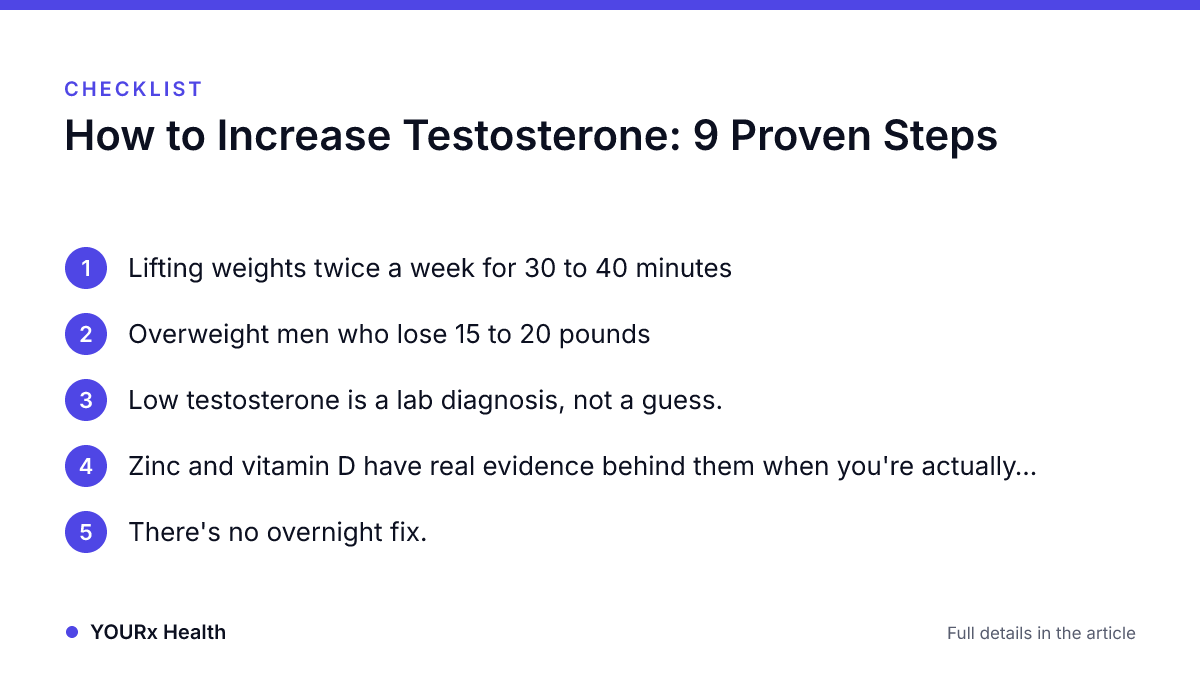
- Lifting weights twice a week for 30 to 40 minutes measurably boosts testosterone and keeps your metabolism elevated for a day or two afterward, according to University of Utah Health.
- Overweight men who lose 15 to 20 pounds often see significant testosterone improvement, per the same University of Utah research. It’s the most reliable lever most men have.
- Low testosterone is a lab diagnosis, not a guess. Urology Care Foundation guidance points to morning blood draws showing below-range levels alongside symptoms, not symptoms alone.
- Zinc and vitamin D have real evidence behind them when you’re actually deficient. Most shelf “testosterone boosters” don’t, per GoodRx.
- There’s no overnight fix. The fastest realistic path stacks resistance training, fat loss, sleep repair, and a lab-confirmed diagnosis before you spend a dollar on anything else.
Half the men who walk into a consult convinced they have low testosterone had their blood drawn at 3 p.m. after a skipped lunch. That number means very little. Testosterone peaks in the morning, and an afternoon draw can turn a perfectly normal man into a patient.
Thank you for reading this post, don't forget to subscribe!
So start with the real answer. You raise testosterone by lifting weights, dropping excess body fat, sleeping enough, and cutting back on alcohol, then confirming with a properly timed blood test that you were low to begin with. Men who lose 15 to 20 pounds of excess weight see meaningful gains, and lifting just twice a week for 30 to 40 minutes gives you a hormonal and metabolic bump that lasts a day or two past the workout, according to University of Utah Health. If those changes don’t move your labs in a few months, that’s when a physician-supervised protocol becomes the right conversation. Not another supplement bottle.

Table of Contents
- How Can You Tell If Testosterone Is Low?
- How Do I Raise My Testosterone Fast?
- Which Foods Raise Testosterone?
- How Do Prescription Testosterone Therapies Compare?
- What Lab Tests and Monitoring Schedule Do Doctors Use?
- Frequently asked questions
How Can You Tell If Testosterone Is Low?
Low testosterone shows up as a cluster of symptoms confirmed by blood work, never as one obvious sign. The usual list: reduced sex drive, fewer spontaneous erections, muscle loss despite training, new fat around the waist, fatigue that sleep doesn’t fix, brain fog, low mood, thinning hair.
Here’s the part men skip. Urology Care Foundation notes those symptoms only count as testosterone deficiency when they come paired with a below-range blood test. Plenty of men with normal labs feel wrecked for entirely different reasons. Treat the wrong problem and you lose six months.
Women with low testosterone get overlooked almost entirely, since the hormone gets filed under “men’s health.” Low libido, unexplained fatigue, loss of muscle tone, and mood changes around perimenopause can all trace back to declining testosterone. Either way, a real workup looks at total and free testosterone, not the single number that came off a routine physical.
Pro tip: Book the draw before 10 a.m., and don’t do it the morning after a night of drinking or four hours of sleep. Both drag the number down. If you want a result you can actually build a plan on, show up rested, fasted, and early.
How Do I Raise My Testosterone Fast?
There’s no legitimate overnight spike, but you can move the number within weeks by hitting the biggest levers first: training, fat loss, sleep, alcohol. This is the order I’d give a patient, sequenced by what works fastest and what’s easiest to keep doing.
- Get baseline labs before you change anything. No starting number means no way to know whether you’re deficient or just tired. Ask for total testosterone, free testosterone, SHBG, and LH at minimum, drawn in the morning.
- Start lifting at least twice a week. Thirty to 40 minutes of resistance training, twice weekly, measurably raises testosterone and keeps metabolism running hot for a day or two afterward (University of Utah Health). Daily gym sessions aren’t the price of admission. Two hard ones are.
- Lose the weight, especially around your midsection. Fat tissue converts testosterone into estrogen. Overweight men who drop 15 to 20 pounds often see significant testosterone improvement as a direct result. If you only do one thing on this list, do this one.
- Fix sleep before you fix your diet. Most testosterone production happens during deep sleep, and chronically short nights suppress it no matter how well you train or eat. Snoring heavily? Waking up gasping? Ask about sleep apnea screening. Untreated apnea is one of the most common fixable causes of low T we see.
- Cut the nightly drink. Heavy regular drinking suppresses production in the testes and pushes estrogen conversion up. Going from every night to two or three nights a week shows up in follow-up labs for a lot of men.
- Eat enough protein and fat. Testosterone gets built from cholesterol, so chronically low-fat, low-calorie eating starves the machinery. The rule of thumb we use in practice: roughly 0.7 to 1 gram of protein per pound of bodyweight, and don’t let dietary fat fall below about 20% of daily calories.
- Correct genuine deficiencies, zinc and vitamin D specifically. These are the two micronutrients with real clinical support, and only when you’re deficient rather than already topped off (GoodRx). A cheap blood panel settles it.
- Review your medication list with a doctor. Opioids, some antidepressants, and long-term steroid use all suppress testosterone. Adjusting or swapping one drug sometimes resolves “low T” without touching hormones.
- If labs confirm deficiency and lifestyle changes plateau, get a physician involved. Give diet, training, and sleep an honest 8 to 12 weeks. Still low? A supervised protocol beats stacking more powders. YOURx Health’s treatments page and how it works walk through what that looks like over telehealth, including our triple therapy protocol for men working on hormones, energy, and performance at once.
Show the math. Say you’re carrying 20 extra pounds and you want the 1-pound-per-week pace most physicians recommend. A pound of fat runs about 3,500 calories, so 3,500 ÷ 7 = a 500-calorie daily deficit. At that rate, 20 pounds ÷ 1 pound per week = 20 weeks. Pair those five months with two lifting sessions a week and you land squarely in the 15-to-20-pound range where the Utah research saw testosterone gains. Run it on your own numbers: divide the pounds you want gone by the weekly rate you can actually hold, and that’s your honest timeline. Starting weight and activity level shift the arithmetic, but the formula doesn’t change.
What Most People Miss
Most men jump to supplements or gray-market vials and skip the boring work, which is exactly backward. Four mistakes come up over and over:
- Assuming any decline is a disease. Testosterone drifts down gradually as men age. Some drop is expected biology, not a diagnosis.
- Retesting way too soon. Labs need six to eight weeks to reflect a real change. Testing after two weeks of lifting measures noise and nothing else.
- Ignoring SHBG. Total testosterone can read normal while free, usable testosterone sits low, because sex hormone-binding globulin is holding it hostage. A full panel catches that. A lone total-T number doesn’t.
- Chasing symptoms without a diagnosis. Fatigue, low libido, and weight gain overlap heavily with thyroid disease, depression, and sleep apnea. A proper workup rules those out before anyone assumes hormones.
Which Foods Raise Testosterone?
No single food raises testosterone. What food does is supply the raw material: zinc, vitamin D, cholesterol, and enough total calories. Prioritize oysters and beef for zinc, fatty fish and egg yolks for vitamin D and cholesterol, leafy greens with nuts and olive oil for magnesium and fats. The Air Force Medicine review of natural testosterone strategies makes the case plainly: whole-food nutrition plus training plus sleep outperforms supplement stacks for legal, sustainable support.
One thing worth being honest about. If your lab report already flags you as vitamin D deficient, salmon twice a week isn’t going to fix it. The men we see in that bucket are indoor workers in northern states in February, and food alone rarely moves their number into range. A dosed supplement and a retest will.
The bigger nutrition mistake is the aggressive crash diet. A man who slashes to 1,200 calories a day with fat down near nothing is trying to lose weight to raise testosterone while simultaneously removing the substrate his body builds testosterone from. Fat loss helps. Starvation doesn’t. Keep the deficit moderate, keep the fat in, keep lifting.
On supplements, be skeptical. Zinc and vitamin D show real benefit when you’re deficient. Ashwagandha has some early evidence from small studies. DHEA, fenugreek, and most over-the-counter T-boosters are marketed far harder than the evidence justifies, per GoodRx’s breakdown of testosterone supplements. Wanting to increase testosterone naturally through food and lifestyle first is the right instinct. Just don’t ask a bottle to do the job of weight training, sleep, and fat loss.
Pro tip: If a label promises to take your testosterone “to 1,000” or reverse a deficiency without a prescription, that’s marketing copy, not medicine. Also check the ingredient panel for proprietary blends. We’ve seen men come in with elevated hematocrit from a “natural” product that turned out to contain an unlisted steroid analog.
How Do Prescription Testosterone Therapies Compare?
Prescription testosterone comes in four main delivery forms. Which one fits depends on your tolerance for needles, how consistent you’ll actually be, and how your body absorbs it.
| Method | How it works | Dosing frequency | Side effects to watch | Best for |
|---|---|---|---|---|
| Injections (IM/SubQ) | Delivered into muscle or fat tissue | Weekly to biweekly | Site soreness; levels dip before the next dose | Men fine with self-injection who want strong, predictable absorption |
| Topical gels/creams | Absorbed through the skin | Daily | Skin irritation; transfers to partners and kids if not washed off | Needle-averse men who won’t forget a daily step |
| Oral capsules | Newer formulations avoid the liver strain of older oral T | Daily, with food | GI upset; absorption depends on eating fat with the dose | Men who want no needles and no messy skin application |
| Pellets | Implanted under the skin, releasing slowly | Every 3 to 6 months | Requires an in-office procedure; dose can’t be dialed back mid-cycle | Men who want to think about it twice a year |
Once you’re on a stable dose, effectiveness is broadly similar across all four. The real differences are convenience, how much your levels swing between doses, and how much discipline the method demands. Injections and pellets hold steadier. Gels and orals demand daily consistency and skip needles.
All of them should start only after labs confirm a genuine deficiency, and if you’re unsure whether a primary care doctor or a specialist should be running that workup, our guide on whether you need a urologist for low testosterone breaks down when that referral actually makes sense. A men’s hormone consult is where you sort out which one fits your life. Not a forum thread, and definitely not whoever’s selling you the product.
What Lab Tests and Monitoring Schedule Do Doctors Use?
Diagnosis starts with two separate morning blood draws showing below-range levels, paired with symptoms. One test isn’t enough, per Urology Care Foundation. A thorough baseline panel usually includes:
- Total and free testosterone. The core numbers, drawn before 10 a.m. while levels are at their daily peak.
- SHBG (sex hormone-binding globulin). Tells you how much of your total testosterone is actually available to your tissues.
- LH and FSH. Separate a testicular problem from a pituitary one, which changes treatment entirely.
- Estradiol. Excess fat tissue converts testosterone to estrogen, and this often explains symptoms total T can’t.
- CBC and metabolic panel. Safety baselines that matter more once treatment starts, since testosterone therapy can push red blood cell counts up.
After treatment begins, standard practice is to recheck labs at six to eight weeks to confirm the dose is landing in range, then move to every three to six months. That’s the cadence we run at YOURx Health: a physician video visit, a lab order, a follow-up check. Not a prescription followed by silence. Our how it works page lays out the full process, and men dealing with related performance issues often pair hormone treatment with something like our Stud ED ODT option instead of chasing each symptom separately.
If you’re already fairly sure the fatigue, the flat libido, and the stalled gym progress aren’t just a birthday problem, your next move is a blood draw before 10 a.m. YOURx Health runs same-day video consults with board-certified physicians, orders the right panel, and builds monitoring around your actual numbers. Our FAQs and the page about our approach cover the details before you book.
Frequently asked questions
How long does it take to see results from testosterone therapy?
In our experience, energy and libido tend to improve within the first month, while changes in muscle mass and body composition become visible closer to the three-to-six-month mark. Blood levels usually stabilize by six to eight weeks, which is why physicians recheck labs then rather than tinkering with the dose earlier.
Can testosterone therapy affect fertility?
Yes. Exogenous testosterone suppresses natural sperm production, so it isn’t appropriate for men actively trying to conceive unless additional medication is added to preserve fertility. Bring it up in your consult if fatherhood is anywhere on your near-term radar, because the plan looks different from standard TRT.
Is it normal for testosterone to feel low even with “normal” lab results?
Yes, and it’s more common than most men realize. Total testosterone can sit comfortably in range while elevated SHBG leaves very little free testosterone available to your tissues. That’s the single most frequent reason a man gets told his labs are “fine” while his symptoms are real, and it’s why the full panel matters more than a total-T number on its own.