
TL;DR
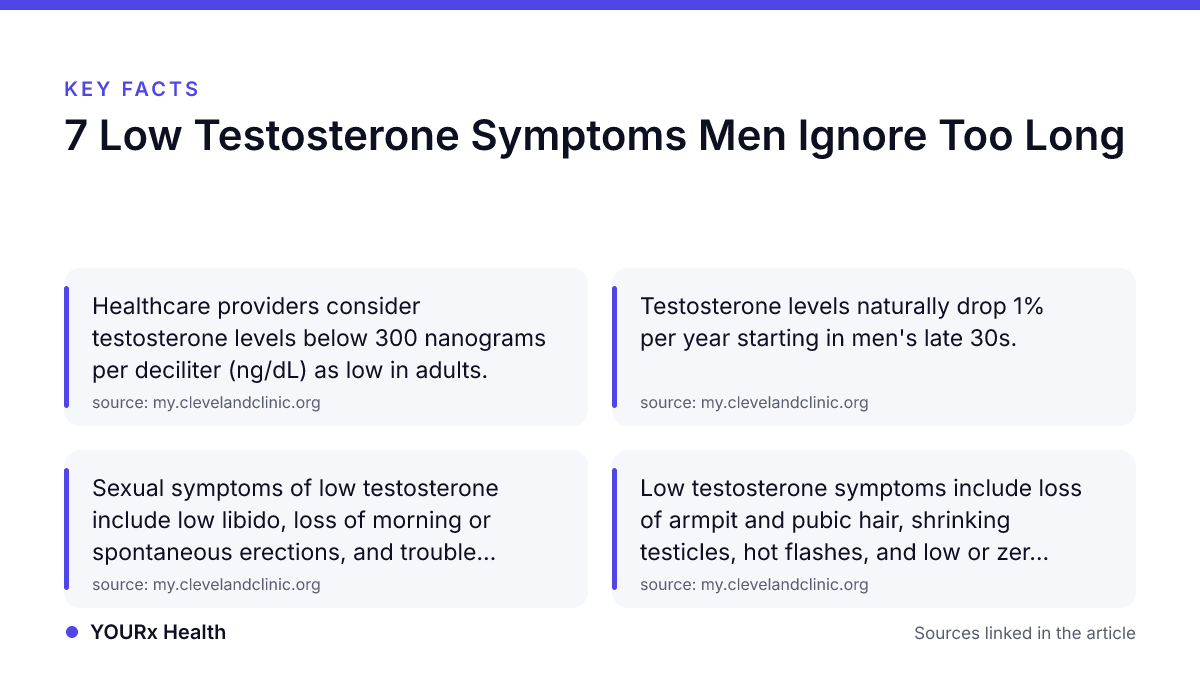
- Doctors define low testosterone as anything under 300 ng/dL in adult men, confirmed by at least two separate morning blood draws because levels swing throughout the day (Cleveland Clinic, UCSF Urology).
- Testosterone drops about 1% per year starting in a man’s late 30s, which is slow enough that fatigue, weight gain, and low libido creep in instead of announcing themselves.
- The most-ignored symptoms are the ones men blame on aging or stress: low energy, lost morning erections, shrinking muscle, brain fog, and mood changes.
- Run the 1%-per-year math and natural decline alone almost never drops a healthy man below 300 ng/dL in his 40s or 50s. A number that low points to something other than birthdays.
- Some symptoms reverse with treatment and some don’t fully bounce back, especially fertility and bone density after years of untreated deficiency.
Most men don’t notice low testosterone the day it starts. They notice it a year later, when the gym stops working the way it used to, sex feels like an obligation, and they’re asleep on the couch by 9 p.m.
Thank you for reading this post, don't forget to subscribe!
The clinical symptom list is longer than most men expect: low libido, loss of morning or spontaneous erections, trouble getting or keeping an erection, loss of armpit and pubic hair, shrinking testicles, low or zero sperm count, hot flashes, depressed mood, trouble concentrating, increased body fat, and decreased muscle mass and strength. Doctors classify a level below 300 nanograms per deciliter as low in adult men (Cleveland Clinic). If three or four of those sound like your last six months, stop guessing and get numbers.

Table of Contents
- How Can a Male Tell If His Testosterone Is Low?
- What Does the 1%-Per-Year Decline Actually Cost You?
- The 7 Symptoms Men Wait Too Long to Address
- Which Low Testosterone Symptoms Are Reversible?
- How Do Men Fix Low Testosterone?
- How Do I Raise My Testosterone Naturally?
- Is Low Testosterone Dangerous If Left Untreated?
- Frequently asked questions
How Can a Male Tell If His Testosterone Is Low?
Only a blood test tells you. Not a symptom quiz, not how you feel on a random Tuesday.
Urology guidance calls for at least two morning testosterone readings before anyone makes a diagnosis, because levels peak early in the day and vary meaningfully between draws (UCSF Urology). Men who do turn out to be low tend to report the same cluster of changes: reduced sex drive, weaker or fewer erections, persistent fatigue, muscle loss, irritability, and poor sleep (UCSF Urology).
Here’s how the symptoms men dismiss line up against what a physician is actually reading them as:
| Symptom you’re having | What men usually blame it on | What a clinician is checking for |
|---|---|---|
| Tired after 8 hours of sleep | Work stress, kids, age | Fatigue is one of the most consistently reported low-T complaints; also screens for sleep apnea and thyroid |
| No morning or spontaneous erections | “Just stress” | A documented sexual symptom of low testosterone, and one of the earliest to disappear |
| Lifts stalled or going backward | Bad programming, getting older | Decreased muscle mass and strength is a listed clinical sign, not normal aging alone |
| Foggy thinking, misplaced words | Too busy, too much screen time | Concentration and memory problems appear on the clinical symptom list |
| Short fuse, flat mood | Marriage, job, midlife | Depressed mood and irritability are documented signs, often noticed by a partner first |
| Belly fat that won’t move | Diet | Increased body fat plus muscle loss is the classic low-T body-composition pattern |
| Smaller testicles, thinning body hair | Rarely noticed at all | Testicular shrinkage and loss of armpit and pubic hair are strong physical indicators |
Pro tip: get drawn before 10 a.m. Afternoon testosterone runs lower even in men with perfectly normal levels, and a single low result without a confirming second test isn’t a diagnosis. It’s a reason to test again on a different morning.
What Does the 1%-Per-Year Decline Actually Cost You?
Run the arithmetic and it reframes the whole conversation. Testosterone falls roughly 1% per year starting in a man’s late 30s (Cleveland Clinic). The formula is simple compounding: starting level × 0.99^(number of years).
Take an illustrative 38-year-old at 650 ng/dL. Twelve years later, at 50:
650 × 0.99^12 = 650 × 0.886 = 576 ng/dL
Still comfortably above the 300 threshold. Now solve for how long natural decline alone would take him below 300: ln(300 ÷ 650) ÷ ln(0.99) = about 77 years. He’d be 115.
Even a man who starts lower, say 400 ng/dL at 38, needs ln(300 ÷ 400) ÷ ln(0.99) ≈ 29 years of pure age-related decline to cross under 300. That puts him at 67.
Here’s what that means for your decision. If you’re 44 and your morning labs come back at 240, aging didn’t do that. Something else is driving it, and that something is usually visceral fat, untreated sleep apnea, chronic stress, a medication you’re on, or a pituitary issue. Rule of thumb we use: any man under 55 testing below 300 deserves a workup for a cause, not just a prescription. Treating the number while ignoring the driver is how men end up on hormone therapy forever with half the symptom relief they were promised.
The 7 Symptoms Men Wait Too Long to Address
These are the ones patients tell us they sat on for months, sometimes years, before they said anything to a doctor.
- Fatigue that sleep doesn’t fix. Eight hours in bed, and you wake up feeling like you got four. Usually the first symptom men notice and the last one they act on.
- Losing your morning erection. Spontaneous nighttime and morning erections are a decent everyday proxy for hormones and blood flow working together. When they quietly stop, most men file it under stress.
- Strength that won’t respond to training. Decreased muscle mass and strength is a recognized clinical sign. If your working sets have gone backward across four solid months of consistent training and decent food, testosterone belongs on the list of suspects.
- Brain fog and memory slips. Trouble concentrating and losing the thread mid-sentence are on the clinical symptom list. Easy to blame on being busy.
- A mood that’s gone flat or short-tempered. Depressed mood and irritability are documented low-T symptoms, and in our experience the partner raises it before the patient does.
- Body fat around the midsection. Increased body fat paired with muscle loss is the classic pattern, and it feeds itself. Lower testosterone drives fat gain, and more fat tissue pushes testosterone lower still.
- Libido off a cliff. The symptom men will finally admit to, usually after ignoring the other six for a year.
Pro tip: log two or three of these for a month before your visit. Sleep quality, workouts, and libido are the easiest to track. A physician can move much faster on “zero morning erections in three weeks, bench is down 30 pounds since March, asleep by 8:45 most nights” than on “I just don’t feel like myself.”
Which Low Testosterone Symptoms Are Reversible?
The symptoms driven directly by hormone levels tend to improve once testosterone is restored and given time: libido, energy, mood, and the ability to build muscle again. Erectile function often improves as well, though how much depends on how long the deficiency ran untreated and whether blood flow or metabolic problems are also in the mix.
Less certain to fully reverse:
- Fertility and sperm production. External testosterone suppresses your body’s own signaling, so unmonitored self-treatment can dig the hole deeper. If you want kids in the next five years, say so at the first visit, before anything is prescribed. It changes the protocol.
- Muscle and bone density lost across years of low T. Rebuilding takes months of consistent resistance training on top of restored levels, not weeks.
- Testicular size, which is slow to change even with appropriate treatment.
This is why the monitoring matters more than the first prescription. Our physicians track labs and symptoms over time through YOURx Health’s treatments program because “start it and forget it” testosterone protocols reliably under-deliver on symptoms while over-suppressing what your body still makes on its own.
How Do Men Fix Low Testosterone?
Testosterone replacement is the standard first option. It’s rarely the whole answer by itself. A complete approach pairs hormone optimization with the metabolic and cellular pieces that produced the symptoms in the first place.
- Testosterone replacement therapy (TRT): Restores levels via injections, gels, or pellets, with follow-up labs to keep you in range instead of overshooting into acne-and-irritability territory.
- Peptide therapy: Compounds like sermorelin support your own growth hormone production, which pairs well with testosterone for energy and recovery. Recovery peptides like BPC-157 get used alongside hormone protocols for joints and connective tissue in men rebuilding lost muscle.
- Metabolic and weight support: When excess body fat is part of the loop, GLP-1 medication reduces the fat tissue that’s working against your hormones. That combined approach is sometimes bundled into a triple therapy protocol.
- Sexual health treatment separate from hormones: Erectile difficulty isn’t always a testosterone problem. Options like Stud ED ODT address blood flow and performance directly, which matters when normalized testosterone doesn’t fully resolve the symptom.
- Cellular energy support: Fatigue that persists after your numbers look good sometimes points to nutrient or mitochondrial issues, where NAD or B12/MIC can close the remaining gap.
Pro tip: if your entire plan is “get on TRT,” ask two questions before you start. What happens to my natural production and fertility while I’m on this? And what’s the monitoring schedule? A good telehealth provider builds the answers into your how it works process on day one instead of raising them after your first refill.
How Do I Raise My Testosterone Naturally?
Lifestyle changes genuinely help, and they move the needle less than medical treatment once you’re clinically low. Both things are true. The habits that matter most, in order of what we see produce results:
- Fix your sleep first. Short sleep suppresses production, and low testosterone worsens sleep, so this loop feeds itself. If you snore and wake up unrested, get evaluated for sleep apnea before you blame your hormones. We’ve seen men’s morning numbers move substantially on a CPAP alone.
- Lift weights, especially compound movements. Squats, deadlifts, presses, rows. Resistance training directly counters the muscle loss that comes with low T, and it’s the one habit that pays off whether your labs come back low or normal.
- Lose the visceral fat. Fat tissue converts testosterone into estrogen, so a bigger waist works against you on both sides of the equation.
- Cut back on alcohol. Four drinks on a Friday will show up in a Monday morning blood draw. If you’re testing, keep the week before honest or you’re measuring your bar tab.
- Check your micronutrients. Zinc, vitamin D, and magnesium deficiencies are common, cheap to test, and cheap to correct. Rule them out before assuming you need hormone therapy.
- Manage chronic stress. Sustained high cortisol competes with testosterone production, and if you’re noticing the classic low cortisol symptoms too, chronic stress could be dragging down more than one hormone at once. Stress that never lets up is a slow, steady drag on your levels.
For a deeper walkthrough, our guide on how to increase testosterone in 9 proven steps breaks each lever down with specifics. Do these regardless of what your labs say. Just don’t expect them to pull a 240 back over 500 on their own.
Is Low Testosterone Dangerous If Left Untreated?
It’s not an emergency. It is a pattern that compounds. More body fat, less muscle, worse mood, disrupted sleep, and no sex drive tend to drag other health markers down with them over the course of years. Untreated low T also shows up in ways men rarely connect to hormones at all, including hot flashes, a reduced sperm count, and even breast tissue growth, a condition covered in our breakdown of gyno in men (Cleveland Clinic; Urology Care Foundation), and it’s worth remembering hormone shifts aren’t just a men’s issue, either — plenty of the low testosterone symptoms doctors miss in women get written off as stress or aging in the same way.
Nothing about it is urgent the way chest pain is urgent. Nothing about it fixes itself, either. The men who wait five years to get tested almost universally wish they’d tested in year one.
If three or more of the seven symptoms above describe your last six months, the fastest path to a real answer is a morning lab draw and a conversation with a physician who treats this every day. YOURx Health was built by our founder, Vincent Broussard, to get evidence-based hormone and metabolic care out of elite clinics and into a same-day video visit, with labs, monitoring, and discreet delivery included. Check the FAQs or start your health profile and find out where your numbers actually land.
Frequently asked questions
What causes low testosterone in young men in their 20s and 30s?
In younger men it usually traces back to obesity, untreated sleep apnea, chronic stress, certain medications including opioids and some antidepressants, testicular injury, or a pituitary issue, rather than the age-related decline that begins after the late 30s. It’s less common at that age, which is exactly why it deserves labs and a cause hunt instead of a shrug about gym plateaus.
What does high testosterone look like, and is it something to worry about?
Too-high testosterone shows up as acne, an unusually short temper, heavy body hair growth, and suppressed sperm production. It’s rarely spontaneous. Far more often it’s the result of unmonitored dosing, which is why lab monitoring during any hormone protocol matters as much at the top of the range as the bottom.
Can low testosterone symptoms overlap with other conditions?
Yes, heavily. Fatigue, low libido, weight gain, and mood changes are also the calling cards of thyroid disease, depression, sleep apnea, and type 2 diabetes. That overlap is why diagnosis runs on blood work rather than symptoms, and why a physician should be reviewing your full panel instead of a single testosterone number.