
TL;DR
- Anastrozole blocks aromatase, the enzyme that converts testosterone into estradiol. It’s the reason doctors reach for it in men whose estrogen runs high relative to testosterone.
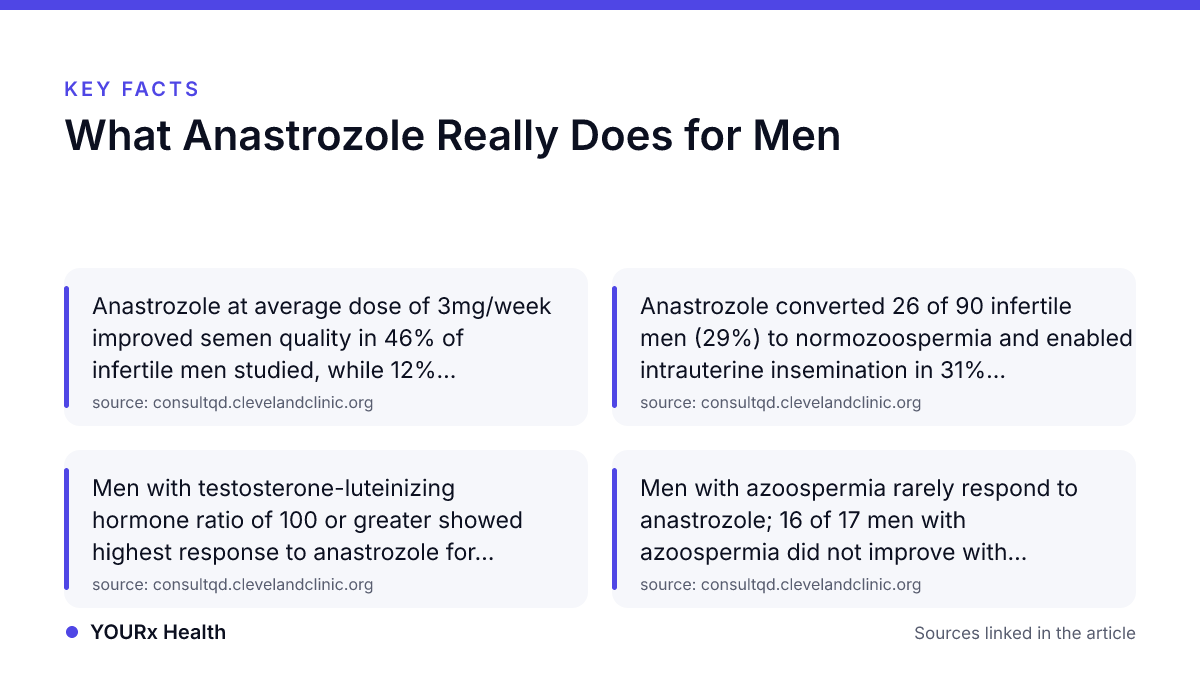
- In research cited by Cleveland Clinic, 46% of infertile men improved semen quality on an average dose of 3mg/week. Another 12% got worse.
- 26 of 90 men (29%) reached normozoospermia (normal sperm counts) on anastrozole, and it opened up IUI as an option for 31% who weren’t previously eligible.
- Men with a testosterone-to-LH ratio of 100 or higher respond best. Men with azoospermia almost never respond: 16 of 17 studied saw no improvement at all.
- Off-label use for TRT, libido, or bodybuilding carries a different risk profile than the FDA-approved breast cancer dose, and it demands lab monitoring rather than guesswork.
Spend an hour in any TRT forum and you’ll see anastrozole described two ways. Miracle fix for “high estrogen” symptoms. Or the drug that wrecked a guy’s joints and killed his libido. Both reputations are earned, and the difference between them usually comes down to whether anyone was drawing blood.
Thank you for reading this post, don't forget to subscribe!
Anastrozole is a legitimate, well-studied aromatase inhibitor. It was built for postmenopausal breast cancer patients, not for men chasing a leaner physique or a better sex life. Used with monitoring, it solves real problems for a specific type of patient. Used carelessly, it creates new ones. Here’s where that line actually sits.

Table of Contents
- What does anastrozole do to a man?
- What are the benefits of taking anastrozole in men?
- How is anastrozole dosed and monitored for men?
- What is the dark side of anastrozole?
- Is anastrozole safe for long-term testosterone optimization?
- Ready to find out if anastrozole fits your protocol?
- Frequently asked questions
What does anastrozole do to a man?
Anastrozole stops the aromatase enzyme from converting testosterone into estradiol, which lowers circulating estrogen. That matters because men on testosterone replacement therapy sometimes aromatize too much of their dose. The result is water retention, mood swings, glandular breast tissue growth, and flat libido despite a total testosterone number that looks great on paper.
Pull the conversion back and the testosterone-to-estradiol ratio shifts into a range where TRT delivers what it’s supposed to. It’s also used off-label in male infertility, because some men with poor sperm parameters have a hormone ratio that anastrozole can correct.
One distinction trips people up constantly: anastrozole is not a testosterone booster. It doesn’t add testosterone. It reduces what gets converted away. If your total testosterone is genuinely low, anastrozole alone won’t fix that, and you need a plan that addresses production rather than conversion. Our guide on how to increase testosterone covers what to check first if low energy, low libido, or lost muscle are your starting symptoms.
What are the benefits of taking anastrozole in men?
The best-documented benefit is in male infertility, where a study reviewed by Cleveland Clinic found measurable gains for a specific subset of men.
- Improved semen quality. 46% of infertile men studied saw semen quality improve on an average dose of 3mg/week. It isn’t risk-free: 12% saw quality decline instead.
- A path to natural conception or IUI. 29% of the 90 men studied converted to normozoospermia, and treatment made intrauterine insemination possible for 31% of men who weren’t previously eligible.
- Reduced gynecomastia risk on TRT. When testosterone therapy drives estradiol too high, cutting the conversion can prevent or shrink glandular breast tissue before it becomes a surgical problem.
- Better return on a TRT protocol. Men whose estradiol has been running hot often report the libido and mood improvements they expected from testosterone but weren’t getting.
Pro tip: Don’t chase a single estradiol number. The testosterone-to-LH ratio tells you more about who will respond. Research summarized by Cleveland Clinic found men with a ratio of 100 or higher responded best, while men with azoospermia almost never responded regardless of dose.
Here’s how that math works. A patient’s total testosterone comes back at 700 ng/dL with an LH of 5 IU/L. Divide 700 by 5 and you get 140, comfortably above the 100 threshold associated with the strongest response in the Cleveland Clinic-reported research. That’s a man worth treating.
Now flip it. Testosterone at 300 ng/dL with LH at 8 IU/L gives 37.5. Weak case. Anastrozole is unlikely to move much there, and that’s before you check whether he’s azoospermic, which would make the odds worse still. Run your own numbers off your last panel before you talk to anyone about a prescription. Two figures, one division, and you’ll know which conversation you’re having.
| Finding | Detail | Source |
|---|---|---|
| Semen quality improvement | 46% improved on ~3mg/week average dose; 12% declined | Cleveland Clinic |
| Conversion to normozoospermia | 29% (26 of 90 men) reached normal sperm counts | Cleveland Clinic |
| New eligibility for IUI | 31% of men previously ineligible qualified after treatment | Cleveland Clinic |
| Best responders | T:LH ratio of 100 or higher | Cleveland Clinic |
| Poor responders | Azoospermic men: 16 of 17 showed no improvement | Cleveland Clinic |
How is anastrozole dosed and monitored for men?
Nothing like the breast cancer protocol, and that gap is where most self-prescribed use goes sideways. The fertility research averaged around 3mg per week, spread across the week rather than taken as one dose. Anastrozole is commonly supplied as 1mg tablets, so 3mg/week works out to one tablet three days a week, or half a tablet six days a week if a physician wants steadier levels. Men using it for estradiol control alongside TRT are usually dosed well below that, because the goal is a nudge, not an aromatase shutdown.
According to Mayo Clinic, the approved labeling is built around consistent dosing with regular follow-up. That discipline matters just as much off-label.
| Use case | General approach | What gets monitored |
|---|---|---|
| Estradiol control on TRT | Low, often intermittent dosing timed to injection or application days | Estradiol, lipid panel, bone density over time |
| Male infertility protocol | Roughly 3mg/week on average in studied populations | Semen analysis, T:LH ratio, follow-up bloodwork |
| Unsupervised bodybuilding use | Higher, self-adjusted doses, frequently daily | Usually nothing, which is where problems start |
Timing is the detail most people miss. If you’re injecting testosterone twice a week, estradiol peaks a day or two after each shot, not evenly across the week. Dosing anastrozole on those peak days does more with less drug than spreading it out. Same with lab draws: pulling estradiol the morning before your next injection, at the trough, gives a misleadingly low reading. Draw at the same point in your cycle every time or the numbers aren’t comparable.
Pro tip: Never adjust anastrozole based on symptoms alone. Crashed estradiol feels remarkably like elevated estradiol. Low libido, flat mood, aching joints, poor sleep. Men self-treating off forum advice chase symptoms in circles for months because of it. One lab draw ends the argument.
If you’re on a protocol like TRT creams and suspect estradiol is running high, that’s a conversation for your physician and a blood panel, not a research-chemical website.
What is the dark side of anastrozole?
Over-suppression. Push estradiol too low and you swap one set of complaints for a worse set. Estrogen isn’t a hormone men need to eliminate; it supports bone density, joint lubrication, cognition, and libido in male physiology too.
- Joint and connective tissue pain. Low estradiol reduces joint lubrication. Aching shoulders, elbows, and knees appear out of nowhere on aggressive protocols, and men often blame training volume before they blame the pill.
- Bone density risk with long-term use. Estradiol drives bone mineralization in men. Extended over-suppression is a real concern, which is why Mayo Clinic lists bone effects among the drug’s monitored side effects.
- Mood and libido crashes. The same low-estrogen state meant to fix libido will destroy it if the dose overshoots.
- Lipid changes. Estrogen has a protective effect on cholesterol profiles in men. Suppress it hard enough, long enough, and lipids can drift the wrong way.
- Unpredictable response. 12% of infertile men in the Cleveland Clinic-reviewed research saw semen quality get worse on anastrozole. This is not a one-size-fits-all fix.
The pattern across sources like vantageurology’s TRT-focused review and maleinfertilityguide.com is consistent. Anastrozole is a precision tool for a particular hormonal picture. It is not a default add-on to every TRT protocol, and it is certainly not a stack ingredient you take because a forum poster said to.
Is anastrozole safe for long-term testosterone optimization?
Two very different contexts sit under that question. The FDA-approved indication is daily, long-term use in postmenopausal women whose estrogen physiology looks nothing like a man’s. The off-label use in men is far less standardized. PMC-published research on hypogonadal men shows anastrozole can raise testosterone and normalize the T:E2 ratio, but those studies are smaller and shorter. Long-term safety data in otherwise healthy men doesn’t exist at anything like the scale it does for the cancer indication.
That’s precisely why oversight matters more here than with most hormone medications. A responsible protocol includes:
- Baseline labs before the first dose: total and free testosterone, estradiol (sensitive assay, not the standard one), LH, and a lipid panel.
- Reassessment on a set schedule. Six to eight weeks after any dose change, then at defined intervals, rather than “whenever I feel off.”
- A written stopping point. Decide in advance what estradiol value or symptom triggers a dose cut or a full stop, before you’re tempted to rationalize it away.
- Coordination with the rest of the protocol. Changing your testosterone dose changes how much substrate there is to aromatize, so the anastrozole dose that was right last quarter may be too much this quarter.
In our experience, the men who do best on anastrozole are the ones who need the least of it, and who are willing to come off when the underlying protocol gets fixed. Lowering a too-high testosterone dose or switching to more frequent, smaller injections often solves the estradiol problem outright, no aromatase inhibitor required. That’s the first thing worth trying.
This is why we build lab monitoring and physician check-ins into every treatment at YOURx Health instead of shipping a prescription and going quiet. Anastrozole needs a feedback loop to be worth taking.
Ready to find out if anastrozole fits your protocol?
For most men, the honest answer is “maybe, and only with labs to prove it.” If you’re on testosterone therapy and estradiol symptoms are dragging results down, or you’re working through fertility issues and want someone to actually calculate your T:LH ratio, have that conversation before you order anything off a forum recommendation. You can complete a health profile and meet with a physician to see where your numbers land, or check our FAQs for how the process works.
Frequently asked questions
How long do men typically stay on anastrozole?
It depends entirely on the reason for the prescription. Men treating infertility are generally reassessed with a fresh semen analysis every few months, since sperm production cycles take roughly three months to reflect a change. Men using it for estradiol control on TRT often stay on the lowest effective dose as long as they remain on testosterone, with periodic labs to confirm they haven’t overshot.
Can bodybuilders use anastrozole safely?
It’s used in bodybuilding to control water retention and gynecomastia from high-dose steroid use, but running it without labs is where nearly every reported horror story originates. Joint pain, mood crashes, lipid shifts: those come from over-suppression that nobody caught in time. No bloodwork means no feedback loop, and no feedback loop means you find out you’ve crashed your estradiol from how you feel three weeks too late.
What does anastrozole typically cost through telehealth?
The pill is rarely the expensive part. The monitoring is. Run the comparison yourself with this arithmetic (illustrative figures, use real quotes when you get them): a standalone prescription at $25/month is $300 a year, but add two self-pay hormone panels at $150 each and two physician visits at $75 each and you’re at $750. A bundled program quoting $60/month is $720 a year with labs and visits already included. Nearly identical total, one of them with follow-up built in. Ask any provider what’s in the number before you compare prices, because a cheap prescription with no lab work attached is the most expensive version of this drug you can buy.