TL;DR
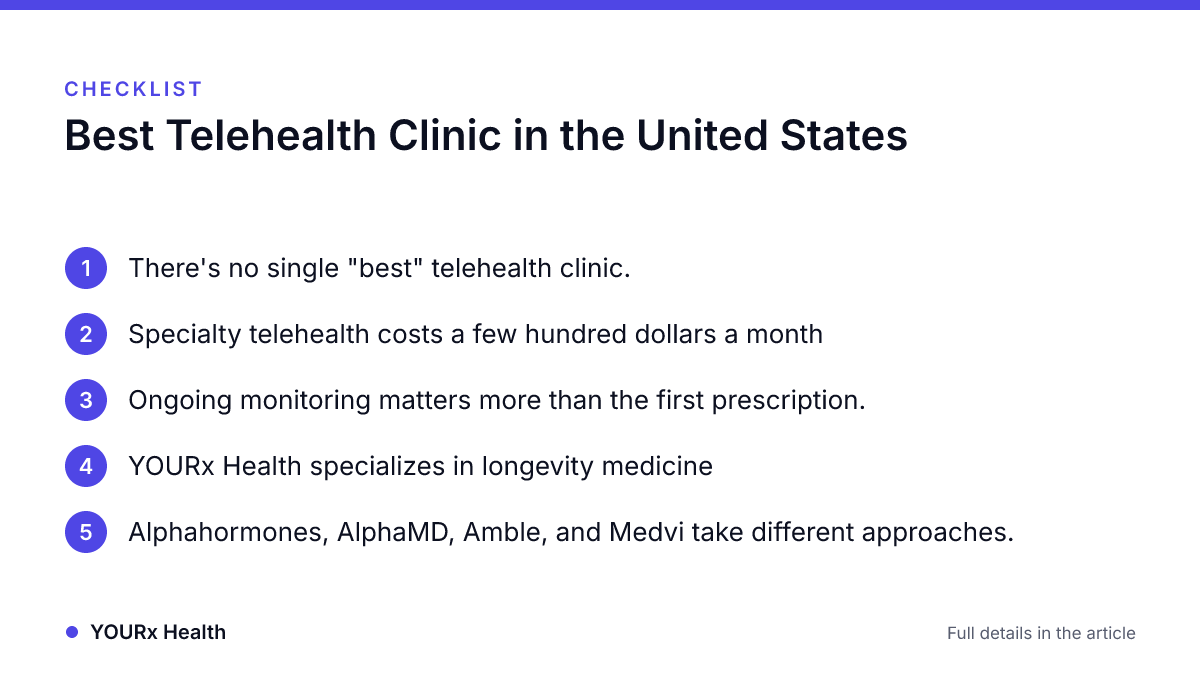
- There’s no single “best” telehealth clinic. It depends on whether you need a cheap sick visit, a general practice like Amble, or a specialty clinic for GLP-1 weight loss, hormone therapy, or peptides.
- Specialty telehealth costs a few hundred dollars a month because you’re paying for medication plus a physician relationship, not a one-off virtual urgent care visit.
- Ongoing monitoring matters more than the first prescription. Ask any provider how they handle lab work, dose titration, and refills before you pay, not after.
- YOURx Health specializes in longevity medicine: GLP-1 protocols, testosterone optimization, sexual health, and peptide therapy, with physician-led care, home lab kits, and discreet delivery.
- Alphahormones, AlphaMD, Amble, and Medvi take different approaches. The right pick depends on what you’re actually treating and how much hand-holding you want.
If you’ve searched “best telehealth clinic,” you’re probably not looking for a same-day strep throat diagnosis. You’re looking for ongoing care. Weight loss, testosterone, sexual health, longevity. That changes the whole equation.
Thank you for reading this post, don't forget to subscribe!
General telemedicine apps are built for one-off visits. Specialty clinics are built for months of monitoring, dose adjustments, and lab work. Confusing the two is how people end up with a GLP-1 prescription, no follow-up plan, and a physician they’ll never speak to again.
Table of Contents
- Who is the best telehealth provider?
- What are the best telemedicine services in the US, by category?
- How do these five telehealth clinics compare?
- What does specialty telehealth cost, and what’s included?
- How do you evaluate monitoring, labs, and refills?
- What credentials should you check before choosing a physician?
- Where does YOURx Health fit, honestly?
- Frequently asked questions
Who is the best telehealth provider?
The best telehealth provider is the one matched to your actual medical need, not the one with the flashiest app.
A general platform is great for pink eye or a sinus infection. It’s a poor fit for testosterone therapy, where someone needs to track your free testosterone, estradiol, and hematocrit across months and adjust accordingly. Here’s the practical difference: after a TRT dose change, we typically wait six to eight weeks before retesting, because that’s roughly when levels settle into a new steady state. Test at week two and you’ll chase a number that was never real. A platform built around 12-minute transactional visits has no mechanism for that kind of waiting and rechecking, which is one reason the in-house vs. outsourced telehealth staffing model behind a clinic matters as much as its marketing.
Same story with GLP-1s. Titration usually moves in monthly steps, and the decision to hold at a lower dose is often the right one, particularly when nausea is killing protein intake. That’s a judgment call, not a script.
If your issue is a UTI or a rash, almost any app on GoodRx’s list of doctor-recommended telehealth apps will do the job. If your issue is low testosterone, stalled weight loss, or erectile dysfunction that hasn’t budged with over-the-counter options, you want a clinic that treats that condition as its specialty rather than a side offering.
Pro tip: Before you pay for a consult, ask whether the physician who prescribes your medication is the same one who reviews your follow-up labs. Many platforms route you to whoever’s online that day, which means nobody owns your case.

What are the best telemedicine services in the US, by category?
“Best” splits by category, because a quick online doctor visit for a cold and a monitored GLP-1 protocol aren’t competing for the same patient. The categories break down like this:
- Urgent, low-acuity care: Sick visits, refills for common conditions, quick consults. Flat-fee apps and Amazon One Medical live here. Fast, cheap, transactional.
- Primary care telehealth: An ongoing relationship with a generalist, annual physicals, chronic condition management. Amble and similar platforms lean this way.
- Hormone and men’s health telehealth: Testosterone replacement therapy, sexual health, performance support. Alphahormones and AlphaMD operate in this space.
- Metabolic and weight-loss telehealth: GLP-1 prescribing, sometimes paired with metformin for insulin resistance, plus metabolic panels and long-term weight management. Medvi and YOURx Health both play here.
- Longevity and peptide medicine: Cellular energy, recovery peptides like BPC-157, NAD+, broader healthspan work. A much smaller category, and it’s what YOURx Health is built around.
A platform that’s excellent for antibiotics may have no protocol at all for peptide therapy or a full hormone panel. Match the category to the need first, then compare within it.
How do these five telehealth clinics compare?
Here’s what a buyer should actually weigh. Where we don’t have verified specifics on a competitor, we’ve written it as a question to ask them directly instead of guessing.
| Clinic | Primary specialty | Service area | Speed to first visit | Pricing approach | Best for |
|---|---|---|---|---|---|
| YOURx Health | Longevity medicine: GLP-1 weight loss, TRT, sexual health, peptides (BPC-157, sermorelin, NAD+) | All 50 US states | Same-day video consults | Membership pricing tied to your protocol; medication shipped to your door | A physician-led longevity plan, not a single prescription |
| Alphahormones | Hormone optimization and men’s health | Confirm they hold a license in your state | Ask for current consult wait times | Ask whether it’s subscription or per visit | Buyers focused purely on hormone therapy |
| AlphaMD | Men’s health, hormone and performance care | Confirm licensing in your state | Ask if same-day slots exist | Ask what’s bundled vs. à la carte | Cross-shopping hormone-focused telehealth |
| Amble | General and primary care telehealth | Confirm state coverage | Ask for the typical scheduling window | Ask about visit fees vs. membership | A general practice relationship, not a specialty protocol |
| Medvi | Metabolic health and weight management | Confirm licensing in your state | Ask about intake-to-prescription timing | Ask how labs and monitoring are priced | Buyers focused narrowly on medical weight loss |
Pro tip: When you compare pricing, ask each clinic three questions: Is lab work included or billed separately? Does the monthly fee cover follow-up consults, or only the medication? Does my price change when my dose goes up? Those three answers explain most of the gap between sticker prices.
What does specialty telehealth cost, and what’s included?
Specialty telehealth pricing is rarely apples-to-apples, because “the price” can mean the physician fee, the medication, the labs, or all three bundled together. GLP-1 weight loss is the clearest example, since it’s where the sticker shock lands hardest.
Three line items make up your monthly cost:
- Physician consult and monitoring. Usually folded into a membership fee. What you’re really buying is check-in cadence, so ask how many touchpoints that fee covers.
- The medication. Compounded semaglutide costs a fraction of the brand-name cash price, and the cost climbs as your dose does. Ask what your bill looks like at your target dose, not your starting dose.
- Labs. Sometimes bundled, sometimes billed per draw. At-home kits usually cost less than a walk-in draw plus your time off work.
Run your own math. Here’s the formula: (monthly membership × 12) + (monthly medication × 12) + (lab panels per year × cost per panel) = your true annual cost. Say a clinic quotes you $199/month for the membership, $250/month for medication at your maintenance dose, and two lab panels a year at $95 each. That’s ($199 × 12) + ($250 × 12) + (2 × $95) = $2,388 + $3,000 + $190 = $5,578 for the year, or about $465 a month. Those figures are illustrative, so plug in the real quotes you’re given.
Now compare that to the cheap route. A flat-fee visit app might charge you $25 a visit. Over a year of GLP-1 treatment you’d realistically need four: initial visit, dose change, side-effect check, refill. That’s $25 × 4 = $100 in visit fees. Genuinely cheaper on paper. What you don’t get is anyone titrating your dose, reading your labs, or noticing that you’re losing muscle along with fat. You’re self-managing the hardest part of the protocol to save roughly $5,000 a year, which is a real trade-off worth naming honestly, not a scam.
The threshold we’d use: if you plan to be on treatment longer than three months, pay for the monitoring. If you need a one-time refill of something you’ve already been stable on, don’t. Physician-led programs like the YOURx Health GLP-1 program exist for the first case.
Pro tip: For metabolic slowdown and insulin resistance, ask whether metformin belongs in the conversation. It’s far cheaper than a GLP-1, and some protocols pair the two at lower GLP-1 doses to manage both side effects and cost. Worth raising with any clinic rather than assuming a GLP-1 alone is the only path.
How do you evaluate monitoring, labs, and refills?
Ask these five questions before you commit. They separate real medical care from a mail-order prescription.
- Who orders your labs, and where do you get drawn? Some clinics ship at-home kits. Others send you to find a Quest or Labcorp on your own dime and your own schedule.
- How often does a physician actually review results? “You can message us anytime” isn’t a review. You want a scheduled read tied to your protocol.
- What happens when your dose needs to change? Good programs adjust based on labs and symptoms. Weaker ones lock you into a fixed 90-day script.
- Can you pause or cancel? Plateaus happen. Side effects happen. Travel happens.
- Do they treat related issues under one roof? Low testosterone and low libido usually travel together. A clinic that can address both without a referral saves you a season of waiting.
This is where volume-driven apps struggle. They’re optimized for speed, not for the slow, iterative work of titrating a GLP-1 or correcting a hormone panel over a quarter. The YOURx Health how it works page walks through that loop: health profile, physician video visit, delivery, then scheduled check-ins and lab monitoring. The monitoring is the product. The first prescription is just the start of it.
What credentials should you check before choosing a physician?
Board certification and state licensing are the floor, not the finish line. You also want a physician who works in the protocol they’re prescribing week after week.
Any generalist can write a testosterone script. A physician who manages hormone therapy regularly knows how to read the whole panel, notices when rising hematocrit means it’s time to pull the dose back, and can tell the difference between symptoms that need a dose change and symptoms pointing at something else entirely.
Confirm these with any clinic, YOURx Health included:
- Is the prescribing physician board-certified, and in what specialty?
- Are they licensed in your state, not just licensed somewhere?
- Does the clinic say who’s behind it? YOURx Health is physician-led and was founded by Vincent Broussard, who built the practice out of his own experience managing AMN (adrenomyeloneuropathy). That background shapes the focus on chronic symptom management and cellular energy rather than quick-fix prescriptions. More on the about page and the practice’s oath.
- Do they screen for underlying causes? Unexplained fatigue with low cortisol can trace back to adrenal or pituitary problems. Rarely, a pituitary tumor drives abnormal growth hormone output, which needs a real diagnostic workup rather than a supplement suggestion. Good intake asks those questions before anyone writes anything.
Pro tip: If a platform won’t tell you which physician is reviewing your case and won’t name a medical director, weigh that heavily against a low price. Healthline’s telehealth company reviews are a reasonable place to cross-check who’s actually behind a given platform before you hand over a card number.
Where does YOURx Health fit, honestly?
YOURx Health makes sense if you want a physician-led relationship built specifically around longevity medicine, rather than a general practice that also happens to offer weight loss on the side. GLP-1 treatment with real dose management, testosterone optimization, sexual health, peptide therapy like BPC-157 or sermorelin: that’s the lane, with same-day consults, discreet home delivery, and ongoing lab monitoring.
It’s the wrong pick for urgent primary care, pediatric visits, or mental health therapy. Those sit outside the practice, and a general platform or a service like Amble will serve you better. Nobody with a sinus infection needs a longevity-medicine intake.
Everything in between is where the higher price earns itself: chronic fatigue with no clear diagnosis, weight loss that stalled despite doing the diet right, libido that started sliding around 40, a genetic condition you’ll be managing for decades. Browse the full list of treatments or the health hub for condition-specific guides, including how to increase testosterone naturally, which is worth trying alongside any prescribed protocol.
| Your situation | Better fit |
|---|---|
| Cold, UTI, pink eye, one-off script | A general telehealth app on a flat per-visit fee |
| Ongoing primary care relationship | Amble or a similar general practice platform |
| Testosterone or hormone-focused care | Alphahormones, AlphaMD, or YOURx Health; compare intake and monitoring |
| Medical weight loss with a GLP-1 | Medvi or YOURx Health; compare labs, titration, and total monthly cost |
| Peptides, NAD+, cellular energy, broader longevity plan | YOURx Health |
| Chronic fatigue or a genetic condition needing long-term management | YOURx Health, with physician screening for underlying causes |
Frequently asked questions
Can I use telehealth without insurance?
Yes. Most specialty telehealth clinics, YOURx Health included, run as cash-pay or membership models, largely because insurance coverage for GLP-1s, TRT, and peptide therapy is inconsistent at best. That’s exactly why pricing transparency matters more here than at a copay-based office visit. You’re comparing full out-of-pocket cost, not a $30 copay.
Is a cheap online doctor visit enough for weight loss or low testosterone?
It can get you a prescription. It usually can’t get you monitoring. A flat-fee visit works fine for a refill of something you’re already stable on, but weight loss and hormone therapy both need labs tracked over months and doses adjusted to how your body actually responds. A single 10-minute visit isn’t structured to do that.
How fast can I start treatment?
With same-day consults, you can complete your health profile, meet a physician by video, and have medication shipped within days rather than weeks. The real variable is whether labs need to come back first and how quickly you finish intake.
Pick the clinic that matches the condition, not the ad. If you’re dealing with low energy, stalled weight loss, low libido, or you’re curious about peptide therapy and want a physician who’ll manage the protocol over time rather than hand you a script and disappear, YOURx Health is accepting new patients now with same-day consults and no clinic visit required.